Jul 5 / Linda Meredith

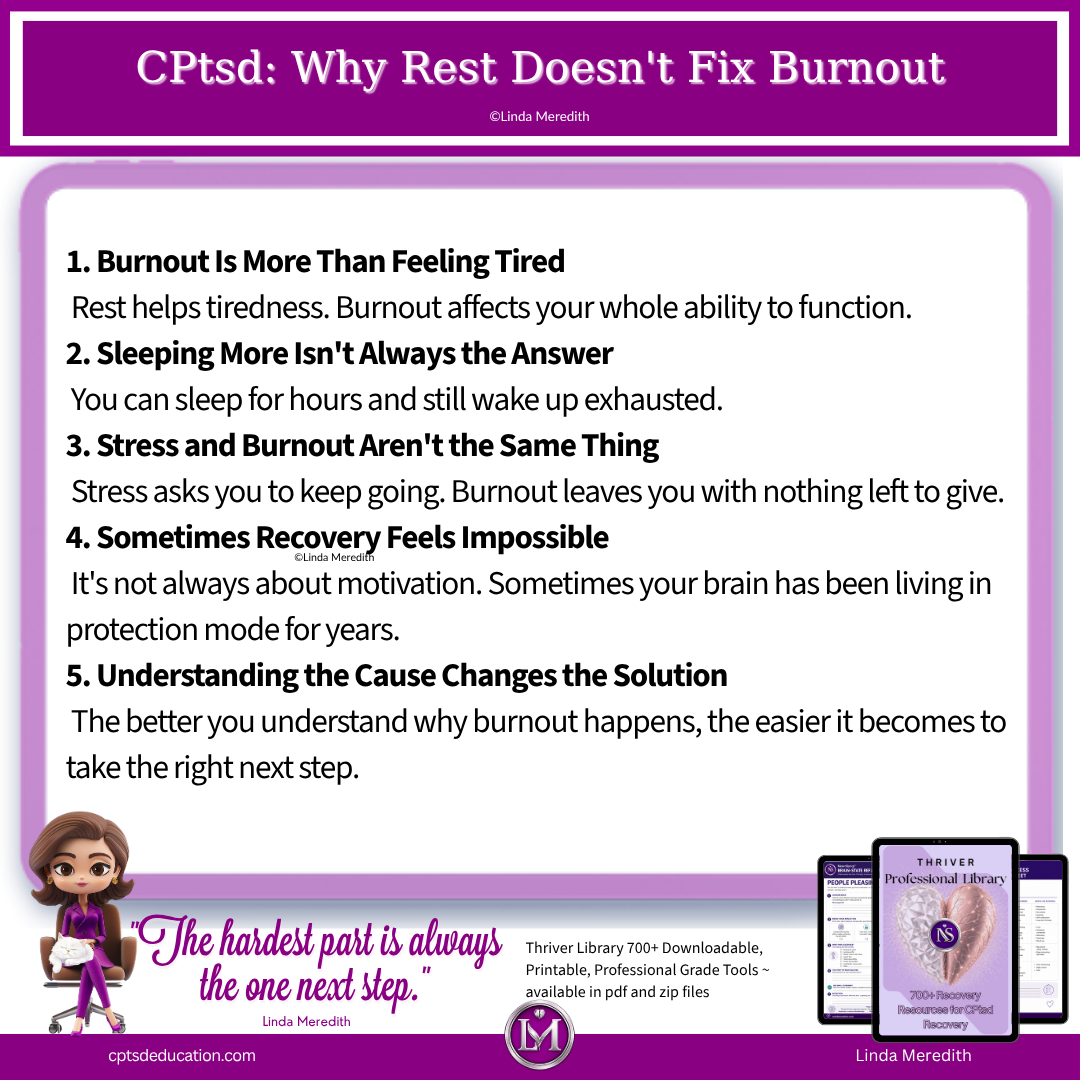
Why Rest Doesn’t Fix Burnout

You slept all weekend... so why are you still exhausted?

If you've ever woken up after a long sleep, a weekend off, or even a holiday and still felt completely drained, you're not alone. Many people assume they're simply tired. But burnout is often something very different.

Key Takeaways

  • Burnout can continue after sleep or a holiday because it affects energy, thinking, motivation, emotional capacity, and everyday functioning

  • Long-term stress and Complex Ptsd can keep threat detection and survival patterns active even when you are physically resting.

  • Recovery improves when you name what is driving the exhaustion and pick actions that match the root pattern

When a weekend off still leaves you drained

You sleep 10 hours, take Saturday slow, maybe even grab a long weekend, and still show up Monday feeling like you never stopped. You may have slept, but your thinking is still foggy, your patience is thinner, and ordinary tasks still feel too hard.  That mismatch is often the first sign that “more rest” is not the missing piece.


A simple benchmark can help: if rest worked on its own, most people would feel noticeably more restored after about 48 hours off. If you took that time and your baseline barely moved, treat it as a clue, not a personal failure. It may mean your stress system is still acting like it is on call, even when you are not.


Here’s what you will be able to do by the end of this piece: tell regular tiredness from burnout, and pick a clearer next step. That can mean choosing a smaller work change (like reducing meetings for two weeks), a recovery habit you can actually repeat (like a 15-minute walk after work), or getting outside support when the pattern has lasted for months.

Why burnout is not the same as being tired

Next, it helps to separate normal tiredness from burnout, because they look similar on the surface but behave differently in real life.

When you’re tired, sleep and a slower day usually bring you back online within a day or two. With burnout, you can get a full night’s sleep and still wake up with a heavy, foggy feeling, like your brain is running at 40% and the basics cost more than they should.


Burnout often shows up in areas people do not immediately connect with exhaustion, especially the parts that make work and daily life feel manageable:

  • Focus slips: you reread the same email three times and still miss the point

  • Motivation drops: even easy tasks feel strangely hard to start

  • Emotions run hotter: small problems trigger tears, irritability, or numbness

  • Memory gets patchy: you forget why you opened a tab or walk into a room

  • Decisions feel risky: choosing lunch feels like choosing a career

  • Daily functioning degrades: laundry, replies, and basic planning stack up fast


Here’s the catch: burnout can create a self blame loop that keeps it going. You notice the drop in output, then your brain fills in a story like “Maybe I’m lazy,” or “Everyone else can handle this.” That self-criticism does not create motivation, it adds threat. And when your system feels threatened, your attention narrows, your patience shrinks, and recovery gets harder, which then “proves” the lazy story and restarts the spiral.


If you do one thing in this section, do this: rename the experience from a character flaw to a signal. Try a simple check-in before you judge yourself:

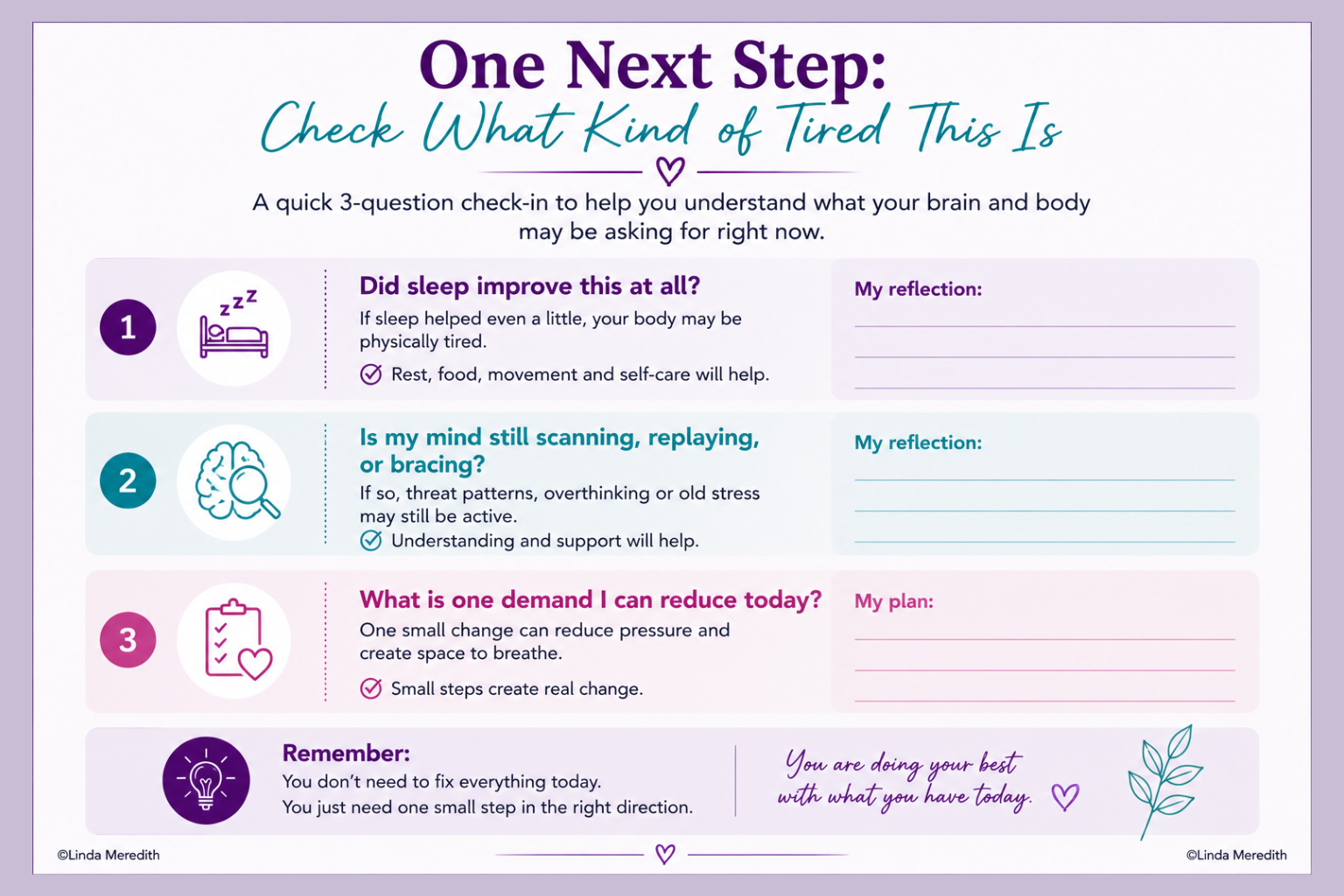
  1. Is my capacity lower than usual across multiple areas (focus, mood, decisions)

  2. Have I been “pushing through” for more than 2 weeks

  3. Does rest help for hours, but not for days

If those are mostly yes, treat it like burnout, not tiredness. That shift cuts the self-criticism amplifier and makes the next steps far more likely to work.

What long term stress and Complex Ptsd do to recovery 
Next, it helps to name what can happen after months or years in survival mode: your body might be lying down, but your brain does not fully stand down. This can mean threat detection, attention, memory and emotional response patterns stay active, even when the present moment is quiet..


In Complex Ptsd (CPtsd), that high alert setting can become the default. CPtsd is a pattern that can form after long term, repeated stress where safety has felt uncertain for a long time, so your mind and body learn to stay watchful even when nothing is happening.

That shows up in a common burnout experience: you get 8 or 9 hours of sleep and still wake up foggy. You may have slept, but your attention is still scanning for what could go wrong next, so you do not get the same “downshift” people mean when they say they feel recovered.


A few signs this protection mode may be involved:

  • You wake up tired even after enough hours in bed

  • You may startle easily or feel jumpy at small noises

  • You feel wired at night but heavy in the morning

  • Thinking may feel slow, forgetful, or blank during simple tasks.


Here’s the catch: trying to fix this with “more rest” can backfire, because the problem is not effort, it is safety signals. If you do one thing, track how you feel 30 minutes after waking, not just how many hours you slept, so you can spot the gap between time asleep and actual recovery.

A practical reframe that makes recovery possible
So instead of asking, “What’s wrong with me?”, shift to “What’s driving my exhaustion?” That one change turns the problem from a personal flaw into a signal you can read, name, and respond to.


If you do one thing from this section, do this quick check: “Am I physically tired, or mentally and emotionally carrying too much for too long?” The answer changes what helps next, because a longer nap cannot fix an overloaded life the same way a lighter workload cannot fix a body that truly needs sleep.


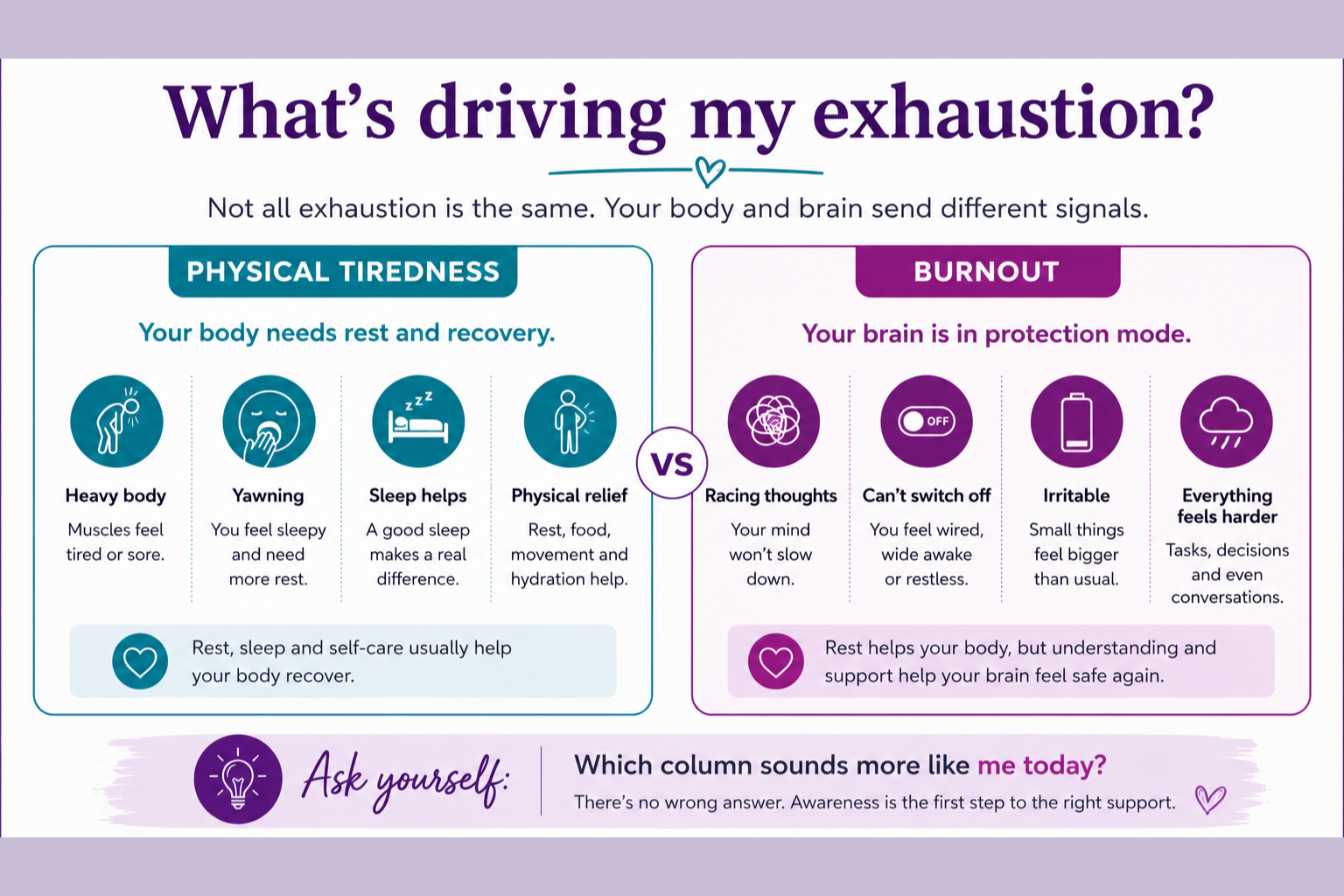
Here’s a simple two-column self-check you can do in 60 seconds.

Physical tiredness cues

  • Heavy eyelids, yawning, slower reaction time

  • Body feels sore or depleted after a busy day or workout

  • Sleep helps at least a little, even if you still feel stressed

  • Food, water, and a short rest improve your energy within a few hours


Mental and emotional overload signs

  • Racing thoughts when you try to rest, replaying conversations or tasks

  • Irritability, numbness, or sudden tears over small triggers

  • A “wired but tired” feeling, you are exhausted but cannot switch off

  • Rest time turns into doom scrolling, worry, or planning because attention is still locked onto possible problems


A common mistake is treating overload like a sleep problem and then feeling worse when sleep does not bring you back. The fix is to match support to the driver: if it is physical, prioritize basic recovery; if it is overload, reduce the load even in small ways, like cutting one commitment this week or setting a stop time for work (for example, 6:30 pm for five days) and protecting it like an appointment.


IF rest hasn’t fixed it, it does not mean you are weak or doing recovery wrong. Rest helps, but insight guides recovery. When your body stays on alert, a quiet day off can feel like you are still “on,” just without the tasks. The shift often starts when you stop asking, “What’s wrong with me?” and start asking, “Nothing about that question means you are broken. It usually means the explanation has been too shallow.”


What would change if you stopped blaming yourself and started mapping what your brain has learned to treat as too much, too unsafe, or too demanding? Even a 10-minute check in after a hard meeting or a tense commute can give you one usable clue for what to adjust next.

Watch the video

Next, watch the YouTube video: “Why burnout is more than tiredness and what’s happening in your brain.”

As you watch, listen for the difference between feeling sleepy and feeling stuck. If you’re short on time, skim the first few minutes for the main idea, then come back later for the full explanation.


Then do this one-question check-in in writing (2 minutes):

  • Right now, do I feel more tired, or more shut down

Write one or two sentences, and add one small next step you can do in 10 minutes today (for example: a short walk, a glass of water, a message to a friend, or turning off one notification)

Choose your One Next Step

References

  1. American Psychiatric Association. (2022). Diagnostic and Statistical Manual of Mental Disorders (5th ed., text rev.; DSM-5-TR).
  2. World Health Organization. (2019). Burn-out an occupational phenomenon: International Classification of Diseases (ICD-11). (Useful because it defines burnout as an occupational phenomenon rather than a medical diagnosis.)
  3. Centers for Disease Control and Prevention. (2024). Information on stress, sleep, and mental health.
  4. National Institute for Health and Care Excellence. (Updated guideline). Post-traumatic stress disorder (NG116). Useful for trauma recovery principles.
  5. International Society for Traumatic Stress Studies. (2019). Prevention and Treatment Guidelines.
  6. Substance Abuse and Mental Health Services Administration. (2014). Trauma-Informed Care in Behavioral Health Services.
  7. A landmark ACEs paper (Felitti et al., 1998) if you're discussing developmental trauma.
Write your awesome label here.
Testimonials

Some feedback from our students

We are dedicated to empowering you with knowledge, skills, and confidence to provide immediate answers to your clients.

“Interesting courses”

The course was the right mix of technical and non-technical elements. The course was also interesting, as I learned a lot about complex trauma and how this would apply for individual clients in the real world. Linda Meredith did a good job of communicating and making it easier to work with my  clients with CPtsd.
Paula w.

“I improved my knowledge”

The course taught me in a very friendly and engaging way. The course material was really helpful in preparing my skills and knowledge needed in the real world. It was well structured and the content was interesting and relevant. The materials were excellent, the mentoring approach was excellent and the free supervision helped me get my business off the ground.
Gina F.

“Easy to understand”

The courses are taught by Linda Meredith who is highly experienced and knowledgeable. Linda clearly understands the importance of working with clients with complex trauma and takes the time to ensure you understand the information in a way that is easy to grasp and use with clients. 
Lisa A.

Linda Meredith

Passionate, Innovative, and Dedicated to

Complex Trauma Recovery


An Advanced, Neuroscience Based Approach for Mental Health Professionals

Linda Meredith is an accredited trainer, counsellor  and creator of the NeuroSynqt™ modality for CPtsd recovery. Known as a Professional Brain Untangler, Linda combines advanced neuroscience, lived experience  and years of client practice to develop trauma trained education that’s both practical and deeply human.

Her work has been peer reviewed and accredited by specialists with tertiary qualifications in the trauma field, ensuring every course is grounded in professional standards as well as real world application.

👉 Want to know more about Linda’s background, qualifications  and journey? Read Linda’s full story 
Write your awesome label here.

NeuroSynqt™ education is peer reviewed and delivered by a Registered Training Provider.

Write your awesome label here.

Supporting integration that addresses intergenerational trauma at its source

By addressing developmental trauma at the level of organisation, NeuroSynqt™ supports:

  • more stable identity across contexts
  • improved relational capacity
  • consistent behavioural change
  • reduced reliance on coping cycles

This is where recovery becomes sustainable - not cyclical.


Stay connected:
Follow us on social media using the links below and sign up for our newsletter to receive special offers and updates on new content.
Thank you!
Created with