NEUROSYNQT™ ELECTIVE 2 · PROFESSIONAL CPTSD TRAINING
Complex Ptsd, Narcissism and Relational Trauma: Development, Identity and Adult Recovery
For practitioners working with adults impacted by childhood developmental trauma and Complex Ptsd, Elective 2 provides six specialist courses examining narcissism and relational trauma within additional developmental, psychological and Complex Ptsd context.
The Elective maintains important distinctions between narcissistic traits, Narcissistic Personality Disorder, broader models of narcissistic presentation, developmental trauma and the psychological impact experienced within harmful relationships.
Across the series, attention moves between the development of the person, the relational environment and the person affected by relational harm, providing a broader professional context than narcissism or Complex Ptsd considered in isolation.
Payment Plan Available ~ Lifetime Access
Elective 2 extends established knowledge of narcissism and relational trauma into the developmental, psychological and brain-based complexity that becomes relevant when Complex Ptsd is part of the professional picture.
Courses
Learning Time
Delivery
CEU's
Access
Investment
When Narcissism and Relational Trauma Are Part of a More Complex Presentation
Build to fit your existing practice
Global Accreditation
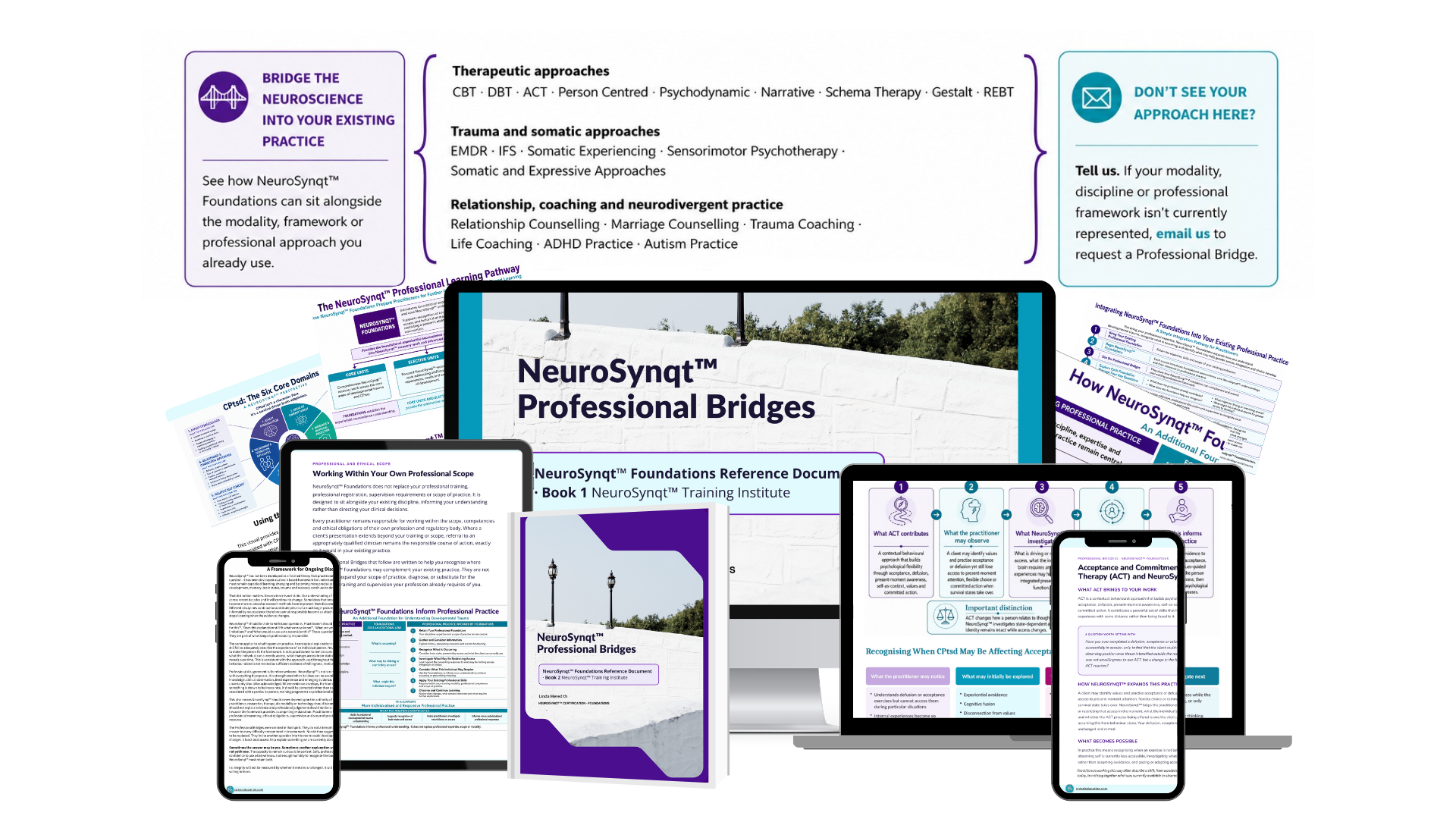
Elective 2 is designed to complement established professional qualifications, modality training and professional experience rather than replace them.
The NeuroSynqt™ framework provides additional developmental-trauma and Complex Ptsd context for narcissism, identity, relational harm and recovery while remaining complementary to existing training and professional scope.
COMPLEMENTS EXISTING TRAINING
Designed to sit alongside your current professional approach.
BUILT FOR PRACTICE
Specialist Complex Ptsd professional learning designed for application within established practitioner roles and professional settings.
SUPPORTS PROFESSIONAL REASONING
A differentiated professional framework for considering narcissistic presentations and relational harm within the wider developmental and psychological complexity of Complex Ptsd.
WORK WITHIN YOUR SCOPE
Integration within existing professional role, qualifications, competence and scope of practice, with appropriate attention to client autonomy, relational safety and professional boundaries.
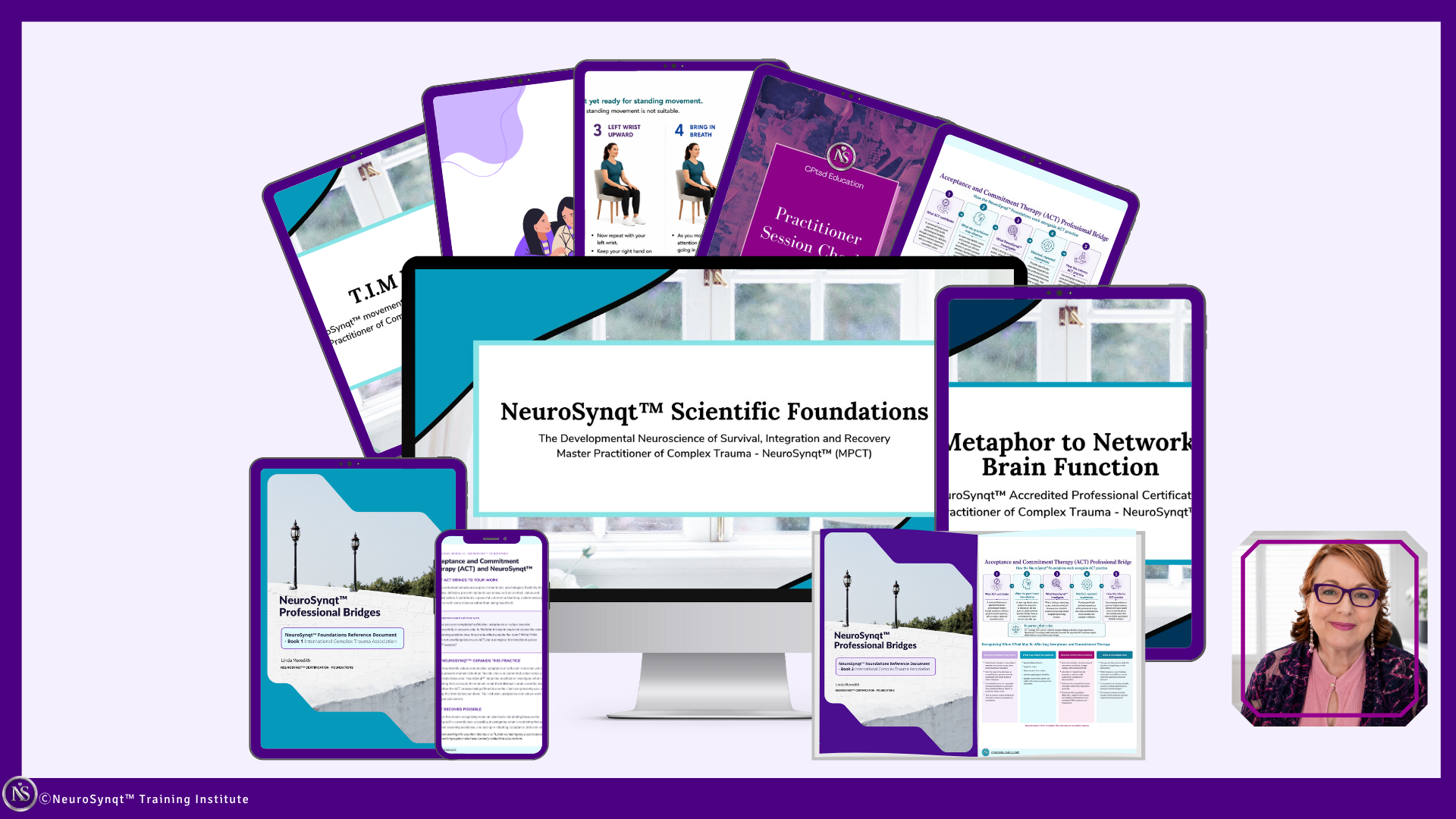
Three professional resources, delivered together
Elective 2 is built on a shared clinical foundation
Your enrolment includes permanent access to NeuroSynqt™ Clinical Foundations - the shared professional framework that underpins NeuroSynqt™ training.
Across eight foundational courses, the Clinical Foundations establish the neuroscience based and trauma trained framework used throughout NeuroSynqt™, providing shared professional context for developmental trauma, brain processes, trauma related responses and their wider impact on functioning.
Clinical Foundations also introduce the practical NeuroSynqt™ frameworks used to recognise current brain state access, support clinical decision making and bring this understanding into existing professional practice.
8 Clinical Foundations Courses ·
32 Professional Bridges · Permanent Access
Professional Application Across Elective 2
01 | Narcissism Within Developmental Context
Develop professional understanding of narcissism within the wider context of developmental trauma and Complex Ptsd.
02 | Identity, Adaptation and Adult Functioning
Extend professional consideration of identity and adaptation within developmental, attachment and relational experience.
03 | Trauma Bonding and Relational Attachment
Include trauma bonding within professional understanding of relational trauma and Complex Ptsd across a broader range of relational contexts.
04 | Gaslighting, Perception and Self-Trust
Develop professional understanding of gaslighting, narcissistic relational dynamics and their psychological impact within Complex Ptsd presentations.
05 | Differentiating Narcissistic Presentations
Differentiate established clinical constructs from broader descriptions of narcissistic presentation and consider their relevance within relational experience.
06 | Narcissistic Parenting and Adult Recovery
Extend professional consideration of narcissistic parenting into developmental trauma, family experience and adult recovery within Complex Ptsd.
The Elective 2 Practitioner Learning Pathway
Narcissism, Relational Trauma and Complex Ptsd Recovery
01 | The Neuroscience of Narcissism & Developmental Trauma
2 Videos | 50 Slides | 1 Canva Client Ebook: Recovery from Narcissistic Abuse, 1 Client Bonus Worksheet | Trauma Mapping Instructions, quiz
02 | From Adaptation to Authenticity
2 Videos | 43 Slides | 2 Canva Client Ebooks: Trauma Bond Worksheet & Managing Overwhelm. 1 Client Bonus ebook Cognitive Distortions
03 | CPtsd & Trauma Bonding Recovery
2 Videos | 57 Slides | 1 Canva Client Ebook: Boundaries for No Contact, 1 Client Bonus ebook Identity & CPtsd Recovery
04 | Narcissistic Relational Dynamics, Psychological Cost, CPtsd & Gaslighting Recovery
Gaslighting and narcissistic relational dynamics within Complex Ptsd, including psychological impact and adult recovery.
1 Video | 37 Slides | 2 Canva Client Ebooks: Gaslighting Recovery & Breaking the Fog Gaslighting Recovery. 2 Bonus pdfs: Reconnecting with Emotions after Gaslighting & Gaslighting Tracker
05 | Narcissistic Subtypes and Relational Fallout
2 Videos | 39 Slides | 1 Canva Client Ebook: Developing Healthy Boundaries. 2 Bonus pdfs: Recovering from Narcissistic Abuse Cycle & How to Leave an Abusive Relationship
06 | Narcissistic Parenting, Developmental Trauma and Adult Recovery
1 Video | 53 Slides | 1 Canva Client Ebook: Narcissistic Abuse workbook. 3 Bonus pdfs: Narcissistic Rage, Terms, Techniques, Managing Family Stress & Autonomy and Coaching Worksheets
Beyond Narcissism as a Standalone Explanation
Narcissism can provide an important professional lens for understanding personality and relational presentation. Relational-trauma education can provide another. Developmental trauma and Complex Ptsd introduce additional considerations again. The difficulty arises when one of these becomes the explanation for everything else.
Elective 2 maintains important distinctions across narcissism, developmental trauma, relational experience and Complex Ptsd while examining the broader professional picture in which more than one area may be relevant.
This is particularly important for practitioners who already know the subject. Greater familiarity with narcissism does not automatically provide greater differentiation when developmental trauma, adult relational harm and Complex Ptsd coexist within the same professional presentation.
Integration Across Developmental and Relational Experience
Dan Siegel's work in Interpersonal Neurobiology provides a broader context for considering integration across brain, mind and relationships.
Within Elective 2, this is particularly relevant because developmental trauma, identity, attachment, personality constructs and relational experience can each contribute professionally relevant information without representing the same process.
Differentiation therefore remains important to integration. Narcissistic traits are not treated as synonymous with Narcissistic Personality Disorder, developmental trauma is not treated as synonymous with narcissism, and the experience of relational harm is not treated as evidence of another person's diagnosis.
This allows multiple areas of professional knowledge to contribute to a wider understanding while retaining the conceptual boundaries needed for responsible professional practice.
Within NeuroSynqt™, integration supports a connected professional understanding without requiring distinct areas of knowledge to become a single explanation.
Dr Dan Siegel
Why Trauma Trained Practice Changes what we Notice
Relational Recognition and the Individual Complex Ptsd Presentation
Grounded in Research. Applied in Practice.
Distinct Evidence Bases Across Narcissism, Development and Relational Trauma
Elective 2 draws across developmental neuroscience, attachment, personality and psychological literature, trauma research and professional knowledge concerning harmful relational experience.
These bodies of knowledge do not carry identical evidence status or answer the same professional questions. The curriculum therefore distinguishes established clinical constructs from broader theoretical, descriptive and practice-based frameworks rather than presenting all material as equivalent neuroscience or diagnostic knowledge.
This distinction is particularly important in relation to narcissism. Narcissistic Personality Disorder is a formal clinical construct, while narcissistic traits and the wider range of presentations described within professional and recovery literature require different interpretation and evidentiary caution.
Developmental and neuroscience material provides additional context for examining early adversity, attachment, identity and later functioning, but does not establish a single causal pathway from childhood experience to narcissism, Complex Ptsd or a particular adult relational outcome.
NeuroSynqt™ brings these differentiated areas into specialist Complex Ptsd professional education.
YOUR COMPLETE ONLINE LEARNING PATHWAY
Complete all your course work online
Complete the online learning
Take the knowledge test
Submit a portfolio
Earn your professional certificate
On completion receive your NeuroSynqt™ Certificate of Successful Completion, documenting your training, hours and CEUs.
✓ No live classes
✓ No travel
✓ No postal submissions
✓ No external assessment
✓ Self paced
✓ Lifetime access
One portal. Three areas of professional learning and practice support.
Your learning portal brings together three areas of NeuroSynqt™ professional education and practice resources in one place.
1. NeuroSynqt™ Clinical Foundations
Access begins with the foundational neuroscience and Complex Ptsd recovery framework for beginning to apply NeuroSynqt™ within practitioner and client work. Clinical Foundations can also be completed as Practitioner Course 1 for practitioners seeking CEUs.
2. Your selected professional education
Your chosen Core, Elective and Practitioner courses provide the professional education for your learning pathway, including assessments and practitioner integration portfolios where applicable.
3. NeuroSynqt™ Practitioner Centre
Permanent access extends your learning into practice through practitioner, client, supervision and business resources.
6 Elective courses · NeuroSynqt™ Clinical Foundations · 32 Professional Bridges · NeuroSynqt™ Practitioner Centre · Practice-ready practitioner and client resources · Certificate of Successful Completion ·
18 professional learning hours · 6 CEUs
· Lifetime access
Complete this unit independently - or make it part of your wider certification pathway
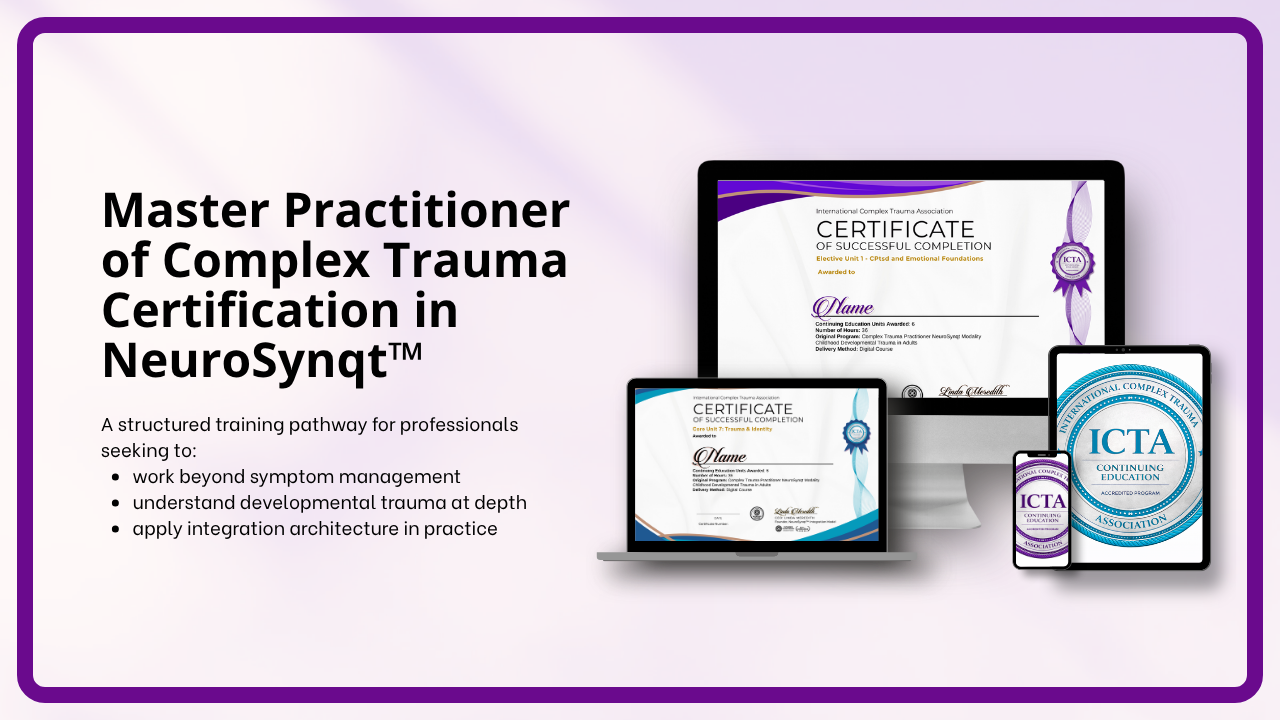
This is a complete professional training unit in its own right. Successfully complete the six courses, knowledge assessments and practitioner integration portfolios to receive a Certificate of Successful Completion documenting your professional learning hours and CEUs.
For practitioners continuing through NeuroSynqt™ professional education, this unit also contributes toward the wider certification pathway leading to the Master Practitioner of Complex Trauma (MPCT) designation.
BRIDGING NEUROSYNQT™ INTO EXISTING PRACTICE
32 Professional Bridges across established approaches and professional roles
WHO THIS TRAINING IS FOR
Suitable for practitioners across professional settings
Counsellors and psychotherapists
Psychologists and mental health professionals
Social workers & community service professionals
Mental health nurses and allied health practitioners
Relationship and marriage counsellors
Somatic, expressive and body based practitioners
EMDR, IFS and other modality trained practitioners
Trauma trained coaches within an established nonclinical scope
Students & emerging practitioners completing relevant training
Pastoral care and ministry professionals
ADHD and Autism practitioners
Professional supervisors and educators
Linda Meredith
Passionate, Innovative, and Dedicated to
Complex Trauma Recovery
An Advanced, Neuroscience Based Approach for Mental Health Professionals
NeuroSynqt™ education is peer reviewed and delivered by a Registered Training Provider.
NeuroSynqt™ education is peer reviewed and delivered by a Registered Training Provider.
Real reviews. Real professionals. Real impact.
NeuroSynqt™ Integration and Professional Practice
NeuroSynqt™ integrates within an existing professional role and scope of practice. It is not a standalone modality and is not practised or billed as a separate service.
For regulated professionals including psychologists and counsellors, NeuroSynqt™ functions as a neuroscience-based integration approach supporting assessment, formulation, psychoeducation and integration-aligned intervention.
Sessions remain billed under existing service codes and professional designations. NeuroSynqt™ informs how the work is structured and sequenced, not what is billed.
Where practitioners are eligible to bill private health or insurance providers, billing structures remain unchanged. NeuroSynqt™ does not alter diagnostic coding, insurer eligibility or licensing requirements.
For non-regulated practitioners operating in educational or professional support roles, NeuroSynqt™ must be represented strictly within the limits of that scope.
NeuroSynqt™ is always applied within an existing scope of practice and in accordance with local regulatory and professional requirements.
Enrol Now
Narcissism and Relational Trauma Within Complex Ptsd
Practitioners working with Complex Ptsd may already encounter narcissistic traits, gaslighting, trauma bonding, harmful relational dynamics or the continuing impact of narcissistic parenting.
Elective 2 extends that existing knowledge through six specialist courses designed to place narcissism and relational trauma within the wider professional context of developmental trauma and Complex Ptsd. For practitioners already trained in trauma, counselling, psychotherapy, psychology, coaching or related fields, Elective 2 is designed to add specialist Complex Ptsd knowledge without replacing the professional foundation already in place.
6 Elective courses · NeuroSynqt™ Clinical Foundations · 32 Professional Bridges · NeuroSynqt™ Practitioner Centre · 6 CEUs · Lifetime access
Take this unit independently or use it toward the NeuroSynqt™ Master Practitioner of Complex Trauma certification pathway.
Frequently asked questions
Can I take this unit without pursuing certification?
What do I receive when I complete it?
Does NeuroSynqt™ replace my existing modality or qualification?
Does this unit count toward MPCT certification?
Do I have to complete it by a certain date?
I already have training in narcissism. How is Elective 2 different?
Does Elective 2 teach practitioners to diagnose Narcissistic Personality Disorder?
Does Elective 2 treat narcissistic traits and NPD as the same thing?
Does Elective 2 assume developmental trauma causes narcissism?
Is Elective 2 only about intimate relationships?
Does Elective 2 focus only on people displaying narcissistic traits?
Does the training tell practitioners whether a client should leave a relationship?