NEUROSYNQT™ CORE 4 · PROFESSIONAL CPTSD TRAINING
Complex Ptsd and Recovery: Brain Processes, Motivation, Purpose and Engagement
For practitioners working with adults impacted by childhood developmental trauma and Complex Ptsd, Core 4 provides a trauma trained professional framework for understanding trauma related brain processes and responses alongside motivation, purpose, engagement and meaningful goal directed activity within the wider recovery picture.
Across six interconnected courses, Core 4 moves from the anterior cingulate cortex, Polyvagal Theory and the periaqueductal gray through to Ikigai, Flow and case study integration, connecting trauma related brain processes with motivation, purpose and meaningful engagement in recovery.
Payment Plan Available ~ Lifetime Access
Trauma related brain processes and responses form part of the recovery picture alongside motivation, purpose, engagement and meaningful participation in life.
Courses
Learning Time
Delivery
CEU's
Access
Investment
Recovery Involves More Than Trauma Response Reduction
Core 4 positions trauma-related brain processes and responses alongside motivation, purpose, agency, Flow and meaningful engagement within a broader Complex Ptsd recovery framework.
Build to fit your existing practice
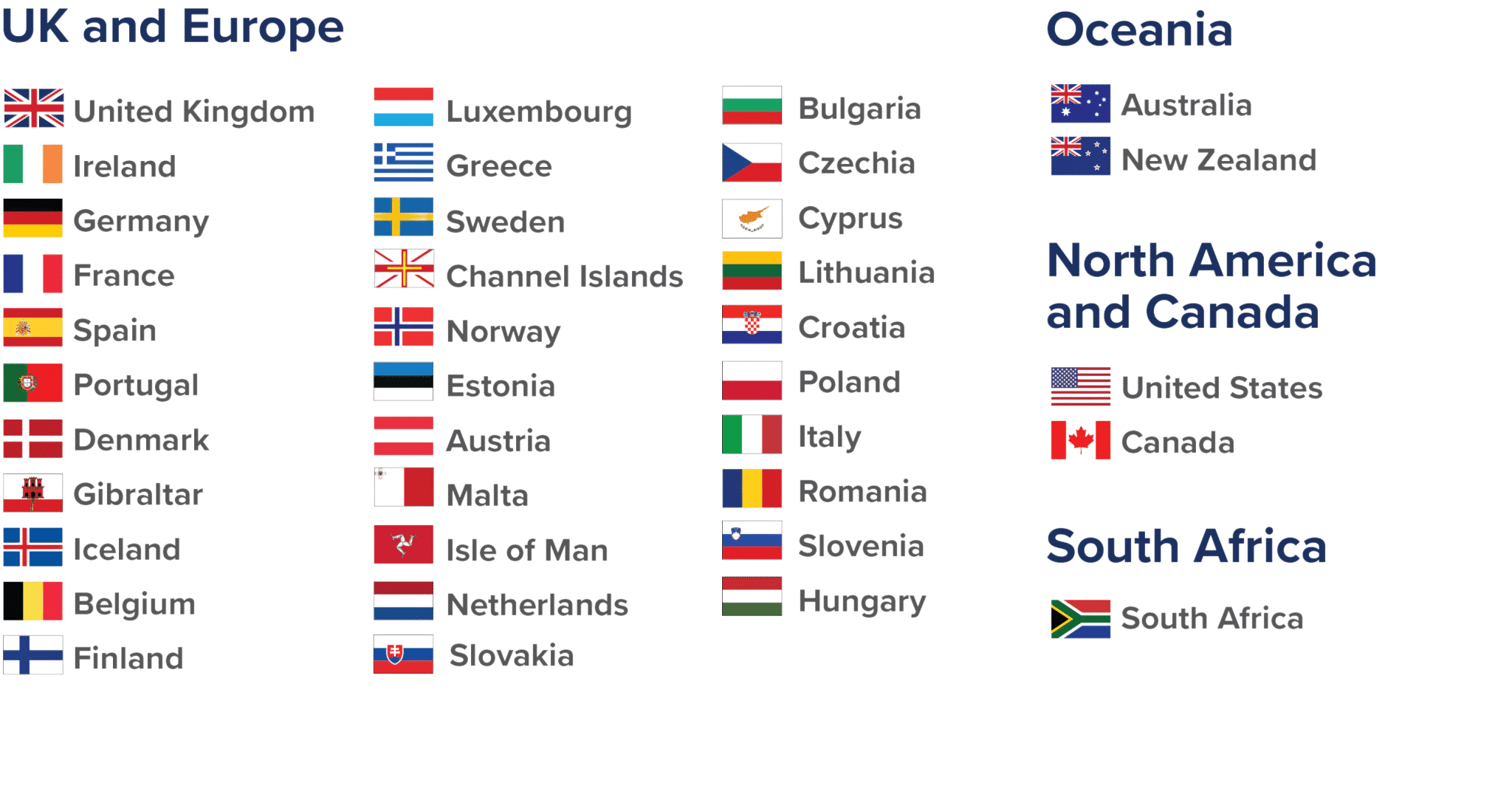
Global Accreditation
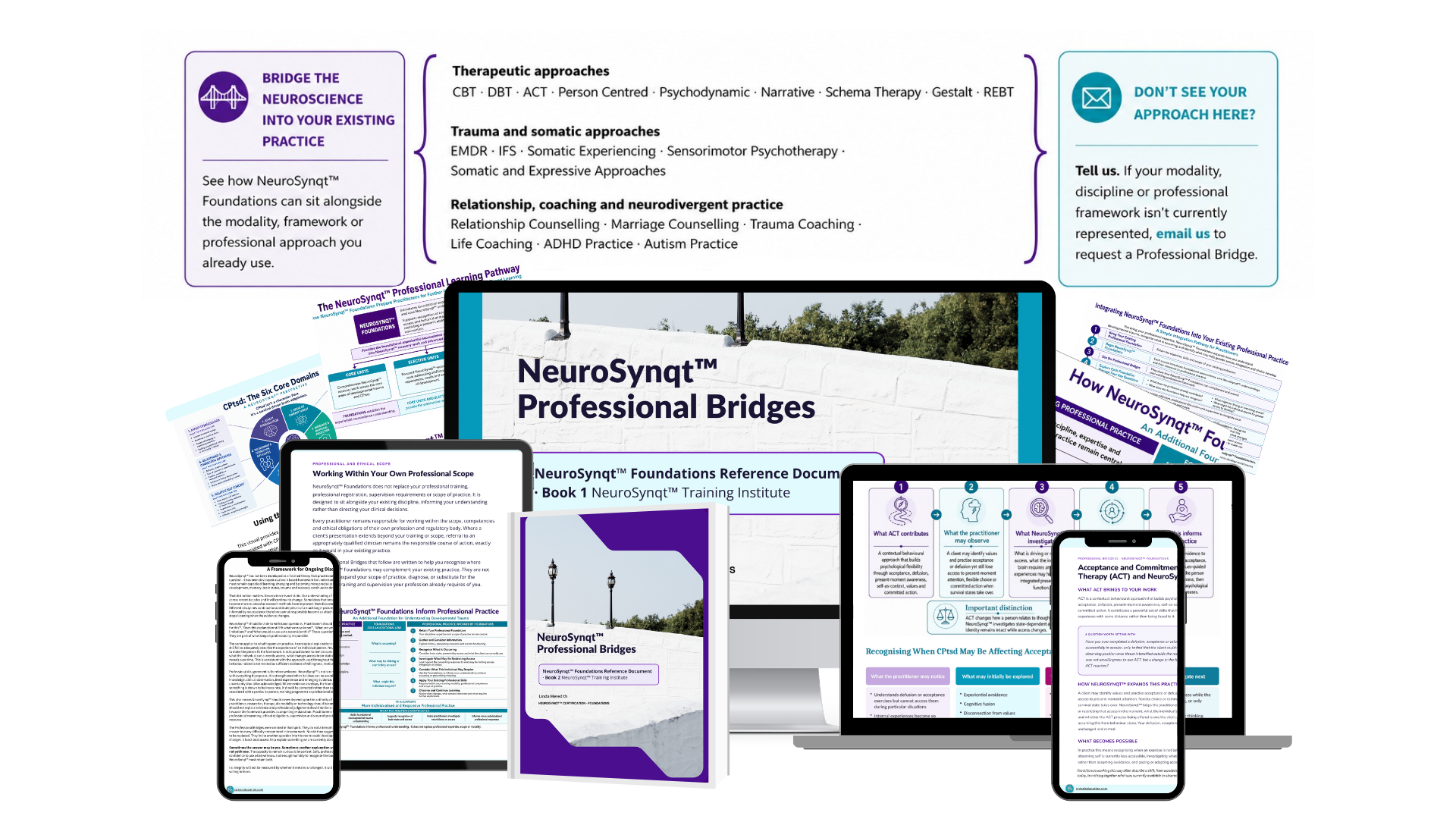
The NeuroSynqt™ framework is neuroscience based and trauma trained, providing additional clinical context that can be incorporated within existing professional training, modalities and scope of practice.
COMPLEMENTS EXISTING TRAINING
Designed to sit alongside your current professional approach.
BUILT FOR PRACTICE
Professional context connecting trauma related brain processes and responses with motivation, goals, purpose, agency, Flow and meaningful engagement in recovery.
SUPPORTS CLINICAL THINKING
An integrated view of trauma related brain processes and responses alongside motivation, purpose, agency and meaningful engagement within Complex Ptsd recovery.
WORK WITHIN YOUR SCOPE
Integration within your existing professional role, competence and scope of practice.
Three professional resources, delivered together
Core 4 is built on a shared clinical foundation
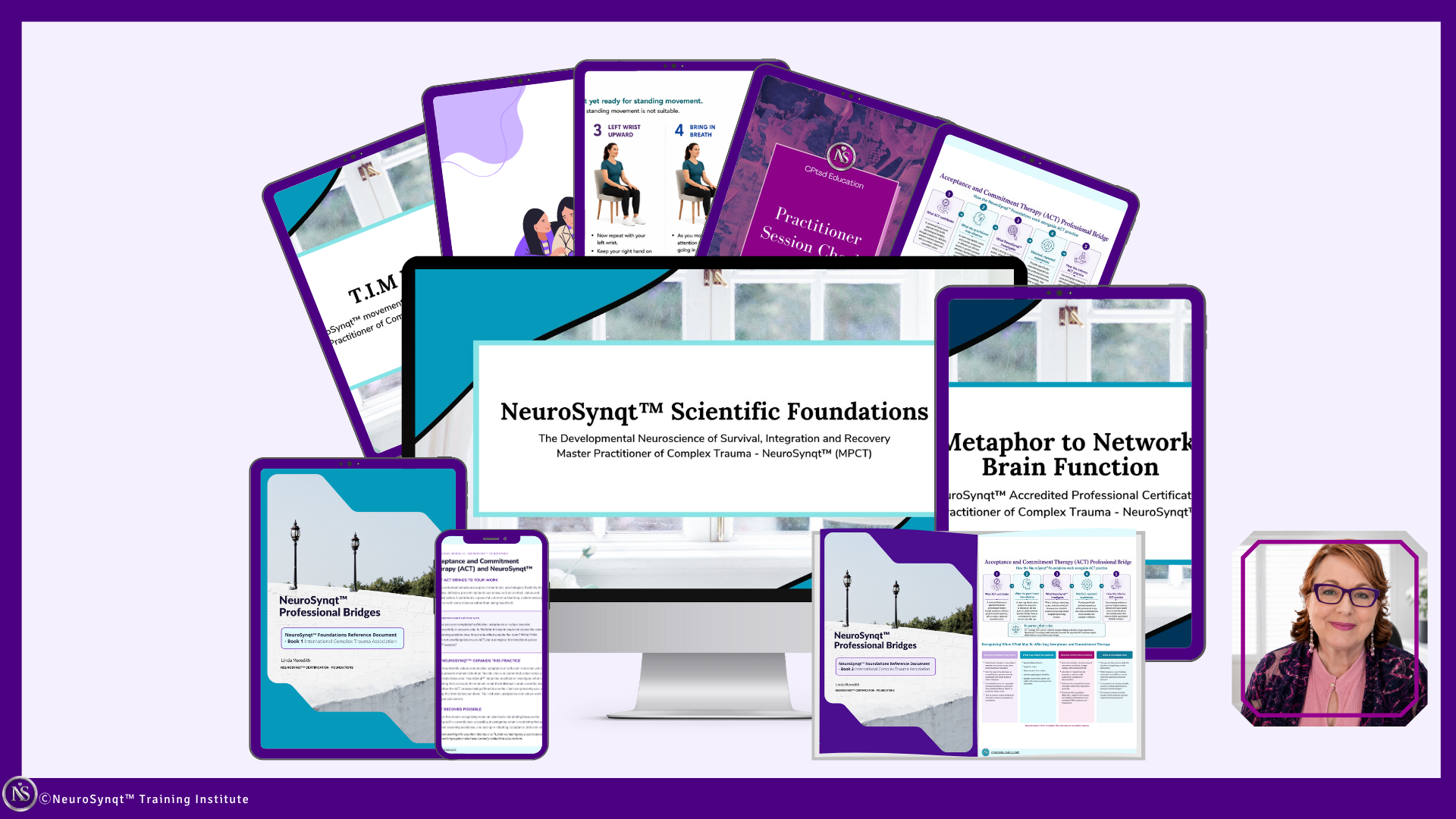
Your enrolment includes permanent access to NeuroSynqt™ Clinical Foundations - the shared professional framework that underpins NeuroSynqt™ training.
Across eight foundational courses, practitioners develop the neuroscience-informed understanding used throughout Core 2: how developmental trauma can shape brain organisation, present access and a person's capacity to make use of professional intervention.
Clinical Foundations also introduces the practical NeuroSynqt™ frameworks used to recognise current brain state, understand changes in access, support clinical decision making and bring this understanding into existing professional practice.
8 Clinical Foundations Courses ·
32 Professional Bridges · Permanent Access
Professional Application Across Core 4
01 | Attention, Motivation and Behavioural Response
Increase understanding of how anterior cingulate cortex functioning relates to attention, motivation, emotional regulation and behavioural response within trauma related presentations.
02 | Autonomic States and Trauma Responses
Use Polyvagal Theory as a framework for understanding autonomic states, safety, connection and trauma related responses within Complex Trauma.
03 |Defensive and Survival Responses
Include the role of the periaqueductal gray in defensive responding, survival behaviour, pain modulation and trauma related reactions.
04 | Purpose, Hope and Goal Directed Thinking
Extend the recovery framework to include Ikigai, meaning, purpose, hope, pathways, agency and meaningful goal directed thinking alongside trauma related processes.
05 | Flow and Meaningful Engagement
Bring the psychology of Flow into the recovery picture through motivation, challenge, skill, meaningful activity and participation in life.
06 | Professional Integration
Bring Core 4 learning together through reflective case study, information gathering, experiential learning and action planning within professional context.
The Core 4 Practitioner Learning Pathway
Brain Processes, Autonomic Responses, Purpose, Flow and Clinical Integration
01 - Anterior Cingulate Cortex
02 - Polyvagal Theory and Complex Trauma
03 - Periaqueductal Gray & Complex Trauma
04 - Ikigai and Complex Trauma
05 - Flow
06 - Case Study 1
THE CLINICAL DISTINCTIONComplex Ptsd recovery is not limited to understanding or reducing trauma-related responses.
Attention, motivation, agency, purpose and meaningful engagement can also form part of the wider professional recovery picture.
Core 4 extends established trauma knowledge into a differentiated professional framework for considering recovery beyond trauma response alone.
From Trauma Related Processes to Purposeful Engagement in Recovery
Complex Ptsd can affect areas of experience that extend beyond recognised trauma responses. Recovery may also involve attention, motivation, purpose, agency and the capacity for meaningful participation in life.
Practitioners may already hold substantial knowledge of trauma responses, nervous system concepts, motivation or recovery. Core 4 does not simply add these subjects together. It places differentiated areas of professional learning within the wider complexity of Complex Ptsd recovery.
Neuroscience-informed material, autonomic and defensive-response frameworks, psychological perspectives and recovery-oriented concepts each contribute different forms of professional context. They are retained as distinct areas rather than being collapsed into one explanation of what recovery requires.
NeuroSynqt™ provides the wider professional framework in which these areas can be considered alongside existing assessment, formulation, modality knowledge and professional judgement.
Why Integration Matters When Recovery Extends Beyond Trauma Response
Recovery can involve multiple areas of human experience that are professionally relevant without representing the same process.
Dan Siegel's work in Interpersonal Neurobiology provides a broader context for integration through differentiation and linkage, including the relationship between mind, brain and relational experience.
Within Core 4, this principle is particularly relevant because neuroscience-informed material, trauma related responding, autonomic experience, motivation, purpose and meaningful engagement contribute different forms of professional information.
Integration does not require these areas to be treated as equivalent or reduced to a single mechanism. Their distinctions remain important when considering the wider recovery picture.
Within NeuroSynqt™, integration provides an organising principle for bringing differentiated information into a connected Complex Ptsd recovery framework while retaining appropriate conceptual and evidence boundaries.
Dr Dan Siegel
Why Trauma Trained Practice Changes What We Notice
Beyond Trauma Response Recognition to a Wider Recovery Enquiry
Grounded in Research. Applied in Practice.
Differentiated foundations across neuroscience, trauma response and recovery
Core 4 draws across neuroscience, psychological research and established theoretical frameworks relevant to trauma related responding, motivation, purpose and meaningful engagement.
The anterior cingulate cortex and periaqueductal gray material contributes neuroscience-informed context for brain functions and processes relevant to the curriculum. Polyvagal Theory is included as a theoretical framework for considering autonomic states and trauma-related responses rather than being presented as equivalent to established neuroanatomical evidence.
Ikigai and Flow contribute different conceptual perspectives to the recovery curriculum. Their inclusion extends professional consideration toward meaning, purpose, goal-directed activity and meaningful engagement without presenting these concepts as neuroscience explanations for Complex Ptsd.
These different bodies of knowledge retain their own theoretical and evidence status within the curriculum and are not presented as interchangeable mechanisms.
Core 4 brings differentiated neuroscience-informed, theoretical, psychological and recovery-oriented knowledge into a wider professional framework for considering Complex Ptsd recovery beyond trauma response alone.
YOUR COMPLETE ONLINE LEARNING PATHWAY
Complete all your course work online
Complete the online learning
Take the knowledge test
Submit a portfolio
Earn your professional certificate
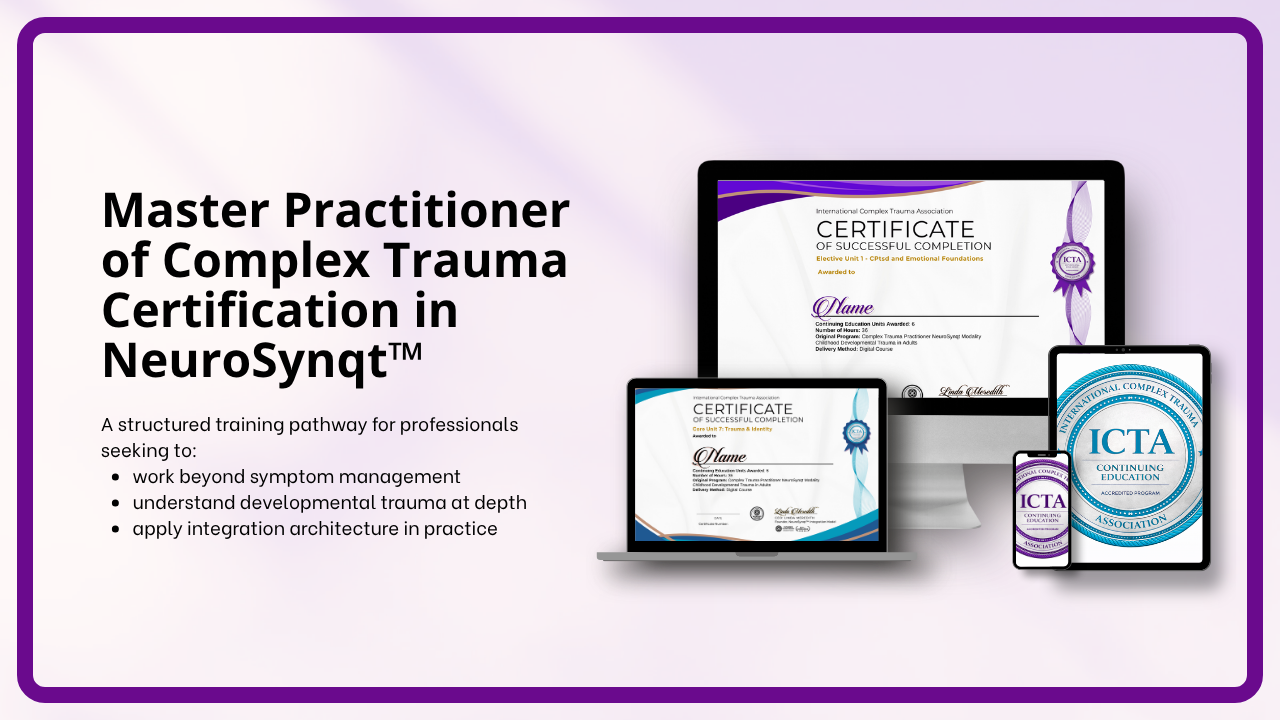
On completion receive your NeuroSynqt™ Certificate of Successful Completion, documenting your training, hours and CEUs.
✓ No live classes
✓ No travel
✓ No postal submissions
✓ No external assessment
✓ Self paced
✓ Lifetime access
One portal. Three areas of professional learning and practice support.
Your learning portal brings together three areas of NeuroSynqt™ professional education and practice resources in one place.
1. NeuroSynqt™ Clinical Foundations
Access begins with the foundational neuroscience and Complex Ptsd recovery framework for beginning to apply NeuroSynqt™ within practitioner and client work. Clinical Foundations can also be completed as Practitioner Course 1 for practitioners seeking CEUs.
2. Your selected professional education
Your chosen Core, Elective and Practitioner courses provide the professional education for your learning pathway, including assessments and practitioner integration portfolios where applicable.
3. NeuroSynqt™ Practitioner Centre
Permanent access extends your learning into practice through practitioner, client, supervision and business resources.
6 Core courses · 6 CPtsd client education ebooks · 32 Professional Bridges · Practice ready Canva templates and training · Certificate of Successful Completion ·
6 CEUs · Lifetime access
Complete this unit independently - or make it part of your wider certification pathway
This is a complete professional training unit in its own right. Successfully complete the six courses, knowledge assessments and practitioner integration portfolios to receive a Certificate of Successful Completion, documenting your professional learning hours and CEUs.
For practitioners continuing through NeuroSynqt™ professional education, this unit also contributes toward the wider certification pathway leading to the Master Practitioner of Complex Trauma (MPCT) designation.
BRIDGING NEUROSYNQT™ INTO EXISTING PRACTICE
32 Professional Bridges across established approaches and professional roles
WHO THIS TRAINING IS FOR
Suitable for practitioners across professional settings
Counsellors and psychotherapists
Psychologists and mental health professionals
Social workers & community service professionals
Mental health nurses and allied health practitioners
Relationship and marriage counsellors
Somatic, expressive and body based practitioners
EMDR, IFS and other modality trained practitioners
Trauma trained coaches within an established nonclinical scope
Students & emerging practitioners completing relevant training
Pastoral care and ministry professionals
ADHD and Autism practitioners
Professional supervisors and educators
Linda Meredith
Passionate, Innovative, and Dedicated to
Complex Trauma Recovery
An Advanced, Neuroscience Based Approach for Mental Health Professionals
NeuroSynqt™ education is peer reviewed and delivered by a Registered Training Provider.
NeuroSynqt™ education is peer reviewed and delivered by a Registered Training Provider.
Real reviews. Real professionals. Real impact.
Some feedback from our students
NeuroSynqt™ Integration and Professional Practice
NeuroSynqt™ integrates within an existing professional role and scope of practice. It is not a standalone modality and is not practised or billed as a separate service.
For regulated professionals including psychologists and counsellors, NeuroSynqt™ functions as a neuroscience-based integration approach supporting assessment, formulation, psychoeducation and integration-aligned intervention.
Sessions remain billed under existing service codes and professional designations. NeuroSynqt™ informs how the work is structured and sequenced, not what is billed.
Where practitioners are eligible to bill private health or insurance providers, billing structures remain unchanged. NeuroSynqt™ does not alter diagnostic coding, insurer eligibility or licensing requirements.
For non-regulated practitioners operating in educational or professional support roles, NeuroSynqt™ must be represented strictly within the limits of that scope.
NeuroSynqt™ is always applied within an existing scope of practice and in accordance with local regulatory and professional requirements.
Enrol Now
Bring Trauma-Related Brain Processes, Motivation, Purpose and Engagement Into the Wider Recovery Picture
6 Core courses · Clinical Foundations · 32 Professional Bridges · Practitioner resources · 6 CEUs · Lifetime access
Take this unit independently or use it toward the NeuroSynqt™ Master Practitioner of Complex Trauma certification pathway.
Frequently asked questions
Can I take this unit without pursuing certification?
What do I receive when I complete it?
Does NeuroSynqt™ replace my existing modality or qualification?
Does this unit count toward MPCT certification?
Do I have to complete it by a certain date?