NeuroSynqt™ Courses

CPtsd: Developmental Trauma, CPtsd and Brain Organisation

Core 1 -Foundational structural training in developmental trauma formulation.

Professional training in developmental trauma and its impact on brain organisation, integration capacity and adult presentation.

For professionals working with adults impacted by childhood developmental trauma.

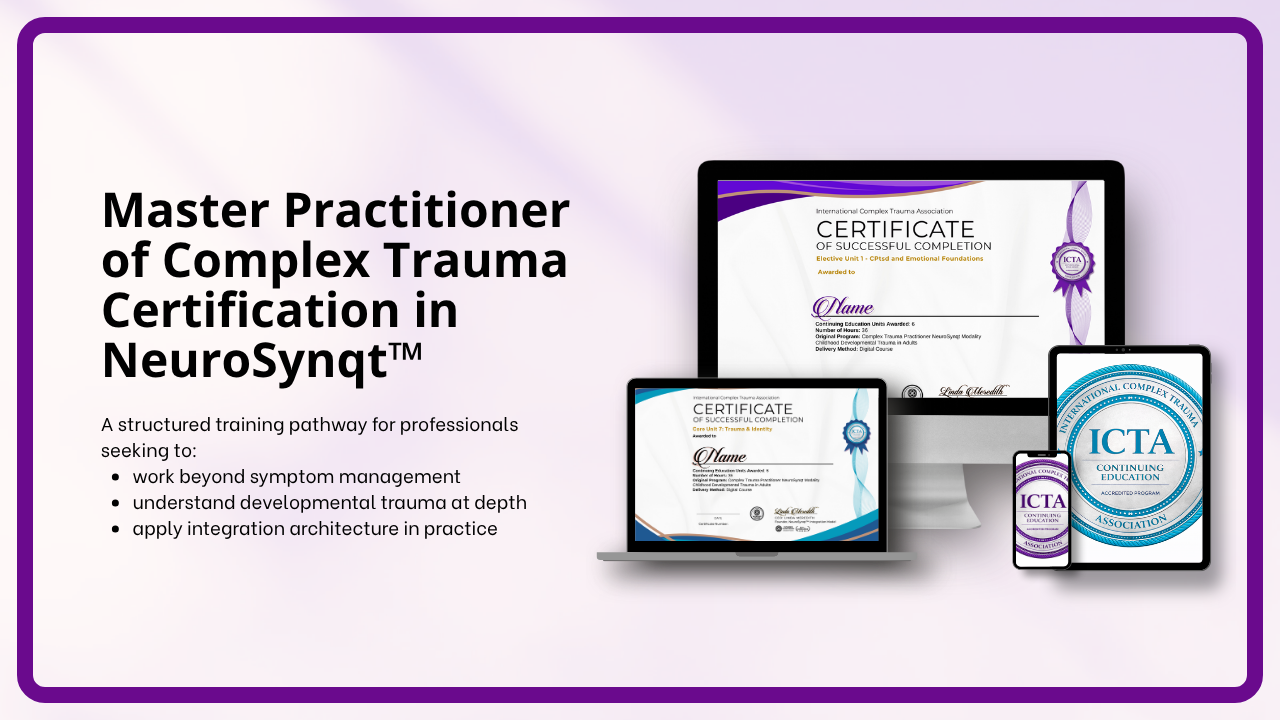
Core 1 - MPCT - NeuroSynqt™
Accredited Professional Certification Pathway
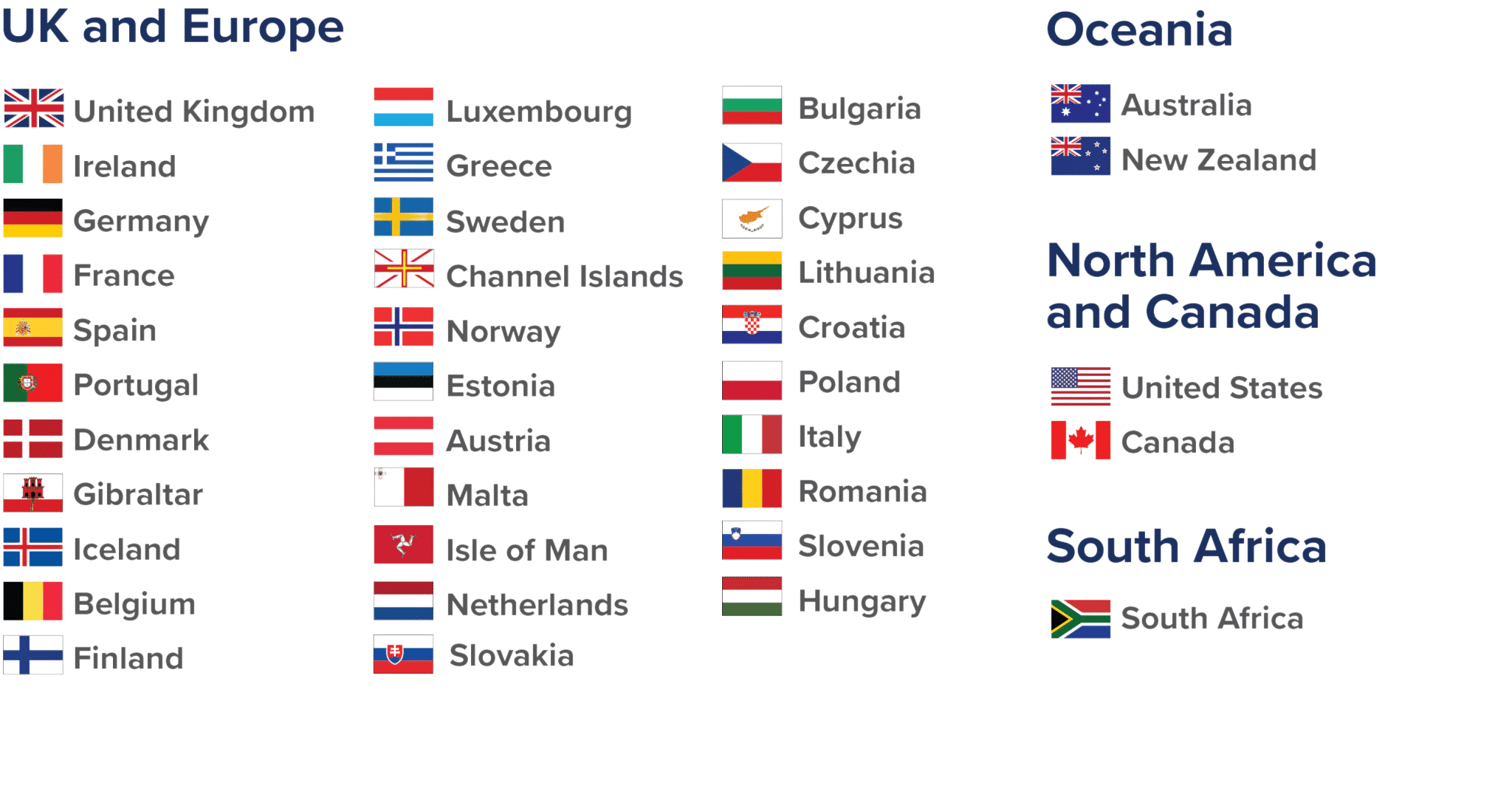
Master Practitioner of Complex Trauma - NeuroSynqt™ (accredited globally) 

Core 1 - CPtsd:Brain Foundations & Supervision Bundle

Write your awesome label here.
  • Registered Training Provider & Accredited Trainer – Linda Meredith
  • Course Level: Advanced (Professional Training Only)
  • Flexible payment options available
  • On Demand digital delivery
  •  Time:18 hrs
 Portfolio: 1
 Exams: 1
 CEU: 6
Course overview

CPtsd: Developmental Trauma and Brain Organisation

Core Unit 1 establishes the foundational formulation required for competent clinical work with adults impacted by developmental trauma. CPtsd is approached as a developmental integration injury, not as a cluster of symptoms and not as a personality configuration.

Across the six courses, practitioners examine how prolonged early threat reorganises brain-led functioning across cognition, attachment, affect regulation, behaviour and self-concept. The focus is not descriptive symptom review. The focus is structural organisation and its impact on integration capacity across adult functioning.

Practitioners develop clarity in differentiating survival organisation from personality structure. Fight, flight, freeze and fawn responses are contextualised as adaptive developmental responses rather than enduring traits. Negative bias, dissociation, trigger activation and identity disruption are mapped as consequences of disrupted integration pathways rather than motivation or resistance.

The distinction between regulation and integration is clarified.  Without understanding the distinction, intervention may increase insight while fragmentation persists.

This training provides the developmental trauma foundations not addressed in standard mental health education. It delivers applied neuroscience in a clinically usable format.


Developmental Trauma Indicators in Adult Presentation

Adults impacted by developmental trauma may present with structural patterns such as:

  • Persistent negative bias in perception and interpretation

  • State-dependent shifts in behaviour or identity presentation

  • Fragmented self-concept across relational contexts

  • Dissociation during narrative recall or emotional activation

  • Escalation from minor triggers to overwhelm

  • Repetitive behavioural patterns despite insight

  • Inconsistent executive functioning under relational stress


These patterns reflect survival-mode organisation rather than behavioural non-compliance.


Core 1
provides the structural lens required to map these indicators within an integration framework.

Write your awesome label here.

Why Integration Specific Training Is Required in CPtsd

 Clinical Reality

What practitioners already do well

  • Therapeutic relationship

  • Emotional processing

  • Stabilisation approaches

These competencies are essential.

What practitioners observe

  • Insight develops

  • Emotional awareness increases

  • Relational safety improves

Yet integration remains inconsistent across contexts.

Dissociative shifts interrupt continuity.

Present-day cognitive and relational access fluctuates under stress.

This is where Core 1 provides structural alignment.


 Clinical Gap

What this reflects.

  • Structural reorganisation resulting from prolonged developmental trauma.
  • Disruption in integration across attachment, regulation, cognition, behaviour and self-concept.


Why this matters

Without structural formulation, intervention may target symptoms while fragmentation remains active.

Insight may increase while integration remains inconsistent.


Core
 1 establishes the developmental lens required to recognise integration disruption in CPtsd presentations and to organise assessment prior to intervention.

Integration and Clinical Scope

Distinguishing insight, stabilisation and relational safety from integration capacity in CPtsd

What Practitioners Recognise

  • Insight does not automatically restore present-day cognitive and relational access

  • Emotional processing does not consistently prevent dissociative shutdown

  • A safe therapeutic relationship does not alone resolve fragmentation

  • Clients may understand their trauma and still experience loss of access during activation

  • This does not indicate treatment failure.


What This Reflects


  • Developmental disruption in integration pathways

  • Survival organised developmental adaptations

  • Limitation in integration capacity rather than practitioner competence

  • Awareness alone does not reorganise integration capacity.


Core Unit 1 provides the structural clarity required to organise developmental trauma presentations prior to intervention.

It establishes the formulation discipline necessary to distinguish:

  • Symptom expression from structural disruption

  • Insight from integration capacity

  • Stabilisation from developmental organisation

This strengthens practitioner accuracy and sequencing without replacing existing therapeutic orientation.


What NeuroSynqt™ Adds to Existing Practitioner Training

When insight, stabilisation and trauma processing do not translate into structural integration.

What NeuroSynqt™ Adds

  • Structural mapping of survival brain fear signalling

  • Clear differentiation between insight and integration capacity

  • Identification of sensory integration disruption

  • Formulation of gut mediated threat persistence

  • Structured mapping of cognitive distortions under activation

  • Recognition of rigidity patterns driven by fear

  • Adult self and identity structure clarification

  • Developmentally aligned pacing guidance

  • Integration capacity tracking across activation states

NeuroSynqt™ complements and strengthens existing therapeutic approaches by addressing integration gaps in developmental trauma presentations.


What NeuroSynqt™ Does Not Replace

  • Professional licensure
  • Stabilisation practices
  • Trauma processing modalities
  • Existing therapeutic orientation
  • Scope of practice requirements


NeuroSynqt™ informs clinical sequencing and structural formulation within scope. It is a neuroscience based integration framework specifically designed for adults who experienced developmental trauma, not a standalone treatment modality.

Write your awesome label here.
NeuroSynqt™ training addresses the integration gap by introducing a structured, neuroscience aligned model designed specifically for developmental trauma presentations.

What Current Approaches Do Well

Many trauma approaches effectively support:

  • Emotional stabilisation

  • Relational safety

  • Trauma processing

  • Cognitive understanding

These are essential components of trauma-informed practice.


What Individuals find can Still Persist

Practitioners frequently observe that:

  • Dissociative access disruption remains

  • Fragmentation re-emerges during activation

  • Present-day cognitive and relational access fluctuates

  • Insight does not consistently prevent shutdown

This reflects a gap in integration alignment rather than a gap in practitioner skill.

Regulation and Integration in CPtsd

CPtsd reflects structural adaptation across developmental periods.
Sustainable recovery requires integration capacity alignment.

Developmental organisation formed under survival conditions may limit consistent access to cognition, motivation and relational engagement.
These limitations require structured sequencing rather than symptom focus alone.

What Regulation Addresses

  • Reduces immediate activation intensity

  • Supports short-term stabilisation

  • Increases tolerance for emotional arousal

  • Enhances situational safety


Regulation skills at a neurological level are a vital component of trauma trained CPtsd recovery work.

What Integration Addresses

  • Reorganises fragmented internal organisation
  • Restores consistent access across internal states
  • Supports identity coherence

  • Reduces state-dependent motivational collapse

Regulation alone does not restore integration capacity.

CPtsd Recovery requires developmental alignment, not symptom stabilisation alone.

NeuroSynqt™ integration and professional billing

NeuroSynqt™ integrates within an existing professional role and scope of practice. It is not a standalone modality and is not practised or billed as a separate service.

For regulated professionals including psychologists and counsellors, NeuroSynqt™ functions as a neuroscience-based integration approach supporting assessment, formulation, psychoeducation and integration-aligned intervention.

Sessions remain billed under existing service codes and professional designations. NeuroSynqt™ informs how the work is structured and sequenced, not what is billed.

Where practitioners are eligible to bill private health or insurance providers, billing structures remain unchanged. NeuroSynqt™ does not alter diagnostic coding, insurer eligibility or licensing requirements.

For non-regulated practitioners operating in educational or professional support roles, NeuroSynqt™ must be represented strictly within the limits of that scope.

NeuroSynqt™ is always applied within an existing scope of practice and in accordance with local regulatory and professional requirements.

Write your awesome label here.

NeuroSynqt™ principles

NeuroSynqt™ recognises CPtsd as a developmental integration injury rather than a behavioural or diagnostic issue.

It approaches adult presentation through structural formulation, identifying survival-organised adaptations that influence access to cognition, motivation and relational engagement.

NeuroSynqt™ does not assume a single recovery pathway. It recognises that developmental trauma produces diverse patterns of organisation requiring individualised sequencing.

Principles are shared for orientation and conceptual clarity. Application, sequencing and clinical use are taught exclusively within accredited education and supervision.

Write your awesome label here.

NeuroSynqt™ Core Courses


The NeuroSynqt™ Core Courses form a six unit professional training sequence.

Each Course addresses a specific integration domain and is designed to be completed in sequence, as later units build on earlier developmental foundations.

The series supports practitioners to identify gaps commonly left unaddressed in CPtsd training and to work in ways that support durable, developmentally aligned recovery.

Browse the Courses for detailed course information.


Write your awesome label here.

Course 1

Understanding the Trauma Impacted Brain

Course 2

How CPtsd Impacts Daily Functioning

Course 3

Key Areas the Brain Learns to Adapt

Course 4

Why the Brain Leans Toward Threat - and How We Work With It

Course 5

Trauma, Identity & Meaning (TIM)

Course 6

Recognising Triggers Without Becoming Them

Competency Outcomes

Core Unit 6 - Attachment and the Brain
Upon completion of Core Unit 1 practitioners will be able to:
  • Differentiate Type 1 and Type 2 trauma
  • Describe CPtsd as developmental and prolonged trauma exposure
  • Identify and explain the 7 Areas of Impact
  • Recognise how survival-mode organisation affects attachment, biology, regulation, dissociation, behaviour, self-concept and cognition
  • Identify patterns of negative bias in trauma-affected clients
  • Use structured self-observation tools (including T.I.M.) to increase clinical awareness
  • Recognise early trigger progression leading to overwhelm
  • Differentiate dissociative experiences from present day functioning in clinical discussion
  • Prevent destabilisation through capacity-aligned pacing
  • Assess integration capacity prior to intervention
  • Formulate CPtsd as a neuroscience integration injury
Competency is measured through formulation accuracy and integration aligned clinical decision making.

Course 1 - Complex Trauma Foundations

Developmental trauma definitions and structural implications.
Course includes 47 slides
Completing this course will help you work competently in: Developmental Trauma Differentiation Differentiating Type 1 and Type 2 trauma and identifying prolonged developmental trauma patterns consistent with CPtsd.
    1. Define trauma types and differentiate acute, chronic and complex trauma.

    2. Recognise developmental trauma as prolonged exposure that reshapes the growing brain.

    3. Explain the timeline of trauma research from Herman to van der Kolk and beyond.

    4. Understand how trauma alters self-perception and creates fragmented identity.

    5. Identify early relational trauma as the foundation for adult emotional dysregulation.

    6. Describe how the brain encodes trauma through implicit, non-verbal memory networks.

    7. Recognise the duality of self between present day awareness and trauma based responses.

    8. Support clients in understanding why talk therapy alone fails for CPtsd recovery.

    9. Explain the role of safety, curiosity and experiential work in rebuilding brain integration.

    10. Lay the foundation for brain-based recovery, where reconnection precedes regulation.

Course 2 - Impact of CPtsd

Functional disruption across adult life domains.
Course includes 50 slides
Completing this course will help you work competently in: System Wide Impact Mapping Mapping the 7 Areas of Impact across attachment, biology, regulation, dissociation, behaviour, self concept and cognition within adult presentation.
    1. Recognise how prolonged trauma rewires the brain and alters thinking, emotion, and behaviour.

    2. Explain the triune brain model and its relevance to developmental trauma.

    3. Identify survival dominance patterns and their impact on memory and attention.

    4. Understand the amygdala hijack and why clients experience emotional flooding.

    5. Describe prefrontal cortex disengagement and its effect on logic, planning, and self-control.

    6. Recognise the physical and cognitive consequences of chronic stress and oxygen deprivation.

    7. Apply a biopsychosocial-spiritual model to address the full scope of trauma impact.

    8. Introduce proprioception and breath awareness to support reconnection with the present.

    9. Support clients to differentiate trauma self and adult self for safe internal awareness.

    10. Build foundations for authentic recovery, integrating neuroscience, awareness, and practical daily habits.

Course 3 - 7 Areas of Impact

System wide trauma impact mapping.
Course includes 18 slides
Completing this course will help you work competently in: Survival-Mode Organisation Recognition Identifying how prolonged threat shapes perception, negative bias and behavioural repetition patterns.
    1. Describe the seven core areas of CPtsd impact identified by Dr Judith Herman and how they shape lifelong functioning.

    2. Recognise how chronic trauma alters brain development, creating fragmented self-awareness and disrupted identity.

    3. Identify emotional regulation challenges linked to prolonged survival dominance and blocked integration.

    4. Explain cognitive effects such as concentration issues, intrusive memory, and distorted self-perception.

    5. Understand relational impacts including attachment disruption, fear of intimacy, and cycles of isolation.

    6. Recognise the loss of meaning and purpose as a survival outcome, not a personality flaw or moral failing.

    7. Support clients in rebuilding trust and agency through safe, consistent, experiential practice.

    8. Integrate reflection tools that help clients observe internal patterns without self-judgement.

    9. Apply a brain-centred recovery map to track progress across emotional, cognitive, and relational domains.

    10. Encourage self-awareness as the first layer of integration, guiding clients from observation to choice.

Course 4 - Negative Bias and Survival Processing

Threat-based perception patterns.
Course includes 20 slides
Completing this course will help you work competently in: Dissociative State Identification Recognising dissociation, depersonalisation and state-dependent functioning within trauma-affected clients.
    1. Define the brain’s negativity bias and its purpose in detecting threat and preserving safety.
    2. Explain how trauma strengthens negativity pathways, reinforcing risk and rejection.

    3. Recognise the amygdala’s role in storing unprocessed threat memories and driving automatic emotional reactions.

    4. Understand how positive memories fade faster, leaving survivors anchored in cycles of fear and self-doubt.

    5. Identify automatic negative thoughts as brain-based habits rather than conscious belief systems.

    6. Support clients to notice procedural memory patterns that replay survival responses without awareness.

    7. Teach strategies to reframe negative bias, using connection and rewiring.

    8. Integrate reflective practices that engage the hippocampus to strengthen positive memory.

    9. Help clients translate awareness into choice, recognising that awareness interrupts automatic reactivity.

    10. Guide clients in practical brain-based tools that balance realism with hope and build resilience over time.

  • Define the brain’s negativity bias and its evolutionary purpose in detecting threat and preserving safety.

  • Explain how trauma strengthens negativity pathways, reinforcing hyper-focus on risk and rejection.

  • Recognise the amygdala’s role in storing unprocessed threat memories and driving automatic emotional reactions.

  • Understand how positive memories fade faster, leaving survivors anchored in cycles of fear and self-doubt.

  • Identify automatic negative thoughts as brain-based habits rather than conscious belief systems.

  • Support clients to notice procedural memory patterns that replay survival responses without awareness.

  • Teach strategies to reframe negative bias, using attention redirection and micro-pattern rewiring.

  • Integrate reflective practices that engage the hippocampus to strengthen positive memory recall.

  • Help clients translate awareness into choice, recognising that awareness interrupts automatic reactivity.


Course 5 - T.I.M. Structured Self Observation

Internal state tracking without destabilisation.
Course includes 27 slides
Completing this course will help you work competently in: Structured Self-Observation Application Using T.I.M. and reflective tracking tools to increase internal awareness without escalating activation.
    1. Recognise how prolonged trauma rewires the brain and alters thinking, emotion, and behaviour.

    2. Explain the triune brain model and its relevance to developmental trauma.

    3. Identify survival dominance patterns and their impact on memory and attention.

    4. Understand the amygdala hijack and why clients experience emotional flooding.

    5. Describe prefrontal cortex disengagement and its effect on logic, planning, and self-control.

    6. Recognise the physical and cognitive consequences of chronic stress and oxygen deprivation.

    7. Apply a biopsychosocial-spiritual model to address the full scope of trauma impact.

    8. Introduce proprioception and breath awareness to support reconnection with the present.

    9. Support clients to differentiate when old survival patterns are shaping present reactions,

    10. Build foundations for authentic recovery, integrating neuroscience, awareness, and practical daily habits.

Course 6 - Beginning to Recognise Triggers

Early trigger sequencing and overwhelm identification.

Course includes 16 slides

Completing this course will support competent practice in: Trigger Sequence Identification Recognising early-stage emotional activation and tracking escalation patterns prior to overwhelm.


    1. Recognise the early warning signs of overwhelm and track the brain’s progression toward emotional flooding.

    2. Understand triggers as implicit memory activations, not overreactions or personality flaws.

    3. Teach clients to map thoughts, emotions and actions that occur in the hour leading up to emotional overload.

    4. Use reflective questioning techniques to help clients identify brain-based patterns driving recurring distress.

    5. Guide clients in naming layered emotions, building language for subtle shifts before full escalation.

    6. Integrate body awareness exercises that reconnect physical sensations with emotional understanding.

    7. Introduce journalling for brain–body integration, helping clients translate unconscious patterns into conscious choice.

    8. Use somatic and movement-based strategies to retrain the brain’s association between safety and stillness.

    9. Help clients develop emotional sequencing awareness, identifying “lesser” emotions that precede collapse or rage.

    10. Support gradual change through micro-practice, guiding clients to make safety-based adaptations one small step at a time.


Core 1 Curriculum

Join today

💻 Learning That Fits Real Life ➡️

Accessible. Practical. Designed for real world CPtsd practice.

Because true recovery requires integration, not just information.

Your course access includes:

  • 24/7 online learning that fits your daily rhythm

  • Immediate access to all six courses and course materials
  • Printable resources, client ready visuals, and worksheets
  • Experiential learning that supports integration through direct application of the framework.


Trauma trained education aligns practitioner learning with the same developmental processes that shape CPtsd recovery.

🌱 Free Weekly Supervision & Study Space

Free weekly supervision is included with your course enrolment.
You’re welcome to come along each week - to study, ask questions, or simply sit in community.

Supervision provides a safe, supportive environment to:

  • Deepen your NeuroSynqt™ and CPtsd understanding

  • Develop reflective practice and professional confidence

  • Receive real time discussion and mentorship

  • Reconnect with professional clarity and clinical direction

📍 Access your Supervision Module inside your student account - it contains the schedule, what’s included and how supervision supports your professional growth and personal integration.

💬 “No one heals in isolation - we heal through safe, structured connection.”

Comprehensive CPtsd Education

Professional CPtsd education specific to each clinical domain, neuroscience based 

Extra CPtsd Information

A collection containing 8 additional sections of Complex Trauma education

Homework Canva Templates

Homework books, canva templates for clients ~ apply your own brand

Client Materials

A structured collection containing 9 sections of CPtsd client materials

Business Development

A collection containing 11 sections supporting global practitioner business development

Extra Practitioner Tools

A collection of 7 Practitioner tools. Lifetime access to all course updates and materials

Free Canva Course - Canva is used to complete Portfolio material (We also use pdf's)

Course Specific Practitioner Resources

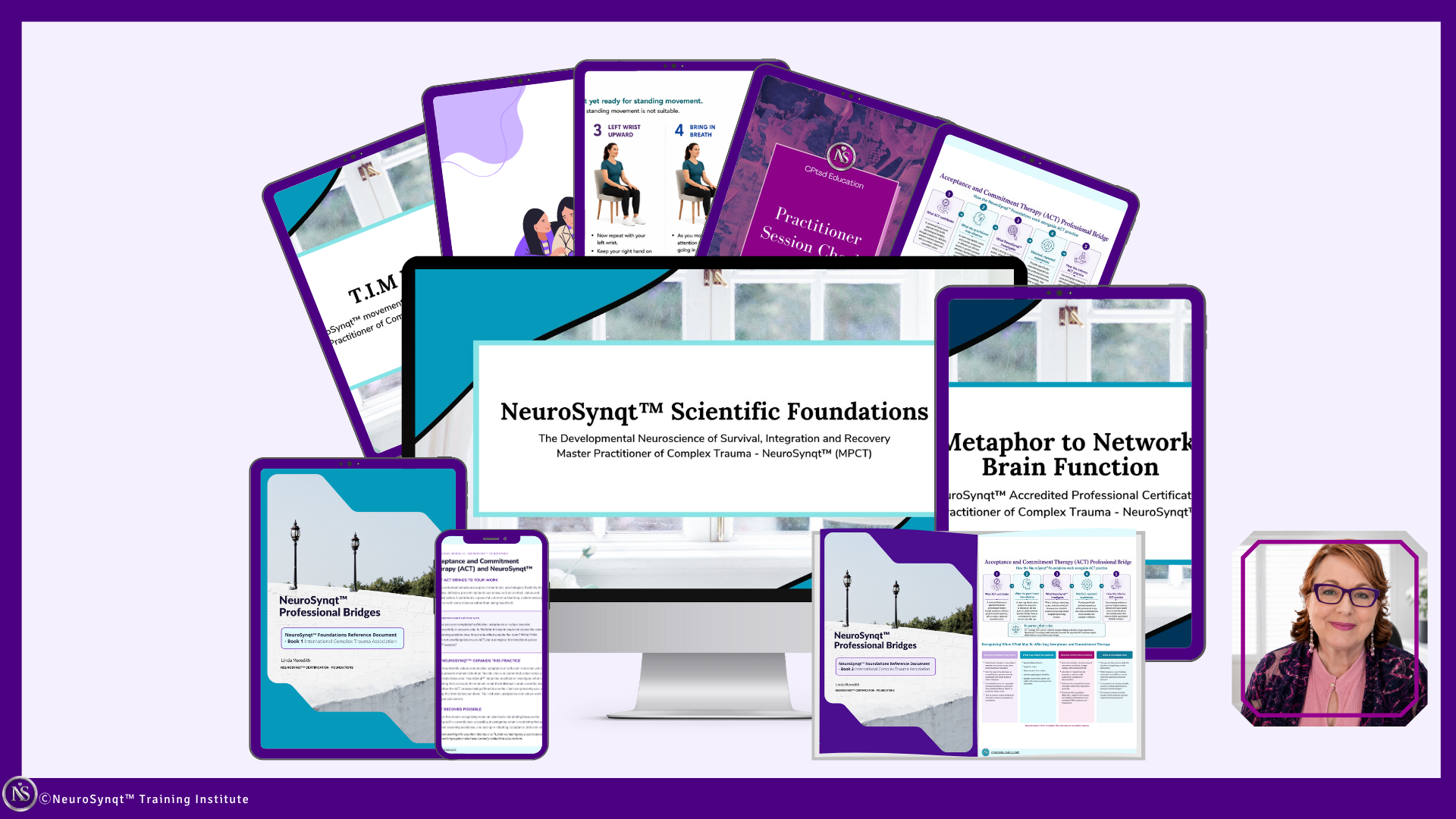
This program includes structured practitioner only and client facing materials aligned to developmental trauma formulation and integration capacity work.

Resources are designed to strengthen formulation accuracy, pacing decisions and real time integration capacity tracking within professional scope.

Materials support session structure and between session continuity. All resources are embedded within the certification aligned learning sequence and support structured application across developmental trauma presentations.

Write your awesome label here.

Why Regulation Is Not the Starting Point in CPtsd Work

While regulation is essential in trauma recovery, research in interpersonal neurobiology demonstrates that regulation capacity develops within integrated neural systems rather than as an isolated skill.

In developmental trauma, integration pathways are disrupted, which means attempts to strengthen regulation without addressing integration capacity can stabilise symptoms without restoring consistent present-day access.

In CPtsd work, integration alignment precedes sustainable regulation.

Dr Dan Siegel

Every form of self regulation we’ve been able to examine
Regulating attention
• Regulating emotions or affect
• Regulating mood
• Regulating thought
• Regulating physiology
• Regulating relationships
• Regulating behaviour
Every aspect of regulation we could explore depends on integration of the brain.

Why Trauma Trained Practice Changes Clinical Accuracy

Beyond trauma informed language into developmentally aligned brain based practice

Trauma informed care improves awareness.
Trauma trained practice strengthens formulation precision.

Being trauma trained means understanding:

• How developmental threat shapes fear signalling and adult adaptation
• Why clients may present as high functioning yet remain structurally fragmented
• How integration capacity limits influence cognition, motivation and identity organisation
• Why stabilisation alone does not restore consistent access to adult self structure

When trauma is addressed at a brain based structural level rather than symptom level alone, clinical sequencing becomes clearer and practitioner decision making becomes more accurate.

Grounded in Research. Applied in Practice.

Bringing research and lived experience together

Current neuroscience and developmental research consistently show that:

• Early relational and environmental threat shapes long term fear signalling patterns
• Trauma impacts perception, cognition and identity organisation - not just emotion
• Professional burnout increases when structural formulation is unclear

This education integrates research with applied formulation, supporting practitioners to work with developmental trauma presentations using structural clarity rather than symptom management alone.

Linda Meredith

Passionate, Innovative, and Dedicated to

Complex Trauma Recovery


An Advanced, Neuroscience Based Approach for Mental Health Professionals

Linda Meredith is an accredited trainer, counsellor  and creator of the NeuroSynqt™ modality for CPtsd recovery. Known as a Professional Brain Untangler, Linda combines advanced neuroscience, lived experience  and years of client practice to develop trauma trained education that’s both practical and deeply human.

Her work has been peer reviewed and accredited by specialists with tertiary qualifications in the trauma field, ensuring every course is grounded in professional standards as well as real world application.

👉 Want to know more about Linda’s background, qualifications  and journey? Read Linda’s full story 
Write your awesome label here.

NeuroSynqt™ education is peer reviewed and delivered by a Registered Training Provider.

Write your awesome label here.

Real reviews. Real professionals. Real impact.

Write your awesome label here.

01 

"Linda Meredith is a powerhouse at making complex trauma understandable and accessible. Her program is flexible, practical, and deeply supportive — allowing me to go at my own pace and truly engage with the material. What stands out is how the homework helps me embody the knowledge, not just memorise it. It’s sparked real ah-ha moments about how to support my clients more effectively. Linda’s generosity shines through everything she creates — from beautiful workbooks to business tools that make it easier to succeed as a coach. It honestly feels like she’s in my corner 24/7. This program is exactly what I needed. Thank you, Linda — you’re a gift. "
Write your awesome label here.

02

"I don’t know if anyone else can resonate, but I’m so hungry for more critical information to better serve my coaching clients that I simply cannot get enough of the material Linda creates! The Complex Ptsd survivors around the world are so fortunate to have someone as amazing as Linda Meredith creating courses for helping professionals! The depth of the content and the support this course offers is PHENOMENAL! If you haven’t started taking the course and you are on the fence, I would HIGHLY recommend you take the leap and sign up

Thanks Linda for what you do!"
Write your awesome label here.

03

“Linda has a warm, caring attitude with a sense of humour to boot about the effects of CPtsd on someone. Her insight, videos, articles, and support have helped me over humps and I have seen the effect it has had on others too. Linda speaks not only through her education, but also from her own experience. She understands what brings about CPtsd and how to help you address that trauma in a caring, kind, compassionate, and sometimes firm fashion. I highly recommend her if you are looking to heal from trauma you’ve experienced or even if you’re looking to understand more about the impact of CPtsd. Be kind, be understanding, and do yourself a favour and learn from Linda’s materials!.”

📚 Explore Other Courses

🏆 Certification Pathway

The NeuroSynqt™ program provides practical, applied online education in the complex trauma field for qualified practitioners working with adults impacted by developmental trauma CPtsd.

Professionals may engage through flexible pathways:

Individual Core Units focused on specific clinical domains
Full Certification leading to recognition as Master Practitioner of Complex Trauma – NeuroSynqt™ MPCT NeuroSynqt, with CEUs available

The certification pathway has been peer reviewed and accredited by professionals with tertiary qualifications in the trauma field, supporting professional credibility and recognition.

NeuroSynqt™ courses are designed for qualified practitioners practising within their existing professional scope. Completion of individual Core Units contributes toward certification requirements but does not constitute certification independently.

Developed through extensive study, applied practice and lived clinical experience, NeuroSynqt™ provides a neuroscience based, clinically grounded framework supporting assessment clarity, structured formulation and integration aligned application in professional practice.

Grab a dose of innovation, straight to your email.

Thank you!
Created with