CPtsd: Trauma and Sexual Abuse Recovery Series

Elective 3~ A Trauma Trained Framework for CSA & CPtsd: From Hidden Survival to Integrated Healing

Professional training. Certification optional. CEU hours available for eligible professionals.

CHILDHOOD SEXUAL ABUSE REWIRES THE BRAIN

CSA isn't just an emotional wound - it alters how the brain forms memory, identity, and connection.

  • 1 in 6 women and 1 in 9 men report experiencing CSA before age 18 (AIFS, 2023).

  • CSA often occurs during critical brain development windows, when safety, attachment, and self-concept are forming.

  • These early violations don’t just hurt - they wire the brain for survival, not connection, increasing risks for dissociation, identity fragmentation, chronic illness, and relationship instability later in life.

  • CSA impacts the amygdala, hippocampus, insula, and default mode network, shaping lifelong relational and emotional responses.

🧠 Understanding how CSA changes brain function is the foundation for effective, body-based, identity-focused trauma recovery.

ABUSE ISN’T RARE — IT’S UNDER-RECOGNISED

CSA often hides in silence, minimisation, or grooming - not in visible violence.

  • Most survivors do not disclose until adulthood - if ever - due to fear, shame, and confusion.

  • Grooming, fawning, and dissociation often mask abuse, making it hard to identify and easy to overlook.

  • Labels like “narcissistic abuse” can oversimplify. Instead, we teach practitioners to map patterns of harm: coercion, betrayal, collapse, and boundary loss.

  • CSA isn’t defined by what happened once — it’s defined by what it taught the brain:
    “You don’t matter.”
    “You can’t say no.”
    “Your body isn’t yours.”

🧭 We train you to decode these patterns in the body, brain and relationships - not just behaviour.

NEUROSYNQT™ HEALS YOU WHILE YOU HEAL OTHERS

Working with CSA survivors is some of the most sacred - and exhausting - work we do.

  • Over 50% of trauma practitioners report emotional exhaustion and burnout.

  • The NeuroSynqt™ process heals the helper and the client at the same time - by restoreing coherence between thinking, feeling, and relating - for both client and practitioner.

This approach supports practitioners to:

  • Stay present in dissociative dynamics

  • Work with preverbal, non-verbal, and somatic trauma

  • Restore trust in the brain’s adaptive logic - even when words fail

Healing doesn't start with fixing - it starts with safety, attunement, and restoring meaning to what the brain did to survive.

💡 Take the Developmental Trauma & Brain Impact Quiz

Explore how early experiences may have shaped your brain’s patterns for safety, connection, and learning.
This brief, anonymous reflection includes two parts - a developmental trauma self-check and a brain impact overview - designed to help you reflect if CPtsd has impacted memory, focus and identity formation. It also includes the tests your professional can do to help you in these areas too. No email required.
✅ Anonymous | 🕒 3 minutes | 🧩 Educational only

Elective Unit 3 – MPCT Accredited Professional Certification Pathway
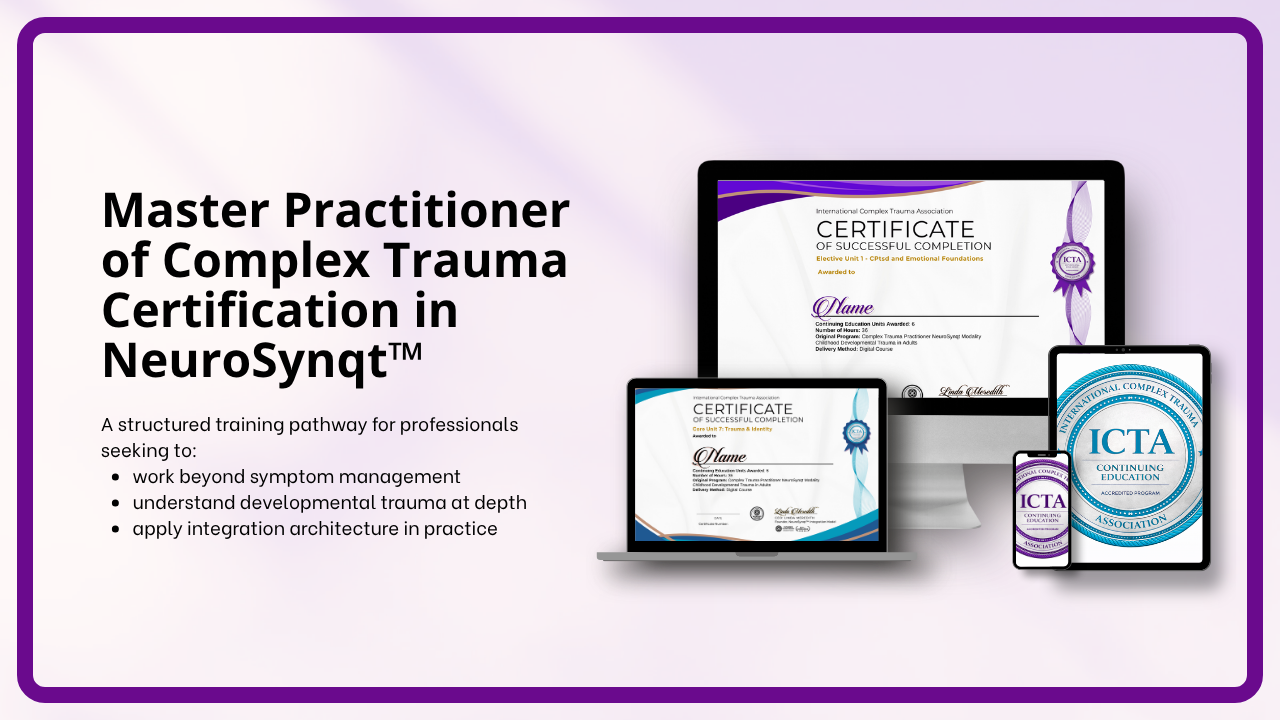
Master Practitioner of Complex Trauma
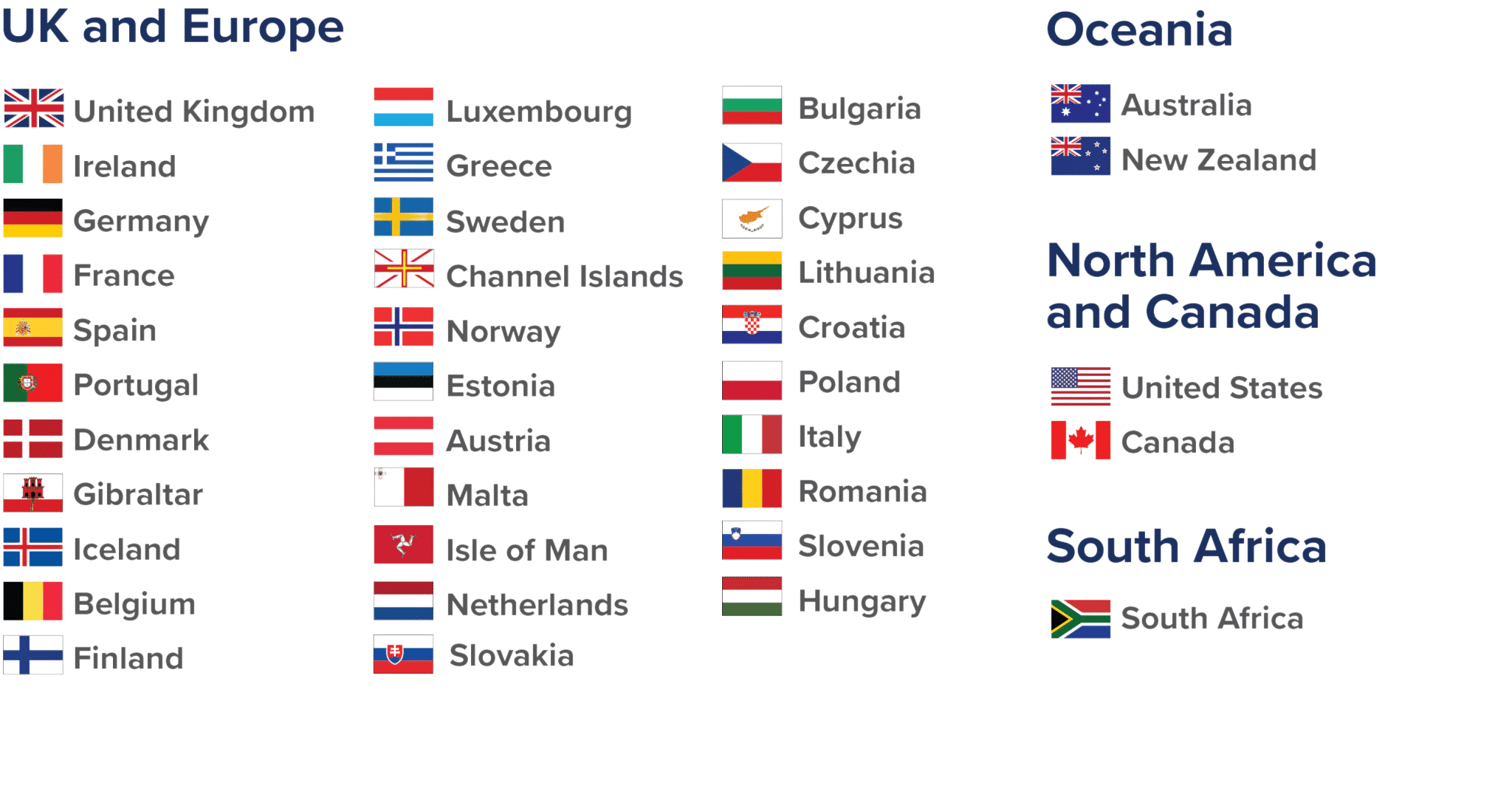
(accredited globally) 

Certification is optional. CEU hours available for eligible professionals.

  • Accredited Trainer – Linda Meredith
  • Course Level: Advanced (Professional Training Level)
  • Payment Plan available
Write your awesome label here.
  •  Time: 38 hrs
 Portfolio: 1
 Exams: 1
 CEU: 6

👉 Elective 3 of the Master Practitioner in CPtsd Recovery (MPCT Accredited).
 CEU hours available for eligible professionals.

International Complex Trauma Association
Healing from Complex Ptsd

course overview

Why can’t my client feel whole - even after all their healing work?

It’s the question that sits heavy for every professional supporting adult survivors of childhood sexual abuse and CPtsd. Clients may appear capable and insightful, yet live behind invisible walls of dissociation, chronic shame, relational mistrust, and fragmented identity.

Traditional approaches often overlook that childhood sexual abuse isn’t just trauma – it is betrayal trauma at the foundation of the developing self, reshaping the brain’s architecture of safety, identity, and trust. What can look like resistance, emotional detachment, or “not trying hard enough” is often the brain’s enduring attempt to stay safe in a world that once wasn’t.

This accredited elective delivers six in-depth modules on sexual abuse recovery through a CPtsd and brain-based lens. You’ll learn how to:

  • Understand sexual abuse as betrayal trauma and its unique imprint on the developing brain and identity.

  • Decode survival adaptations such as dissociation, fawning, and compliance 

  • Identify and work with shame scripts that silence survivors 

  • Address male survivor dynamics, including power, arousal, and defensive shame patterns.

  • Guide clients toward embodied sexual reclamation

  • Support post-traumatic identity reintegration,

This elective speaks to the quiet weight professionals carry – the knowing that their clients are courageous and committed, yet still need a pathway that reaches the deeper layers where betrayal, identity, and the trauma self remain disconnected.

Why CPtsd & Sexual Abuse Training Matters

This elective goes beyond generic trauma education by addressing the profound intersection of CPtsd and childhood sexual abuse. You’ll explore how betrayal trauma, attachment wounds, and early relational violations shape the developing brain and identity. What once served as protection - dissociation, compliance, silence, or emotional withdrawal - often becomes the barrier to connection and integration in adulthood.

Through the NeuroSynqt™ lens, you’ll learn to see how these patterns are not signs of resistance, but evidence of a brain still doing its best to survive. Each concept, framework, and experiential process is designed to help professionals meet survivors where their story began - and guide them safely toward reconnection.

Grounded in neuroscience, compassion, and advanced trauma recovery practice, this course helps professionals:

  • Recognise how childhood sexual abuse reshapes the brain, attachment, and self-concept.

  • Understand the long-term identity fractures caused by betrayal trauma and developmental violations.

  • Identify survival patterns such as fawning, dissociation, or hypersexuality without pathologising.

  • Provide clear, compassionate pathways that support integration, voice, and self-agency.

This elective reflects a new depth of professional care - one that honours the sacred work of helping the brain reconnect what trauma once severed.

Write your awesome label here.
Flexible Learning Support

🎧 Prefer to Listen While You Learn?

Complex trauma can make on screen reading feel heavy or disconnecting. Listening allows the brain to process the material more gently and helps you stay present as you learn.

You can now have your slides read aloud on any device using built in accessibility tools.

Full instructions for Mac, iPhone or iPad, Android, and Windows are included right inside this course.

💜 This feature is designed to support your learning style, not replace it.
🎙️ Linda’s teaching, coaching, and voice remain throughout every course. You will still hear Linda guiding you through the concepts, unpacking examples, and coaching from the slides as part of your learning experience.

👉 Use the Have Your Slides Read To You tab inside the course for device specific instructions and start listening your way through the course.

Write your awesome label here.

Sexual abuse fractures more than safety - it disrupts the brain’s capacity to integrate identity, trust, and embodied presence. Professionals often witness survivors doing the work of healing, yet still feeling disconnected from their own sense of self. Beneath the progress sits a deeper story - one the brain continues to protect.

This course bridges that gap with a blend of neuroscience, compassion, and lived experience, providing a clear map for professionals who want to understand the brain’s logic behind disconnection. Through the NeuroSynqt™ framework, you’ll learn how to guide survivors toward reconnection - not through regulation, but through integration, curiosity, and relational safety that meets them where their brain still hides.

Every module invites you to step into the sacred space between professional skill and human empathy - to see not just the symptoms of trauma, but the brilliance of survival beneath them.


Here’s what you’ll walk away with…

Tools to recognise sexual abuse as betrayal trauma and trace its imprint across identity, attachment, and neurodevelopment.

A neuroscience-informed map of how childhood sexual trauma wires long-term survival adaptations - dissociation, fawning, compliance, or hypersexuality - and how to gently interrupt these patterns.

Frameworks for helping survivors reconnect voice, body, and agency through brain-based integration practices.

Practical worksheets and infographics to use directly with clients in-session.

Strategies to help clients move beyond chronic shame, self-blame, and identity confusion into self-leadership and integration.

Confidence to explain the brain-based impacts of sexual trauma in clear, compassionate, and non-pathologising language.


The depth of the content and the support this course offers is phenomenal! If you’re on the fence, I’d highly recommend taking the leap

Candace Alley,
CEO candacealley.com

Over the past year and a half, Linda has helped me experience growth that I thought was impossible. In a loving and compassionate manner, she has taught me tools and strategies to manage my trauma symptoms. Most importantly, she made me feel heard, seen, and understood.

Lisa Armele,
Ed.S., MA., CAS.

Linda Meredith is a powerhouse when it comes to bringing research and information together to help us understand complex trauma. More importantly, she breaks things down in a way that is easily accessible. The homework isn’t about memorising terms - it’s about embodying the knowledge while healing ourselves and supporting our clients. practically and effectively. As a professional who has had burnout 3 times, Linda's work has helped me not only return to work but to do so in increasing good health whilst helping clients globally achieve the recover results they also desire.

Sherry Yuan Hunter,
CEO Sandwich Parenting

What Makes the 6 Courses Impactful?

This elective goes beyond generic trauma education by addressing the profound intersection of CPtsd and childhood sexual abuse. You’ll explore how betrayal trauma, attachment disruptions, and early relational violations shape the developing brain and identity. What once served as protection - dissociation, compliance, silence, or emotional detachment - often becomes the barrier to connection and integration in adulthood.

Through the NeuroSynqt™ lens, you’ll learn to see these patterns not as resistance, but as evidence of a brain still doing its best to survive. Each framework, discussion, and experiential process is designed to help professionals and individuals meet that story with understanding and guide it gently toward reconnection.

Grounded in neuroscience and advanced trauma recovery practice, this course helps professionals and individuals to:

  • Recognise how childhood sexual abuse reshapes the brain, attachment, and self-concept.

  • Understand the long-term identity fractures caused by betrayal trauma and developmental violations.

  • Identify survival patterns such as fawning, dissociation, or hypersexuality without pathologising.

  • Provide clear, compassionate pathways that support integration, voice, and self-agency.


🧰 Made for Those Who Work in the Messy Middle of Healing

  • Counsellors, psychologists, and social workers seeking advanced training in CPtsd and sexual abuse recovery.
  • Allied health and pastoral care professionals supporting adult survivors of childhood sexual abuse.
  • Educators and community leaders wanting a neuroscience-based, trauma-trained framework for complex trauma recovery.
  • Students and emerging practitioners building professional credibility with CPtsd-specific, brain-based practice.
  • Practitioners working toward certification and CEUs in CPtsd Recovery.
  • Individuals with lived experience pursuing structured, professional-level CPtsd education and personal integration.

🌟 The Shift You’ll See in Clients (and Yourself)

This unit doesn’t just give you theory - it equips you to recognise the hidden impact of childhood sexual abuse and respond with clarity, compassion, and confidence. You’ll leave with brain-based frameworks and practical tools that transform how you approach complex client work and survivor reconnection. 

You’ll be able to:

  • Recognise the deep imprint of betrayal trauma and its influence on identity, attachment, and relational safety.

  • Explain the brain-based effects of sexual trauma in clear, non-shaming language that helps clients make sense of their experiences.

  • Validate survivors’ stories without collusion, minimisation, or avoidance of the deeper developmental wounds.

  • Differentiate survival patterns such as fawning, dissociation, or hypersexuality from authentic self-expression.

  • Support survivors to re-establish voice, boundaries, and agency through brain-based integration practices.

  • Guide clients toward embodied safety and relational trust step by step, without retraumatisation.

  • Strengthen your professional credibility with advanced, trauma-trained insight into sexual abuse recovery.

  • Address the spiritual and identity ruptures that often accompany early sexual violation.

  • Recognise and repair the impact of betrayal-based shame that fragments the sense of self.

  • Provide tools that help survivors reconnect to self-worth and internal safety rather than external validation.

  • Facilitate meaning-making and identity restoration beyond the trauma story.

  • Reframe trauma-driven sexual and relational patterns as survival intelligence, not personal failure.


Write your awesome label here.

Course 1

The Hidden Impact - 
CPtsd, CSA & Adult Recovery

Course 2

Dissociation, Fawning & Fragmented Identity

Course 3

Shame Scripts, Voice Loss & Emotional Displacement

Course 4

When the Survivor Is Male – The Silent Wound of Masculinity

Course 5

Sexuality, Safety & Intimacy After CSA

Course 6

Reclamation – Building Post-Traumatic Identity

Course 1 - The Hidden Impact - Understanding CSA Through the Brain, Body & Betrayal

CSA as betrayal trauma – and its lifelong impact on brain and identity.

Course includes 46 slides
Completing this course will help you work competently in:
Recognise the neurodevelopmental impact of CSA and validate survival-driven adaptations without shame.
 ➜ Understand how freeze, fawn and fragmentation emerge as protective childhood responses rather than defects.
 ➜ Explore identity confusion, dissociation and trauma-time looping as predictable brain-based outcomes of CSA.
 ➜ Identify betrayal-based attachment wounds and their impact on adult trust, intimacy and connection.
 ➜ Address the emotional cost of coerced loyalty and secrecy including self-blame, silence and relational erosion.
 ➜ Facilitate reconnection between trauma-time reactions and real time so clients can check what is true now.
 ➜ Guide clients through the grief of developmental arrest and the loss of safety, innocence and childhood stages.
 ➜ Support early detection of coercive dynamics and grooming echoes to reduce revictimisation risk in adult life.
 ➜ Work with adaptive survival roles (pleaser, performer, caretaker, invisible child, etc.) without pathologising them.
 ➜ Apply NeuroSynqt™ strategies for agency repair and identity integration to rebuild safe connection and self-trust.

Course 2: Dissociation, Fawning 
& Fragmented Identity

How the brain protects through disconnection - and guiding survivors to safely reconnect voice, body, and sense of self.
Course includes slides
Completing this course will help you work competently in:

Course 3: Shame Scripts, Voice Loss & Emotional Displacement

Uncovering how shame rewires inner dialogue - and helping survivors reclaim agency through truth and self-compassion.
Course includes slides
Completing this course will help you work competently in:

Course 4: When the Survivor Is Male – The Silent Wound of Masculinity

Ad
Course includes slides
Completing this course will help you work competently in:

Course 5: Sexuality, Safety & Intimacy After CSA

Ree.
Course includes slides
Completing this course will help you work competently in:

Course 6: 

Integrati
Course includes slides
Completing this course will help you work competently in:

CPtsd and Sexual Abuse Recovery  Course Outline

Join today

💻 Learning That Fits Real Life ➡️

Accessible. Practical. Designed for the trauma-trained mind.

Because true recovery requires integration, not just information.

Your course access includes:

  • 24/7 online learning that fits your daily rhythm

  • Immediate access to all six modules

  • Printable resources, client-ready visuals, and worksheets

  • Experiential exercises that turn theory into transformation

Trauma-trained learning means the education process mirrors the healing process — gradual, safe, and built for integration.

🌱 Free Weekly Supervision & Study Space

Free weekly supervision is included with your course enrolment.
You’re welcome to come along each week - to study, ask questions, or simply sit in community.

Supervision provides a safe, supportive environment to:

  • Deepen your NeuroSynqt™ and CPtsd understanding

  • Develop reflective practice and professional confidence

  • Receive real-time discussion and mentorship

  • Reconnect with the “why” behind your work

📍 Access your Supervision Module inside your student account - it explains the schedule, what’s included, and how supervision supports your professional growth and personal integration.

💬 “No one heals in isolation - we heal through safe, structured connection.”

CPtsd Education

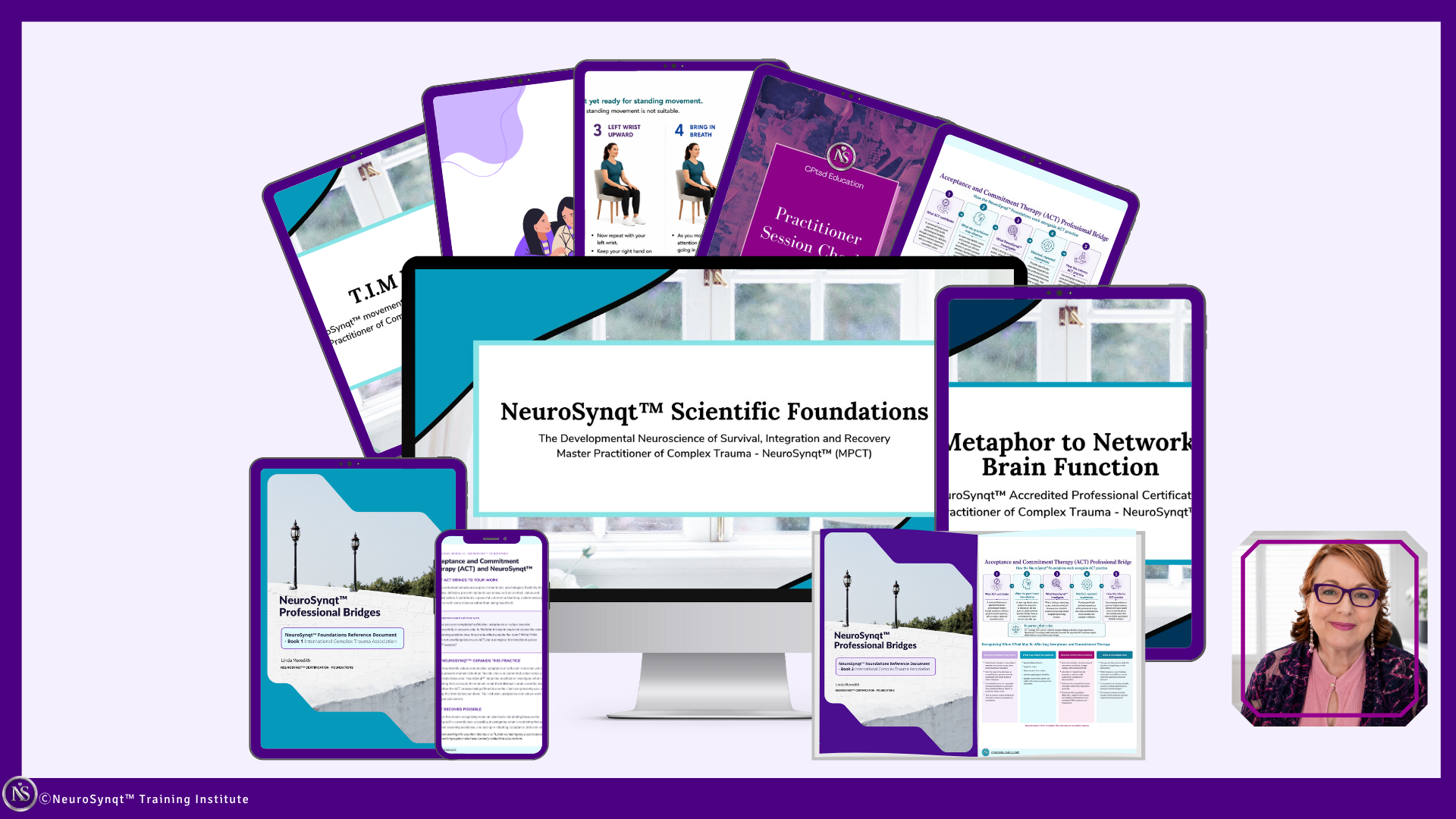
Six in-depth modules (Neuroscience, Recovery, Identity, Family Roles)

Extra CPtsd Information

8 Units of extra Complex Trauma information

Homework Canva Templates

Homework books, canva templates for clients ~ apply your own brand

Client Materials

9 Units of client materials for coaches. Professional infographics, diagrams, and client handouts.

Business Development

11 Business Units to help develop your coaching business

Extra Coaching Tools

7 Units of coaching tools. Lifetime access to all course updates and materials
Free Canva Course - Canva is used to complete Portfolio material (We also use pdf's)

🧠 The NeuroSynqt™ Difference

Connecting the mind, soul, and body for seamless integration

Adults with Complex PTSD have lived in trauma states for so long that dissociation, fragmentation, and survival scripts feel normal. Many do not recognise they are dissociating until explicitly taught how to begin reconnection and how to recognise that the brain is the driver.

Most models (polyvagal, IFS, bottom-up somatics) assume regulation is the starting point. In reality:

  • Regulation is not an entry point.

  • Regulation is a byproduct of integration.


Most recovery models focus on either emotion or behaviour.
NeuroSynqt™ is a brain-based, experiential recovery modality that uses side door entry points. Regulation is not forced; it emerges naturally as a consequence of integration. NeuroSynqt™ recognises that trauma lives deeper - in the brain’s survival patterns and identity systems that form long before language.

Developed by Linda Meredith, a peer reviewed, certified complex trauma educator, counsellor and coach, this neuroscience-based approach helps clients reconnect before regulation.

Dr Dan Siegel


"Every form of self regulation we've been able to look at -

  • regulating attention
  • regulating emotional affect
  • regulating mood
  • regulating thought
  • regulating physiology
  • regulating relationships
  • regulating behaviour
all those terms come under the broad term "Self Regulation"

Every aspect of regulation we could explore depends on integration of the brain"

Why Being Trauma-Trained Changes Everything

Beyond trauma-informed into truly brain-based care

Trauma-informed language is compassionate.
Trauma-trained practice is transformative.

Being trauma-trained means understanding:

  • How narcissistic patterns entangle with CPtsd survival mechanisms

  • Why clients appear “functional” but remain in trauma loops

  • How to build relational safety that rewires identity, not just regulates emotion

When we work with trauma through the brain - not just behaviour - change lasts.


📊 Grounded in Science, Guided by Humanity

Bringing research and lived experience together

Recent studies show:

  • 🧩 Up to 80% of adults raised by narcissistic or emotionally unavailable parents show symptoms consistent with complex trauma

  • 🩺 1 in 3 mental health professionals report moderate to severe burnout (APA, 2024)

  • 🧠 Neuroscience confirms that trauma impacts perception, not just emotion — changing how clients interpret safety, power, and connection

This course bridges clinical research with experiential recovery, giving professionals language that resonates with both the data and the heart.


Trauma Informed vs Trauma Trained

Meet your instructor

Linda Meredith


Passionate, Innovative, and Dedicated to
Complex Trauma Recovery


An Advanced, Neuroscience-Based Approach for Mental Health Professionals

Linda Meredith is an accredited trainer, counsellor, and creator of the NeuroSynqt™ modality for CPtsd recovery. Known as a Professional Brain Untangler, Linda combines advanced neuroscience, lived experience, and years of client practice to develop trauma-trained education that’s both practical and deeply human.

Her work has been peer-reviewed and accredited by trauma specialists, ensuring every course is grounded in professional standards as well as real-world application.

👉 Want to know more about Linda’s background, qualifications, and journey? Read Linda’s full story here ➜
Write your awesome label here.

Real reviews. Real professionals. Real impact.

Write your awesome label here.

01 

"Linda Meredith is a powerhouse at making complex trauma understandable and accessible. Her program is flexible, practical, and deeply supportive — allowing me to go at my own pace and truly engage with the material. What stands out is how the homework helps me embody the knowledge, not just memorise it. It’s sparked real ah-ha moments about how to support my clients more effectively. Linda’s generosity shines through everything she creates — from beautiful workbooks to business tools that make it easier to succeed as a coach. It honestly feels like she’s in my corner 24/7. This program is exactly what I needed. Thank you, Linda — you’re a gift. "
Write your awesome label here.

02

"I don’t know if anyone else can resonate, but I’m so hungry for more critical information to better serve my coaching clients that I simply cannot get enough of the material Linda creates! The Complex Ptsd survivors around the world are so fortunate to have someone as amazing as Linda Meredith creating courses for helping professionals! The depth of the content and the support this course offers is PHENOMENAL! If you haven’t started taking the course and you are on the fence, I would HIGHLY recommend you take the leap and sign up

Thanks Linda for what you do!"
Write your awesome label here.

03

“Linda has a warm, caring attitude with a sense of humour to boot about the effects of CPtsd on someone. Her insight, videos, articles, and support have helped me over humps and I have seen the effect it has had on others too. Linda speaks not only through her education, but also from her own experience. She understands what brings about CPtsd and how to help you address that trauma in a caring, kind, compassionate, and sometimes firm fashion. I highly recommend her if you are looking to heal from trauma you’ve experienced or even if you’re looking to understand more about the impact of CPtsd. Be kind, be understanding, and do yourself a favour and learn from Linda’s materials!.”

📚 Explore Other Courses

🏆 Certification Pathway

The NeuroSynqt™ by Linda program offers some of the most practical and effective online education available in the complex trauma field. Rooted in neuroscience and trauma-trained practice, the program is designed specifically for professionals working with CPtsd and developmental trauma.

You can choose flexible pathways:

  • Individual Courses - like Core Unit 7, focusing deeply on identity repair
  • Full Certification - becoming a Master Practitioner of Complex Trauma Counselling, accredited globally and eligible for CEUs

This certification has been peer-reviewed and accredited by professionals in the trauma field, ensuring credibility and recognition worldwide.

Developed by Linda Meredith through years of study and application with both clients and her own recovery, the NeuroSynqt™ framework is a unique, brain-based approach that delivers results in real-world practice.

Become a Master Practitioner of Complex Trauma Coaching (accredited globally) 

Our Master Practitioner of Complex Trauma Coaching (MPCTC) course combines the latest research from neuroscience and psychology, with an experiential syllabus based on lived experience of CPtsd. The MPCTC course will provide you with: 

Globally Accredited

All courses and the NeuroSynqt™ Modality are internationally accredited — but not through checkbox memberships.

As a Pioneer Training Provider
with the International Institute for Complementary Therapists, Linda’s work was reviewed in depth by independent professionals.

Globally Accredited

Every course, workbook, and the entire NeuroSynqt™ framework underwent a thorough evaluation process — not just a fee-for-certification setup.

This means your qualification isn’t just recognised — it’s earned through standards that prioritise ethical practice, practitioner competency, and trauma-trained excellence.

 Knowledge 

Gives you the skills and confidence to work with people experiencing CPtsd, without having to refer clients on to external specialists 

Innovative 

Teaches you an innovative “side door” approach that provides rapid results, even for individuals who’ve been in therapy for years and made little progress 

Effective 

Helps with your own healing from childhood developmental trauma, so you can stay well while helping clients and growing your business 

 Comprehensive 

Gives you in-depth training in the use of a comprehensive system to provide authentic, time and cost effective recovery for adults experiencing complex trauma 

📚 Explore Other Courses

Created with