NeuroSynqt™ Courses

CPtsd: Trauma and The Conditioned Threat Series

Core 2 - Developmental threat conditioning and survival mode activation patterns in CPtsd.

Professional training in recognising conditioned threat activation and its clinical implications in adult CPtsd presentation.

For professionals working with adults impacted by childhood developmental trauma.

Core 2  - MPCT - NeuroSynqt™
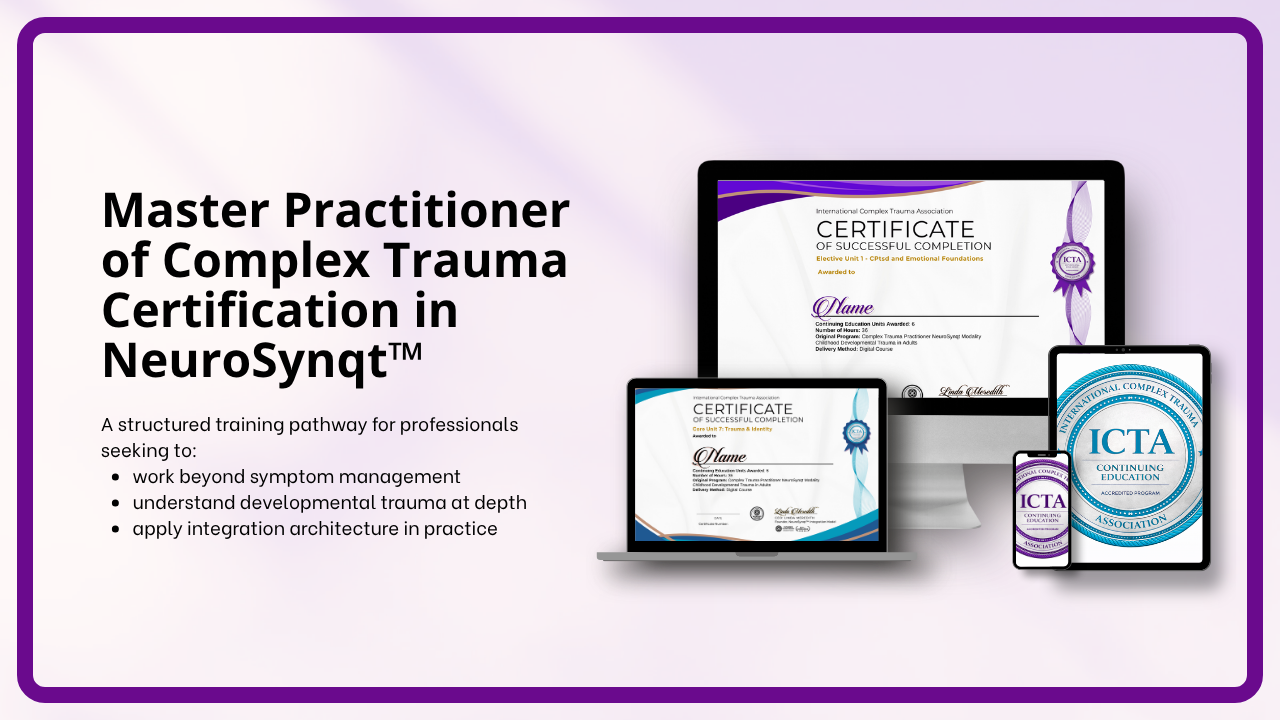
Accredited Professional Certification Pathway

Master Practitioner of Complex Trauma - NeuroSynqt™ (accredited globally) 

Certification is optional. CEU hours available for professionals.

In Brief: Short on time? This is the core of the 6 course sequence.
The full training, application and practitioner depth are unpacked throughout the page.

Core 2 Trauma and The Conditioned Threat Series

This Core establishes how survival mode becomes conditioned, persistent and organised - forming the basis for understanding why symptoms do not resolve through insight alone.

CPtsd: Trauma and The Conditioned Threat Series

Write your awesome label here.
  • Registered Training Provider & Accredited Trainer – Linda Meredith
  • Course Level: Advanced (Professional Training Only)
  • Flexible payment options available
  • On Demand digital delivery
  •  Time:18 hrs
 Portfolio: 1
 Exams: 1
 CEU: 6
Course overview

CPtsd: Trauma and The Conditioned Threat Series

The six courses within Core 2 examine what happens when fear remains organised long after the original threat has passed.

In practice, this often looks like adults who react as though danger is present even when life is stable. Sensory input becomes overwhelming or dull. Shutdown appears calm on the outside while activation runs underneath. Thinking becomes rigid under pressure. Relationships lose clarity. Identity feels unstable when stress increases.

Many practitioners are trained to work with thoughts, emotions and behaviour. Yet in developmental trauma, the issue is not simply what a person thinks or feels. It is how fear shaped organisation during development and continues to influence perception, cognition and relational response in adulthood.

You may recognise:

  • Clients who present as highly cognitive but collapse under relational strain
  • Strong insight that does not translate into behavioural change
  • Repeated conflict patterns despite good therapeutic work
  • Sensory overload that escalates emotional response
  • Emotional numbing that masks internal threat activation
  • Identity confusion that intensifies when expectations increase


Presentations often appear behavioural, motivational or personality based on the surface. Beneath that, there is conditioned fear and survival organised patterning shaped early in life.

These courses clarify how conditioned fear, sensory processing, cognitive rigidity and identity formation interact across adulthood. They provide a structured way to differentiate fear driven organisation from personality style and temporary activation from long standing survival patterning. They also clarify the difference between regulation in the moment and integration that holds under pressure.

This is not symptom management. 

It is developmental trauma education translated into practical application for professionals who want to work at the structural core of CPtsd and align their work with how recovery actually unfolds so their clients can experience more consistent and durable change.

When Fear Activation Remains Organised Around Survival Mode in Trauma Work

These courses are designed for practitioners seeking deeper clinical clarity in fear activation patterns, conditioned threat responses and integration capacity disruption in developmental trauma presentations.

In practice you may observe:

  • Insight increases yet the brain continues to re enter survival mode under stress.
  • Emotional processing improves yet conditioned fear responses persist without present threat.
  • Clients understand their trauma history yet internal alarm escalates rapidly during relational or environmental load.
  • Cognitive distortions intensify when activation rises despite therapeutic progress.
  • Rigid thinking patterns re emerge under pressure even when flexibility is demonstrated in session.
  • Adult Self access fluctuates when internal threat signalling overrides executive reasoning.
  • Cycles of activation repeat across contexts despite stabilisation and behavioural insight.

At this level of work, the challenge is rarely effort or commitment.
It is fear conditioning and integration capacity limits shaped by early developmental threat.

Much trauma education focuses on regulation strategies, symptom management and cognitive reframing. Less attention is given to how conditioned fear signalling persists when the brain remains organised around survival mode and how that disrupts cognition, perception and identity access even when insight is present.

Write your awesome label here.
When activation patterns remain organised around survival preservation, progress may appear inconsistent even when meaningful therapeutic work is occurring. These courses address that layer through developmentally aligned structural formulation of fear activation, gut mediated alarm amplification, cognitive distortion under stress, inflexible thinking patterns and Adult integration capacity.

Recognising Survival Mode Activation in Gut Brain, Cognition and Identity in CPtsd

When the brain is operating in survival mode in adulthood, presentation may include:
  • Persistent physiological unease without present threat
  • Rapid escalation of internal alarm states

  • Sensory overload or sensory blunting

  • Interoceptive misinterpretation

  • Fear activation without contextual trigger

  • Shutdown masking internal activation

  • Heightened threat scanning

  • Avoidance behaviours driven by internal activation

  • Difficulty consolidating fear extinction

  • Cycles of activation despite conscious intention


These patterns reflect survival brain conditioning shaped by early developmental threat. 
Core 2 focuses on mapping survival brain fear signalling within integration capacity limits.

Write your awesome label here.

Why Integration Specific Training Is Required in CPtsd

 Practice Reality

What practitioners already do well

  • Therapeutic relationship

  • Emotional processing

  • Stabilisation approaches

These competencies are essential.

What practitioners observe

  • Insight develops

  • Emotional awareness increases

  • Relational safety improves

Yet:

• The brain re enters survival mode under stress
• Internal alarm re escalates without present threat
• Cognitive distortions intensify
• Rigid thinking replaces flexibility
• Gut driven fear responses override reasoning
• Adult Self access reduces during activation
• Identity cohesion fluctuates under load


Core 2 provides structural alignment for recognising when the brain is in survival mode and how that affects perception, thinking, relational organisation and identity within integration capacity limits.


 The Gap this Core Addresses

What this reflects

• Conditioned fear learning shaped by early developmental threat
• Relational shaping of neural organisation
• Disruption in integration pathways under activation
• Distorted perception when the brain is in survival mode
• Inflexible cognitive organisation under stress
• Reduced access to Adult Self structure
• Fluctuating integration capacity during activation


Why this matter

Without integration specific alignment, progress may stabilise while activation patterns persist. Understanding trauma does not automatically reorganise conditioned fear responses.

Cognitive insight does not guarantee structural flexibility.

Relational safety does not automatically restore integration capacity.

Core 2 clarifies how gut driven fear activation, cognitive distortion, inflexible thinking and identity disruption interact within developmental trauma presentations.

Integration and Clinical Scope

This strengthens practitioner clarity and confidence without replacing existing therapeutic approaches.

What Practitioners Recognise

• Insight does not automatically restore present day cognitive access
• Emotional processing does not consistently prevent the brain re entering survival mode
• Stabilisation does not resolve misinterpretation of internal or external cues
• Clients may understand their trauma and still experience internal fear activation
• Cognitive distortions intensify under activation
• Rigid thinking patterns replace flexible reasoning
• Identity cohesion fluctuates under internal or relational load
• Access to Adult Self organisation reduces during activation
• Attempts at change collapse despite conscious intention
• This does not indicate practitioner failure

What This Reflects

• Developmental disruption in integration pathways shaped by early threat
• Conditioned fear responses persisting into adulthood
• Gut brain amplification of internal alarm signals
• Distortion of perception when the brain is in survival mode
• Inflexible cognitive organisation under stress
• Reduced integration capacity during activation
• Reduced access to Adult Self organisation
• Identity development shaped by survival adaptation rather than stability


Awareness alone does not reorganise integration capacity.

This training provides the clinical clarity required to distinguish:

• Insight from integration

• Stabilisation from alignment
• Cognitive understanding from structural flexibility
• Symptom reduction from identity consolidation


This strengthens practitioner accuracy and sequencing without replacing existing therapeutic orientation.

What Makes the 6 Courses Impactful?

Core Unit 2 focuses on what practitioners repeatedly see in session but are rarely trained to organise clearly when the brain is in survival mode.

Across these six courses, you examine why clients can understand their trauma yet still react as though threat is current. You look at how rapid fear activation, gut driven alarm, cognitive distortion, inflexible thinking and inconsistent access to reasoning are shaped by early developmental threat rather than personality, motivation or resistance.

You’ll explore why insight does not automatically calm fear activation, why emotional processing does not prevent survival mode re entry and why stabilisation alone does not restore consistent executive access under stress.

The courses bring practical clarity to:

• Fear activation that persists without present danger
• Gut based alarm responses that escalate quickly
• Trigger patterns that repeat across different contexts
• Thinking patterns that become rigid under pressure
• State shifts that interrupt present day reasoning
• The distinction between short term regulation and integration capacity
• Why behaviour reverts under load despite therapeutic progress

The focus is usable. It helps you organise what you are already seeing in session and understand it through a developmental lens rather than a behavioural one.

This training addresses the fear conditioning gap often overlooked in standard trauma education. It translates neuroscience into practical formulation clarity you can apply immediately.


What This Training Changes in Practice

• Survival mode activation is no longer misread as resistance
• Insight is not overvalued when integration limits remain unassessed
• Exposure work is sequenced within capacity rather than prematurely
• Cognitive distortions are recognised as activation driven, not personality based
• Trigger activation is understood as access disruption, not content alone

With developmental formulation:

• Intervention sequencing becomes capacity aligned
• Fear activation is recognised early
• Thinking rigidity is contextualised under load
• Technique is applied within integration limits
• Presentation is organised developmentally rather than behaviourally


Designed for Practitioners Working in the Complexity of Active Trauma Recovery

• Counsellors, psychologists and social workers seeking structured CPtsd training
• Allied health and pastoral care professionals supporting adults impacted by developmental trauma
• Educators and community leaders requiring applied neuroscience grounded trauma education
• Students and emerging practitioners building CPtsd specific clinical competence
• Practitioners working toward certification and continuing professional development


What NeuroSynqt™ Adds to Existing Practitioner Training

When insight, stabilisation and trauma processing do not result in structural integration.

What NeuroSynqt™ Adds

  • Practical clarity on conditioned threat responses in developmental trauma
  • Clear distinction between insight and integration

  • Capacity matched tools for change that holds under stress

  • A structured way to work with identity disruption and pattern repetition

  • Integration based application for real life contexts


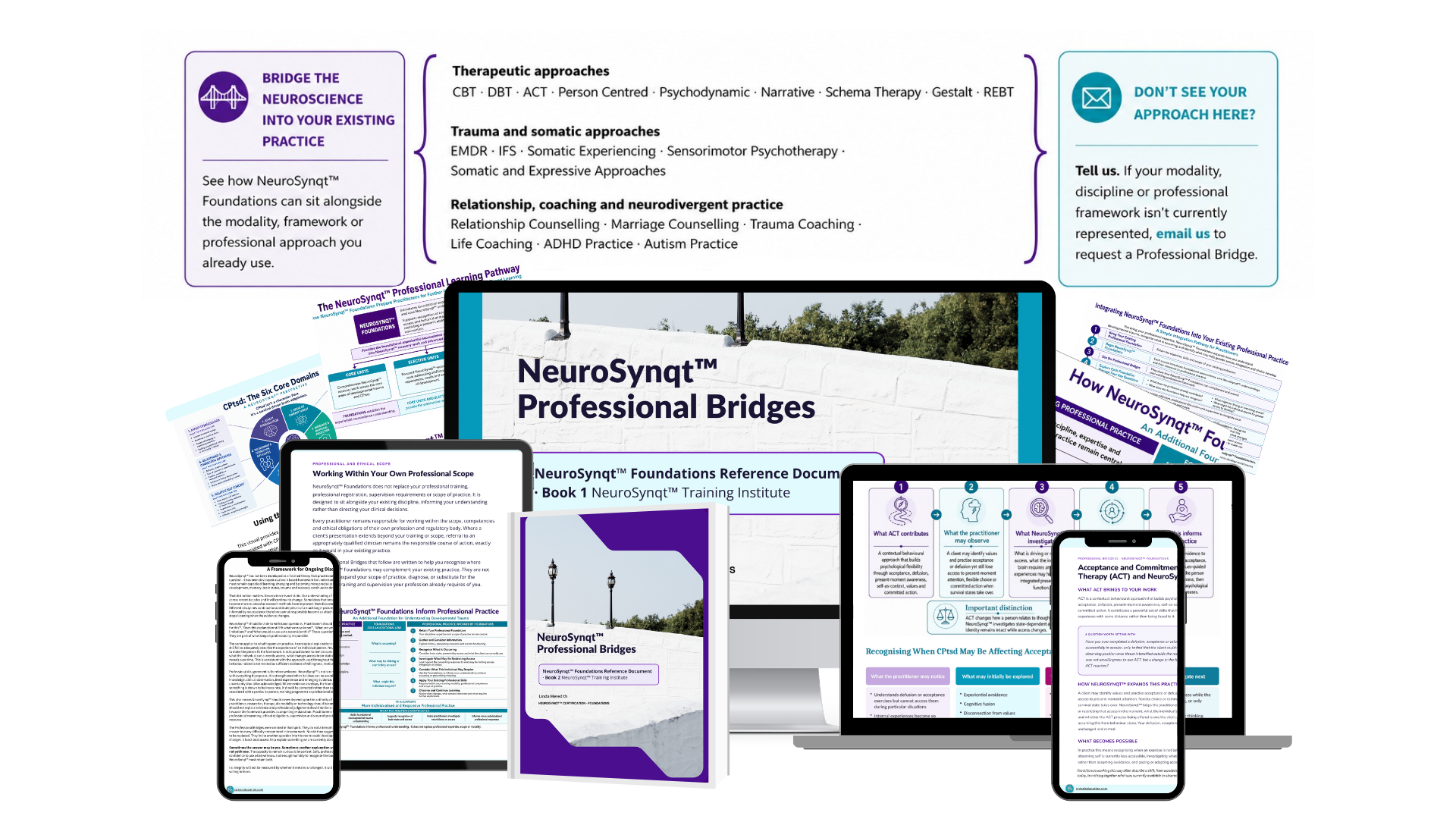
NeuroSynqt™ complements and strengthens existing therapeutic approaches by addressing integration gaps in developmental trauma presentations.

What NeuroSynqt™ Does Not Replace

  • Professional licensure
  • Stabilisation practices
  • Trauma processing modalities
  • Existing therapeutic orientation
  • Scope of practice requirements


NeuroSynqt™ is a neuroscience based integration model specifically designed for adults who experienced developmental trauma, not a standalone treatment modality.

Write your awesome label here.
NeuroSynqt™ training addresses the integration gap by introducing a structured, neuroscience aligned model designed specifically for developmental trauma presentations.

What Current Approaches Do Well

Many trauma approaches effectively support:

  • Emotional stabilisation

  • Relational safety

  • Trauma processing

  • Cognitive understanding

These are essential components of trauma informed practice.


What Individuals find can Still Persist

Practitioners frequently observe that:

  • Dissociative access disruption remains

  • Fragmentation re-emerges during activation

  • Present-day cognitive and relational access fluctuates

  • Insight does not consistently prevent shutdown

These patterns indicate a gap in integration-specific training and sequencing.

NeuroSynqt™ training addresses this gap by introducing a structured, neuroscience aligned model designed specifically for developmental trauma presentations.

Regulation and Integration in CPtsd

CPtsd reflects structural adaptation across developmental periods.
Sustainable recovery requires integration capacity alignment.

Developmental organisation formed under survival conditions may limit consistent access to cognition, motivation and relational engagement.
These limitations require structured sequencing rather than symptom focus alone.

What Regulation Addresses

  • Reduces immediate activation intensity

  • Supports short-term stabilisation

  • Increases tolerance for emotional arousal

  • Enhances situational safety


Regulation skills at a neurological level are a vital component of trauma trained CPtsd recovery work.

What Integration Addresses

  • Reorganises fragmented internal organisation
  • Restores consistent access across internal states
  • Supports identity coherence

  • Reduces state-dependent motivational collapse

Regulation alone does not restore integration capacity.

Regulation helps reduce distress. Integration helps change hold.

NeuroSynqt™ integration and professional billing

NeuroSynqt™ integrates within an existing professional role and scope of practice. It is not a standalone modality and is not practised or billed as a separate service.

For regulated professionals including psychologists and counsellors, NeuroSynqt™ functions as a neuroscience-based integration approach supporting assessment, formulation, psychoeducation and integration-aligned intervention.

Sessions remain billed under existing service codes and professional designations. NeuroSynqt™ informs how the work is structured and sequenced, not what is billed.

Where practitioners are eligible to bill private health or insurance providers, billing structures remain unchanged. NeuroSynqt™ does not alter diagnostic coding, insurer eligibility or licensing requirements.

For non-regulated practitioners operating in educational or professional support roles, NeuroSynqt™ must be represented strictly within the limits of that scope.

NeuroSynqt™ is always applied within an existing scope of practice and in accordance with local regulatory and professional requirements.

Write your awesome label here.

NeuroSynqt™ principles

NeuroSynqt™ recognises CPtsd as a developmental integration injury rather than a behavioural or diagnostic issue.

It approaches adult presentation through structural formulation, identifying survival-organised adaptations that influence access to cognition, motivation and relational engagement.

NeuroSynqt™ does not assume a single recovery pathway. It recognises that developmental trauma produces diverse patterns of organisation requiring individualised sequencing.

Principles are shared for orientation and conceptual clarity. Application, sequencing and clinical use are taught exclusively within accredited education and supervision.

Write your awesome label here.

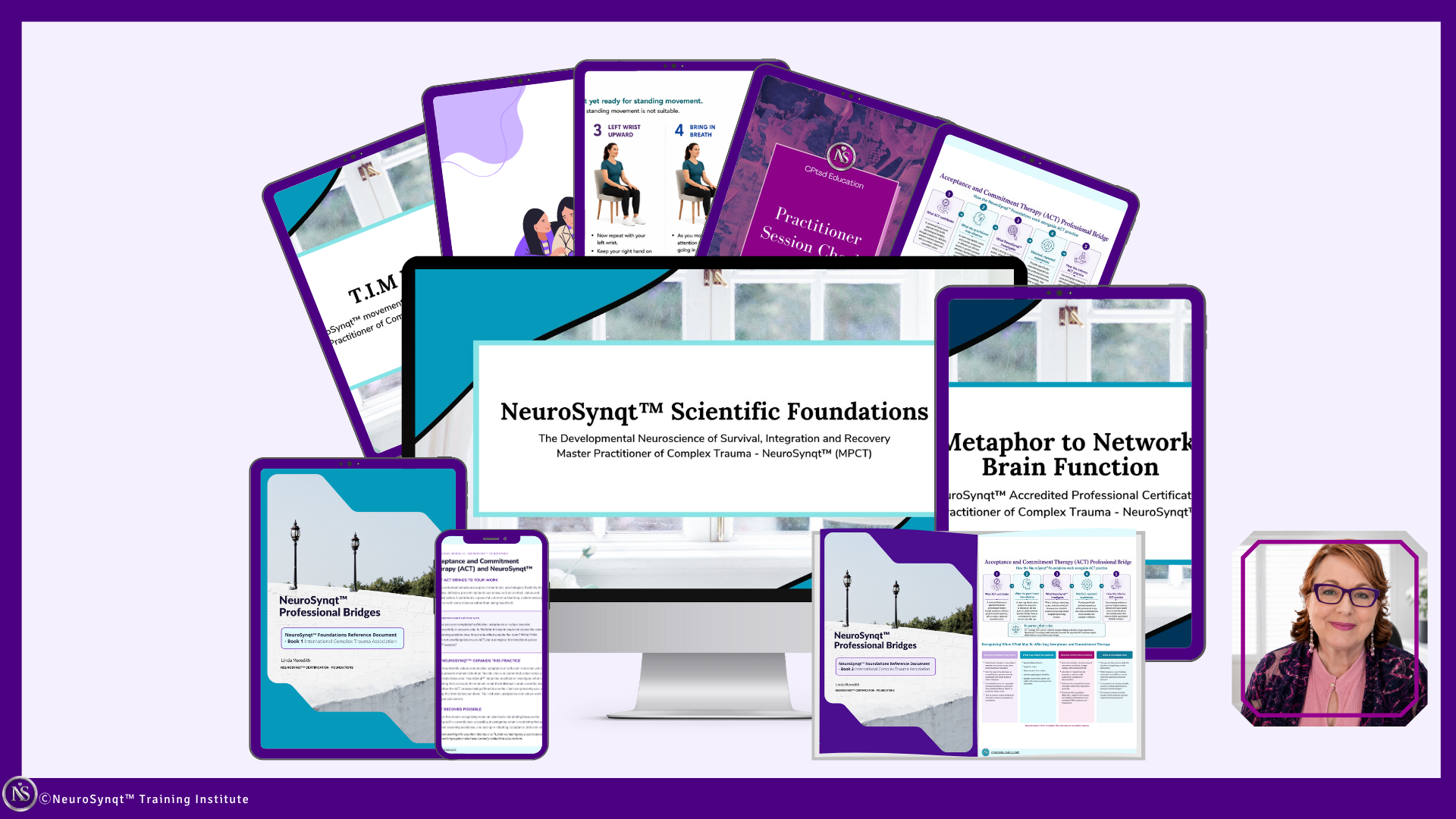
NeuroSynqt™ Core Courses

The Core Courses form a six unit professional training sequence in developmental trauma and integration capacity.

Each course addresses a specific domain of integration and is structured to be completed in sequence, as later courses build on earlier developmental foundations.

The series strengthens practitioner formulation in CPtsd by clarifying commonly overlooked integration gaps and supporting developmentally aligned clinical application.

Browse the courses for detailed information.
Write your awesome label here.

Course 1

Trauma & the gut brain

Course 2

Interpersonal Neurobiology

Course 3

Developing Questions for Clients

Course 4

Cognitive Distortions

Course 5

 Inflexible Thinking

Course 6

Course 6 - Developing a sense of self

Competency Outcomes:

Upon completion of Core 2 practitioners will be able to:

Competency is assessed through structured portfolio submission and formal examination.

✓ Identify survival mode driven fear signalling in adult CPtsd presentation

✓ Differentiate gut mediated activation from present day threat response

✓ Recognise patterns of persistent conditioned fear within developmental trauma formulation

✓ Explain interpersonal neurobiology principles relevant to relational and regulatory development

✓ Map relational shaping of neural organisation within Complex Trauma presentations

✓ Identify cognitive distortions maintained under survival brain dominance

✓ Differentiate inflexible thinking patterns from value based conviction

✓ Assess executive access fluctuation during activation states

✓ Construct developmentally aligned clinical questions that support integration without escalation


✓ Recognise reduced integration capacity during activation and adjust pacing accordingly

✓ Identify weakened identity structure linked to developmental trauma

✓ Differentiate adult self from trauma organised self states within formulation

✓ Integrate layered self development into structural trauma mapping

✓ Sequence intervention planning in alignment with integration capacity limitations

✓ Document integration related clinical indicators in scope consistent case notes

✓ Apply structural formulation principles across gut activation, cognition, identity and relational organisation

✓ Assess integration capacity prior to behavioural planning or cognitive restructuring

✓ Maintain professional scope clarity when addressing survival organised adaptation patterns


Become a Certified NeuroSynqt™ Practitioner
(accredited globally) 

Internationally Accredited. Structurally Assessed. Professionally Aligned.


Globally Accredited

NeuroSynqt™ integrates neuroscience, developmental trauma theory and structural formulation into a cohesive clinical framework for CPtsd recovery.

All NeuroSynqt™ courses and certification pathways are internationally accredited - not through checkbox memberships, but through formal review and independent evaluation.

As a Registered Training Provider with the International Institute for Complementary Therapists, the NeuroSynqt™ framework has undergone structured peer review by qualified professionals.

This means your qualification reflects:

• Evidence informed neuroscience integration
• Developmental trauma competency
• Structural case formulation accuracy
• Ethical and scope consistent practice
• Practitioner level clinical standards

What This Certification Represents

Accredited
Courses and certification pathways are formally reviewed and internationally recognised.

Competency Assessed
Qualification is earned through portfolio and assessment - not attendance alone.

NeuroSynqt™ Aligned
Training reflects structural integration principles specific to developmental trauma.

Practitioner Focused
Designed for counsellors, psychologists, allied health and trauma professionals working with adult CPtsd.

Clinically Grounded
Strengthens formulation accuracy, intervention sequencing and differentiation clarity.

Professionally Transferable
Supports ethical billing, scope integrity and structured case documentation.


Certification Pathway Available

The NeuroSynqt™ Certification pathway provides advanced training in developmental trauma integration, structured assessment and practitioner-level application.


Every course, workbook  and the entire NeuroSynqt™ framework underwent a thorough evaluation process - not just a fee for certification setup.

This means your qualification isn’t just recognised - it’s earned through standards that prioritise ethical practice, practitioner competency, and trauma-trained excellence.

Course 1 - Trauma & the gut brain foundations

Understanding gut mediated fear signalling and its role in survival mode activation
Course includes 25 slides

Completing this course will support competent practice in:

Recognising how survival mode activation influences gut brain signalling and understanding its impact on fear persistence in Complex Trauma presentations.

    1. Describe survival mode activation and its impact on brain body communication.
    2. Explain threat detection pathways and their relationship to gut based responses.

    3. Identify physiological fear signalling that persists beyond present threat.

    4. Recognise gut based activation as part of trauma response rather than personality or character.

    5. Differentiate cognitive awareness from ongoing survival driven activation.

    6. Understand chronic threat reinforcement and how it maintains fear signalling pathways.

    7. Recognise internal alarm patterns that continue without external danger.

    8. Map gut based activation within broader trauma formulation.

    9. Identify executive function reduction during survival brain dominance.

    10. Integrate gut based fear responses into clinical sequencing and formulation.

Course 2 - Interpersonal Neurobiology

Early relational experiences, brain development, regulation and identity formation
Course includes 32 slides

Completing this course will support competent practice in:

Recognising how relational experience influences neural development and contributes to regulation patterns in Complex Trauma presentations.

    1. Explain interpersonal neurobiology principles and their relevance to developmental trauma.

    2. Describe layered brain development including somatic sensory, limbic and cortical organisation.

    3. Identify how early attachment environments shape neural pathways.

    4. Recognise relational impact on emotional and behavioural regulation.

    5. Understand the connection between regulation capacity and relational safety.

    6. Differentiate developmental delay from behavioural resistance.

    7. Identify how dysregulation reflects neural organisation rather than character.

    8. Map relational experiences within structural trauma formulation.

    9. Recognise the role of co regulation in neural integration.

    10. Integrate interpersonal neurobiology concepts into assessment and clinical sequencing.

Course 3 - Developing Questions for Clients

Using structured questioning to support insight without overwhelming integration capacity
Course includes 18 slides

Completing this course will support competent practice in:

Constructing developmentally aligned questions that clarify activation patterns, cognitive distortions and identity confusion in Complex Trauma presentations.

    1. Differentiate content driven questioning from process oriented inquiry.
    2. Construct questions that slow down activation rather than intensify it.

    3. Identify when a client lacks sufficient integration capacity for deeper exploration.

    4. Use questions to clarify survival brain responses without reinforcing shame.

    5. Support clients to distinguish past based activation from present day context.

    6. Guide reflection toward internal experience rather than external blame.

    7. Recognise when questioning becomes cognitively overwhelming for the client.

    8. Sequence questions developmentally to build clarity rather than collapse.

    9. Use structured inquiry to uncover distorted perception without confrontation.

    10. Maintain therapeutic containment while facilitating client self discovery.

Course 4 - Cognitive Distortions

Working with distorted thinking in the context of prefrontal development and survival mode
Course includes 20 slides

Completing this course will support competent practice in:

Identifying cognitive distortions within Complex Trauma presentations 

    1. Define cognitive distortions and recognise common terminology including unhelpful thinking styles, catastrophic thinking and distorted thinking.

    2. Explore the origins of CBT and understand its impact in relation to CPtsd

    3. Recognising the Need for Cognitive Distortion work

    4. Prefrontal cortex development and its impact on behaviour

    5. Identify why CBT and TF-CBT do not work for Developmental Trauma

    6. The developmental impact of prefrontal cortex immaturity including reasoning, impulse control, planning, focus and personality development.

    7. Introduce cognitive restructuring appropriately with respect for developmental attachment disruption and prefrontal skill gaps.

    8. Use structured questioning to unpack distorted thinking to work with different aspects for adults with CPtsd.

    9. Integrate body awareness into cognitive work 
    10. Working with Narrative to assist recognising Cognitive Distortions 
  • Define the brain’s negativity bias and its evolutionary purpose in detecting threat and preserving safety.

  • Explain how trauma strengthens negativity pathways, reinforcing hyper-focus on risk and rejection.

  • Recognise the amygdala’s role in storing unprocessed threat memories and driving automatic emotional reactions.

  • Understand how positive memories fade faster, leaving survivors anchored in cycles of fear and self-doubt.

  • Identify automatic negative thoughts as brain-based habits rather than conscious belief systems.

  • Support clients to notice procedural memory patterns that replay survival responses without awareness.

  • Teach strategies to reframe negative bias, using attention redirection and micro-pattern rewiring.

  • Integrate reflective practices that engage the hippocampus to strengthen positive memory recall.

  • Help clients translate awareness into choice, recognising that awareness interrupts automatic reactivity.


Course 5 -Inflexible Thinking

Understanding rigid thinking patterns maintained by survival mode activation
Course includes 27 slides

Completing this course will support competent practice in:

Identifying and working with rigid cognitive patterns that persist under threat activation in Complex Trauma presentations.

    1. Define inflexible thinking within the context of developmental trauma.

    2. Identify black and white cognition as a survival driven pattern rather than personality trait.

    3. Recognise how fear activation narrows perception and limits cognitive flexibility.

    4. Differentiate protective rigidity from deliberate oppositional behaviour.

    5. Map rigid thinking patterns within broader trauma formulation.

    6. Identify when executive reasoning is reduced during activation states.

    7. Recognise repetitive thought loops that reinforce threat perception.

    8. Distinguish value driven conviction from fear based cognitive rigidity.

    9. Support gradual cognitive flexibility without forcing premature reframing.

    10. Integrate rigidity assessment into developmental sequencing and pacing.

Course 6 - Developing a sense of self

Reduced access to Adult Self organisation under survival activation

Course includes 22 slides

Completing this course will support competent practice in:

Recognising disrupted identity formation in Complex Trauma and supporting development of a stable sense of self.

    1. Define sense of self as the internal experience of “this is me” and “this is not me.”

    2. Identify adult indicators of weakened self structure including boundary difficulty, codependent tendencies, peer influence and chronic anxiety.

    3. Describe layered organisation of self development including somatic sensory, attachment, emotional regulation, behavioural regulation, self esteem, dissociation and cognitive problems.

    4. Differentiate emotions, feelings and felt sense and understand their distinct roles in self awareness.

    5. Explain interoception as perception of sensations from inside the body and its relevance to regulation.

    6. Recognise how Complex Trauma buries core self beneath adaptive survival roles.

    7. Distinguish adult self from trauma self using structured differentiation questions.

    8. Support identification of survival based identity patterns formed in family systems.

    9. Use journalling and structured reflection tools to increase internal awareness.

    10. Integrate adult self development into broader trauma formulation and sequencing.

Core 2 Curriculum

Join today

💻 Learning That Fits Real Life ➡️

Accessible. Practical. Designed for real world CPtsd practice.

Because true recovery requires integration, not just information.

Your course access includes:

  • 24/7 online learning that fits your daily rhythm

  • Immediate access to all six courses and course materials
  • Printable resources, client ready visuals, and worksheets
  • Experiential learning that supports integration through direct application of the framework.


Trauma trained education aligns practitioner learning with the same developmental processes that shape CPtsd recovery.

🌱 Weekly Supervision & Study Space


Comprehensive CPtsd Education

Professional CPtsd education specific to each clinical domain, neuroscience based 

Extra CPtsd Information

A collection containing 8 additional sections of Complex Trauma education

Homework Canva Templates

Homework books, canva templates for clients ~ apply your own brand

Client Materials

A structured collection containing 9 sections of CPtsd client materials

Business Development

A collection containing 11 sections supporting global practitioner business development

Extra Practitioner Tools

A collection of 7 Practitioner tools. Lifetime access to all course updates and materials

Free Canva Course - Canva is used to complete Portfolio material (We also use pdf's)

Course Specific Practitioner Resources

This program includes structured practitioner only and client facing materials aligned to developmental trauma formulation and integration capacity work.

Resources are designed to strengthen formulation accuracy, pacing decisions and real time integration capacity tracking within professional scope.

Materials support session structure and between session continuity. All resources are embedded within the certification aligned learning sequence and support structured application across developmental trauma presentations.

Write your awesome label here.

Why Regulation Is Not the Starting Point in CPtsd Work

Regulation is essential in trauma recovery. However regulation capacity develops within integrated brain organisation rather than as an isolated skill.

In developmental trauma, integrated organisation is disrupted. Strengthening regulation without addressing integration capacity may reduce distress while leaving identity access and cognitive consistency unstable.

In CPtsd work, integration alignment precedes sustainable regulation.

Dr Dan Siegel

Every form of self regulation we’ve been able to examine
Regulating attention
• Regulating emotions or affect
• Regulating mood
• Regulating thought
• Regulating physiology
• Regulating relationships
• Regulating behaviour
Every aspect of regulation we could explore depends on integration of the brain.

Why Trauma Trained Practice Changes Clinical Accuracy

Beyond trauma informed language into developmentally aligned brain based practice

Trauma informed care improves awareness.
Trauma trained practice strengthens formulation precision.

Being trauma trained means understanding:

• How developmental threat shapes fear signalling and adult adaptation
• Why clients may present as high functioning yet remain structurally fragmented
• How integration capacity limits influence cognition, motivation and identity organisation
• Why stabilisation alone does not restore consistent access to adult self structure

When trauma is addressed at a brain based structural level rather than symptom level alone, clinical sequencing becomes clearer and practitioner decision making becomes more accurate.

Grounded in Research. Applied in Practice.

Bringing research and lived experience together

Current neuroscience and developmental research consistently show that:

• Early relational and environmental threat shapes long term fear signalling patterns
• Trauma impacts perception, cognition and identity organisation - not just emotion
• Professional burnout increases when structural formulation is unclear

This education integrates research with applied formulation, supporting practitioners to work with developmental trauma presentations using structural clarity rather than symptom management alone.

Linda Meredith

Passionate, Innovative, and Dedicated to

Complex Trauma Recovery


An Advanced, Neuroscience Based Approach for Mental Health Professionals

Linda Meredith is an accredited trainer, counsellor  and creator of the NeuroSynqt™ modality for CPtsd recovery. Known as a Professional Brain Untangler, Linda combines advanced neuroscience, lived experience  and years of client practice to develop trauma trained education that’s both practical and deeply human.

Her work has been peer reviewed and accredited by specialists with tertiary qualifications in the trauma field, ensuring every course is grounded in professional standards as well as real world application.

👉 Want to know more about Linda’s background, qualifications  and journey? Read Linda’s full story 
Write your awesome label here.

NeuroSynqt™ education is peer reviewed and delivered by a Registered Training Provider.

Write your awesome label here.

Real reviews. Real professionals. Real impact.

Write your awesome label here.

01 

"Linda Meredith is a powerhouse at making complex trauma understandable and accessible. Her program is flexible, practical, and deeply supportive — allowing me to go at my own pace and truly engage with the material. What stands out is how the homework helps me embody the knowledge, not just memorise it. It’s sparked real ah-ha moments about how to support my clients more effectively. Linda’s generosity shines through everything she creates — from beautiful workbooks to business tools that make it easier to succeed as a coach. It honestly feels like she’s in my corner 24/7. This program is exactly what I needed. Thank you, Linda — you’re a gift. "
Write your awesome label here.

02

"I don’t know if anyone else can resonate, but I’m so hungry for more critical information to better serve my coaching clients that I simply cannot get enough of the material Linda creates! The Complex Ptsd survivors around the world are so fortunate to have someone as amazing as Linda Meredith creating courses for helping professionals! The depth of the content and the support this course offers is PHENOMENAL! If you haven’t started taking the course and you are on the fence, I would HIGHLY recommend you take the leap and sign up

Thanks Linda for what you do!"
Write your awesome label here.

03

“Linda has a warm, caring attitude with a sense of humour to boot about the effects of CPtsd on someone. Her insight, videos, articles, and support have helped me over humps and I have seen the effect it has had on others too. Linda speaks not only through her education, but also from her own experience. She understands what brings about CPtsd and how to help you address that trauma in a caring, kind, compassionate, and sometimes firm fashion. I highly recommend her if you are looking to heal from trauma you’ve experienced or even if you’re looking to understand more about the impact of CPtsd. Be kind, be understanding, and do yourself a favour and learn from Linda’s materials!.”

📚 Explore Other Courses

🏆 Certification Pathway

The NeuroSynqt™ program provides practical, applied online education in the complex trauma field for qualified practitioners working with adults impacted by developmental trauma CPtsd.

Professionals may engage through flexible pathways:

Individual Core Units focused on specific clinical domains
Full Certification leading to recognition as Master Practitioner of Complex Trauma – NeuroSynqt™ MPCT NeuroSynqt, with CEUs available

The certification pathway has been peer reviewed and accredited by professionals with tertiary qualifications in the trauma field, supporting professional credibility and recognition.

NeuroSynqt™ courses are designed for qualified practitioners practising within their existing professional scope. Completion of individual Core Units contributes toward certification requirements but does not constitute certification independently.

Developed through extensive study, applied practice and lived clinical experience, NeuroSynqt™ provides a neuroscience based, clinically grounded framework supporting assessment clarity, structured formulation and integration aligned application in professional practice.

Created with