Jul 6 • Linda Meredith

Why Do I Understand My Trauma and Still React the Same Way?

Key Takeaways

  • Insight can reduce shame, but it doesn't necessarily change how the brain organises itself around survival.

  • A more useful question is whether your involuntary responses under pressure are measurably changing over time

  • You might notice your brain still organises itself the same way whenever life becomes difficult

When understanding alone doesn't stop the brain reorganising around survival

You notice the trigger in real time, you can name it, and you can even explain where it came from. But your reaction still shows up before you feel like you had a choice, like your body hit a panic button while your mind was still loading.


A common pattern is being able to explain exactly what triggered you while your automatic response still unfolds before you can change it. By the end of this section, you will know what to track in the moment, and why those markers matter more than having the perfect explanation.

Why understanding and lasting brain change are not the same process
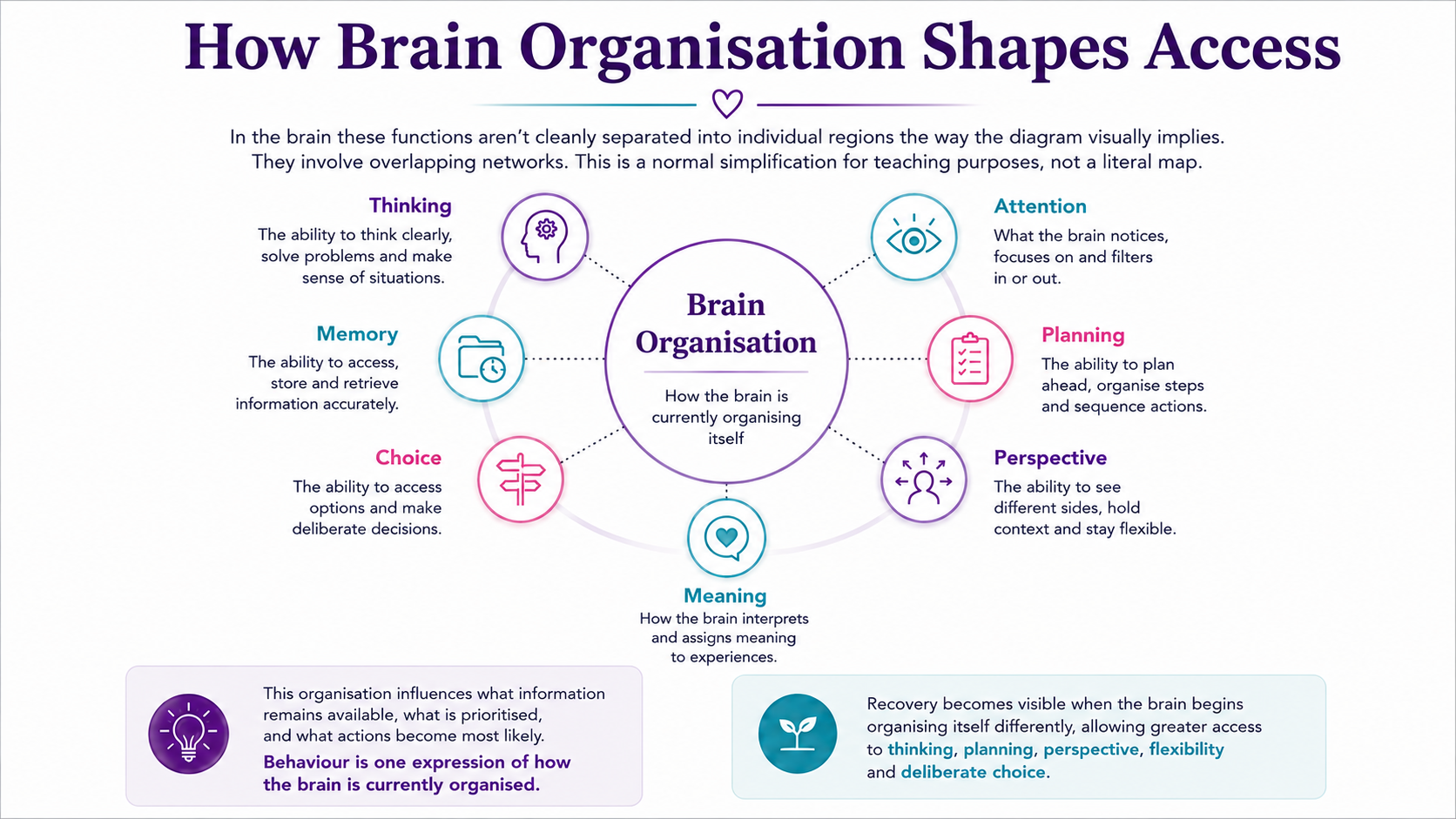
Next, here’s the key idea: understanding the past does not automatically change how your brain organizes itself in the present. Insight is mostly about meaning making, while Lasting brain change becomes visible through different access to thinking, planning, perspective, flexibility and choice when demands increase.


Here’s the catch: when life gets more demanding, the brain tends to shift into survival modes faster and more completely. So the most useful question is not only whether you understand what happened, but whether what your brain does involuntarily has started to change.

The question that changes recovery

Most people ask:

  • Do I understand my trauma

A more useful clinical question may be:

  • Is my brain maintaining different access when life becomes more demanding


In practice, you can observe this without needing a perfect memory or a perfect narrative. Watch what stays available when you are tired, rushed, criticized, or dealing with conflict, like a hard meeting at 3 pm, a sick kid at 2 am, or a deadline that moved up by 24 hours.

What you can actually observe when access begins to change

Also, instead of tracking only what you felt, track what you could access in that moment:

  • Thinking clearly

  • Holding perspective

  • Planning ahead

  • Flexible thinking

  • Deliberate choice

  • Present-day information

    Recovery becomes visible when these remain available for longer than they previously did, even by 10 to 30 seconds at first, and when they return sooner after a surge.

Five signs understanding hasn’t yet become lasting brain change

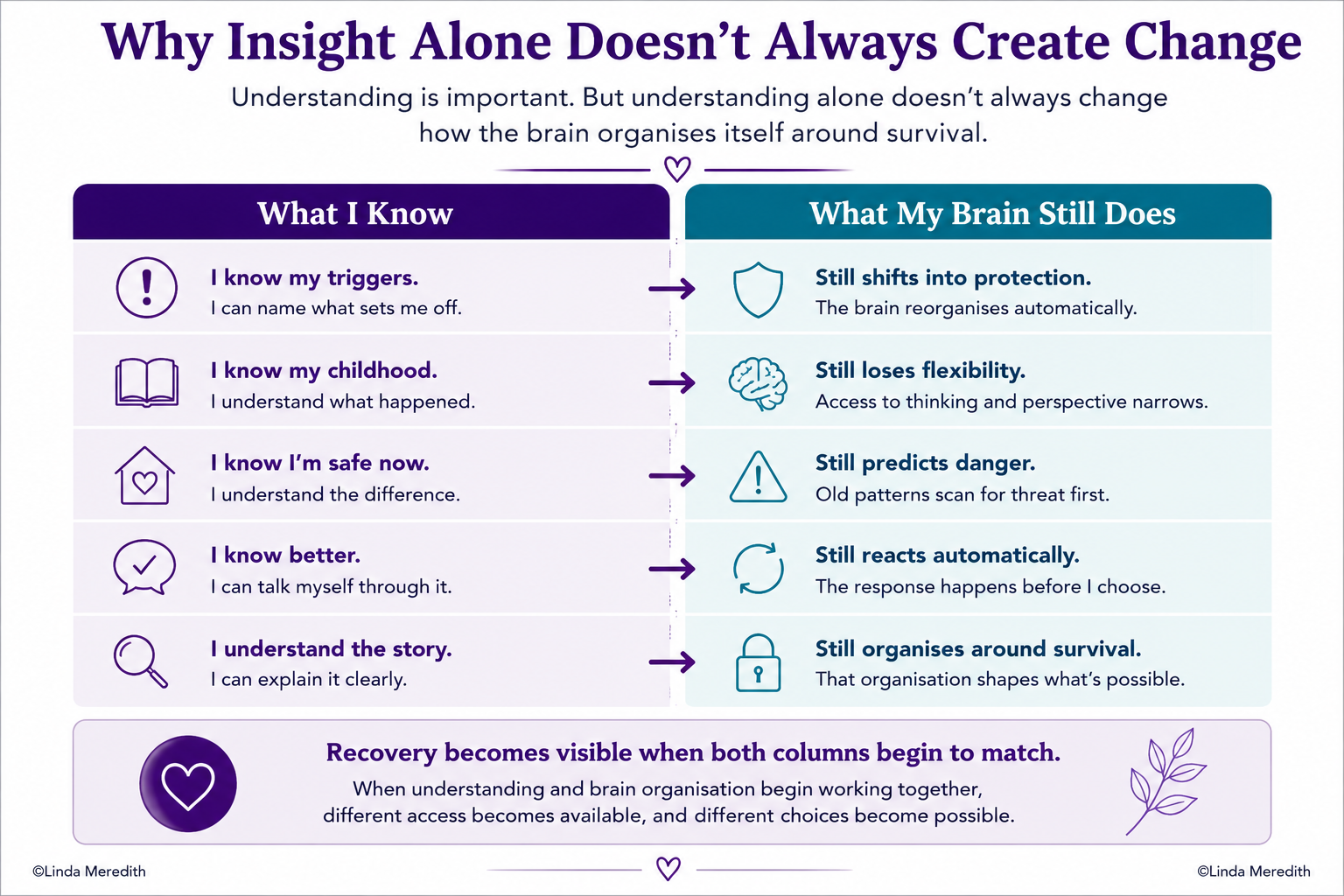
That said, many adults with C-PTSD notice they can do all the insight pieces:

  • Explain exactly why they reacted

  • Recognize the trigger immediately

  • Describe their childhood accurately

  • Predict what they are about to do

  • Understand the psychology behind it

But the brain still shifts into the same protective organization, such as going blank in a conversation, becoming rigid and controlling, people-pleasing on autopilot, or snapping and then feeling confused about how fast it happened.

What to notice instead of “Did I understand it?”

So instead of asking, “Did I understand what happened?”, begin noticing:

  • Did I retain access for longer

  • Did I recover access sooner

  • Did I have more choices available

  • Did I notice the shift earlier

  • Was my brain able to stay organized in ways it couldn’t six months ago

[An image about a white checklist titled "What Changed This Time?" with five checkbox items: "I noticed the shift earlier", "I maintained access for longer", "I recovered more quickly", "I had more choices available", "I returned to Present-Day Self sooner". Minimal clinical design, black text, lots of white space]

Recovery is measured differently

Next, recovery is not simply gaining more insight. It is seeing gradual changes in what your brain is able to access when life becomes difficult.

Rather than asking, “Do I understand my trauma?”, begin asking, “What was my brain able to do today that it couldn’t do six months ago?” Even small changes in access, flexibility, recovery time, and present-day awareness can be meaningful progress.

Choose your One Next Step

References

Felitti, V. J., Anda, R. F., Nordenberg, D., Williamson, D. F., Spitz, A. M., Edwards, V., Koss, M. P., & Marks, J. S. (1998). Relationship of childhood abuse and household dysfunction to many of the leading causes of death in adults: The Adverse Childhood Experiences (ACE) Study. American Journal of Preventive Medicine, 14(4), 245–258. https://doi.org/10.1016/S0749-3797(98)00017-8

Shonkoff, J. P., Boyce, W. T., & McEwen, B. S. (2009). Neuroscience, Molecular Biology, and the Childhood Roots of Health Disparities. JAMA, 301(21), 2252–2259. https://doi.org/10.1001/jama.2009.754

Diamond, A. (2013). Executive Functions. Annual Review of Psychology, 64, 135–168. https://doi.org/10.1146/annurev-psych-113011-143750

Clark, A. (2013). Whatever Next? Predictive Brains, Situated Agents, and the Future of Cognitive Science. Behavioral and Brain Sciences, 36(3), 181–204. https://doi.org/10.1017/S0140525X12000477

Kolb, B., & Gibb, R. (2014). Searching for the Principles of Brain Plasticity and Behaviour. Cortex, 58, 251–260. https://doi.org/10.1016/j.cortex.2013.11.012

van der Kolk, B. A. (1994). The Body Keeps the Score: Memory and the Evolving Psychobiology of Posttraumatic Stress. Harvard Review of Psychiatry, 1(5), 253–265.

 https://doi.org/10.3109/10673229409017088

van der Kolk, B. A. (2005). Developmental Trauma Disorder: Toward a Rational Diagnosis for Children with Complex Trauma Histories. Psychiatric Annals, 35(5), 401–408.


Write your awesome label here.
Testimonials

Some feedback from our students

We are dedicated to empowering you with knowledge, skills, and confidence to provide immediate answers to your clients.

“Interesting courses”

The course was the right mix of technical and non-technical elements. The course was also interesting, as I learned a lot about complex trauma and how this would apply for individual clients in the real world. Linda Meredith did a good job of communicating and making it easier to work with my  clients with CPtsd.
Paula w.

“I improved my knowledge”

The course taught me in a very friendly and engaging way. The course material was really helpful in preparing my skills and knowledge needed in the real world. It was well structured and the content was interesting and relevant. The materials were excellent, the mentoring approach was excellent and the free supervision helped me get my business off the ground.
Gina F.

“Easy to understand”

The courses are taught by Linda Meredith who is highly experienced and knowledgeable. Linda clearly understands the importance of working with clients with complex trauma and takes the time to ensure you understand the information in a way that is easy to grasp and use with clients. 
Lisa A.

Linda Meredith

Passionate, Innovative, and Dedicated to

Complex Trauma Recovery


An Advanced, Neuroscience Based Approach for Mental Health Professionals

Linda Meredith is an accredited trainer, counsellor  and creator of the NeuroSynqt™ modality for CPtsd recovery. Known as a Professional Brain Untangler, Linda combines advanced neuroscience, lived experience  and years of client practice to develop trauma trained education that’s both practical and deeply human.

Her work has been peer reviewed and accredited by specialists with tertiary qualifications in the trauma field, ensuring every course is grounded in professional standards as well as real world application.

👉 Want to know more about Linda’s background, qualifications  and journey? Read Linda’s full story 
Write your awesome label here.

NeuroSynqt™ education is peer reviewed and delivered by a Registered Training Provider.

Write your awesome label here.

Supporting integration that addresses intergenerational trauma at its source

By addressing developmental trauma at the level of organisation, NeuroSynqt™ supports:

  • more stable identity across contexts
  • improved relational capacity
  • consistent behavioural change
  • reduced reliance on coping cycles

This is where recovery becomes sustainable - not cyclical.


Stay connected:
Follow us on social media using the links below and sign up for our newsletter to receive special offers and updates on new content.
Thank you!
Created with