Why Adults with CPtsd May Not Recognise Medical Dismissal

Developmental trauma can drive self-doubt in appointments. Learn 5 CPtsd patterns and one next step to communicate clearly and advocate.
Jul 2 / Linda Meredith

Key Takeaways

  • Developmental trauma can train the brain to doubt itself first, especially in appointments where the clinician holds authority

  • Common appointment habits like over-apologising, minimising symptoms, or backing down fast can be survival adaptations, not personal weaknesses

  • With a bit of preparation, clearer communication, and support, you can ask for care that matches your needs

When you leave the appointment and blame yourself first
You rehearse your symptoms for days, maybe even write a short list in your notes app, and still walk out feeling confused. On the way home, you replay your words and tone, and the thought lands fast: I explained it wrong. I was too intense. I wasted their time.


Many GP appointments are scheduled for about 10 to 15 minutes, and that pace can make trauma patterns louder. When you are rushed, your nervous system may flip into freeze (your mind goes blank), fawn (you agree to keep things calm), or fight (you sound sharper than you meant), and then self-doubt follows as soon as you leave.


Here are a few CPtsd-linked patterns that can show up in a medical setting, without you noticing in the room:

  • Freeze: you forget key details like timing, pain level, or what you already tried

  • Fawn: you downplay symptoms, smile, or say “it’s fine” when it is not

  • Shame spiral: you assume you were the problem, even if you were polite and clear

  • Authority bias: their confidence feels more believable than your lived experience


Here’s why it can feel so convincing: when your brain senses threat, the part that handles clear thinking and sequencing can go less online, while the threat system takes over. In practice, that can look like losing your words at minute 6, nodding at a plan you do not understand, then feeling certain you failed the appointment.


If you do one thing, do this: name what happened without judging yourself. Right after the visit, write a quick 3-line debrief:

  • What I came in for (one sentence)

  • What was decided (tests, meds, follow-up, or “watch and wait”)

  • What I still need answered (one question)


If you are short on time, skip journaling and just record a 30-second voice note in the car park while it is fresh. A common mistake is trying to “be easy” by not asking for clarification; a small fix is to use one steady line next time: “I’m a bit overwhelmed and I want to make sure I understood. Can you repeat the plan and the next step?”

By the end of this section, you should be able to spot the pattern (freeze, fawn, shame), understand the brain-based reason it happens under time pressure, and choose one next step before your next appointment.

Why CPtsd can make you trust authority over your own body

Also, CPtsd can train your nervous system to treat authority as safety, even when your body is sending clear signals. With developmental trauma, the threat system may learn that approval, keeping the peace, and avoiding conflict matters more than accuracy. In a 10 minute appointment, that wiring can show up as automatic agreement, quick smiling, or saying “it’s probably nothing” before you have checked what you actually feel.


A common tradeoff is that this pattern can keep you safe in relationships where pushback used to lead to punishment or withdrawal, but it can fail you in healthcare where details matter. 


If you do one thing, do this: pause and run a fast internal check before you answer.


  • Where in my body do I feel this, and how strong is it from 0 to 10

  • What changed since last week, last month, or since I started the medication

  • What is the one sentence I want in my notes today


Next, early minimising, criticism, or emotional dismissal can condition self questioning before situational questioning. Instead of thinking “That explanation does not fit my symptoms,” you may think “I am overreacting” or “I am being difficult.” For example, a patient with chronic pelvic pain might downplay flare ups because a parent once called them “dramatic,” or a student with migraines may assume they just need better sleep because they were praised for being low maintenance.


Here’s the catch: once the self doubt starts, you can lose track of basic facts. A simple fix is to bring one external anchor so you do not have to rely on memory under stress.

  • A short symptom log with dates and 2 to 3 examples

  • Photos of visible changes (rash, swelling) with timestamps

  • A written list of 3 questions, with space to write the answers

How medical dismissal can be missed in the moment without blaming clinicians
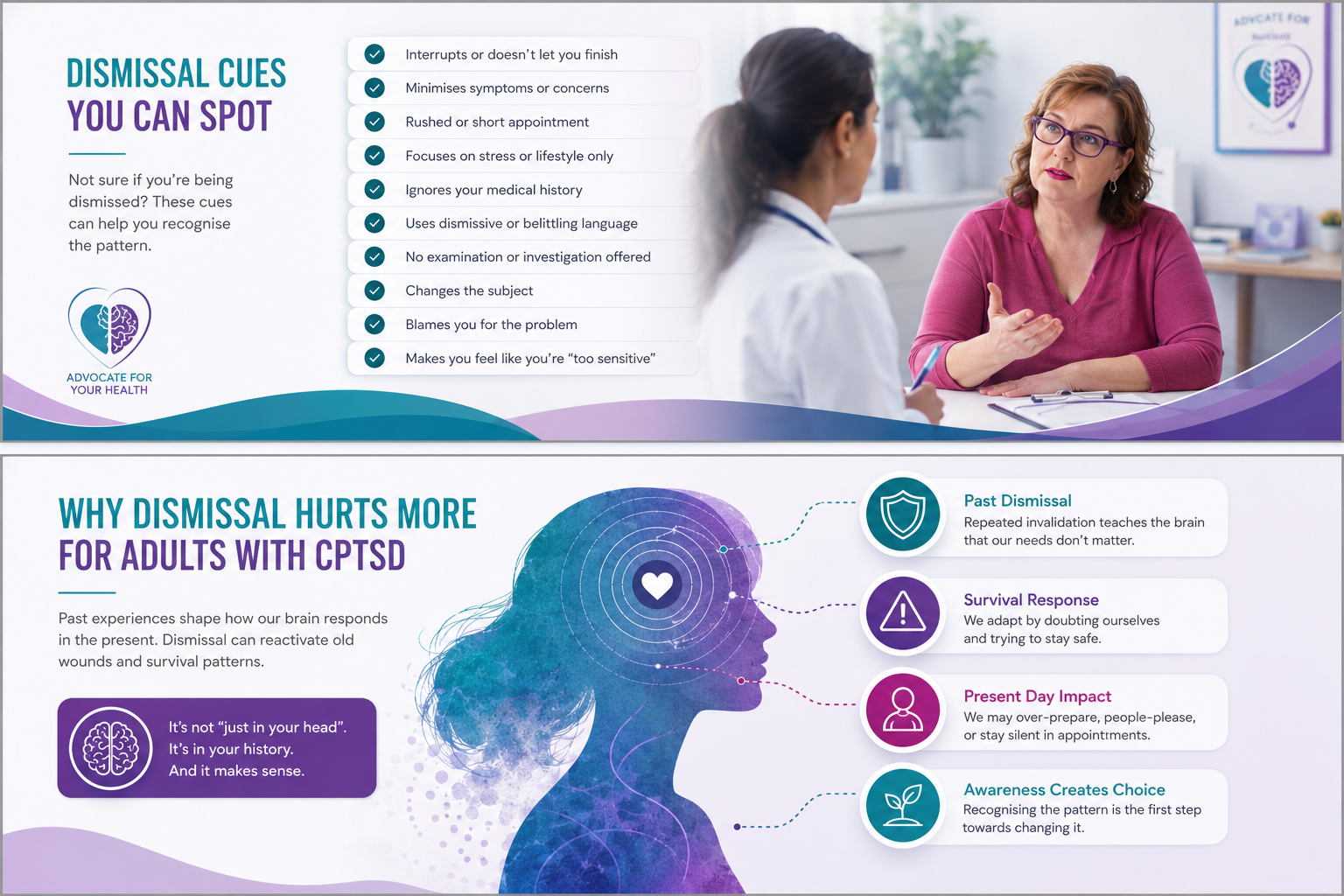
Next, it helps to name what this is and what it is not. Medical dismissal is often a system pattern, shaped by time pressure, uneven power, and whose pain is treated as “credible”, rather than proof that an individual clinician is a “bad person”. You can hold both truths at once: a clinician may be doing their best, and you may still leave without being heard, examined, or taken seriously.


That said, the moment it happens can be hard to clock because appointments are built around authority and speed. A standard slot might be 10 to 15 minutes, and that structure rewards quick summaries, clean timelines, and symptoms that fit familiar categories. If your experience is complex, long-running, or tied to trauma, it can be easy for the room to steer away from nuance before you notice it happening.


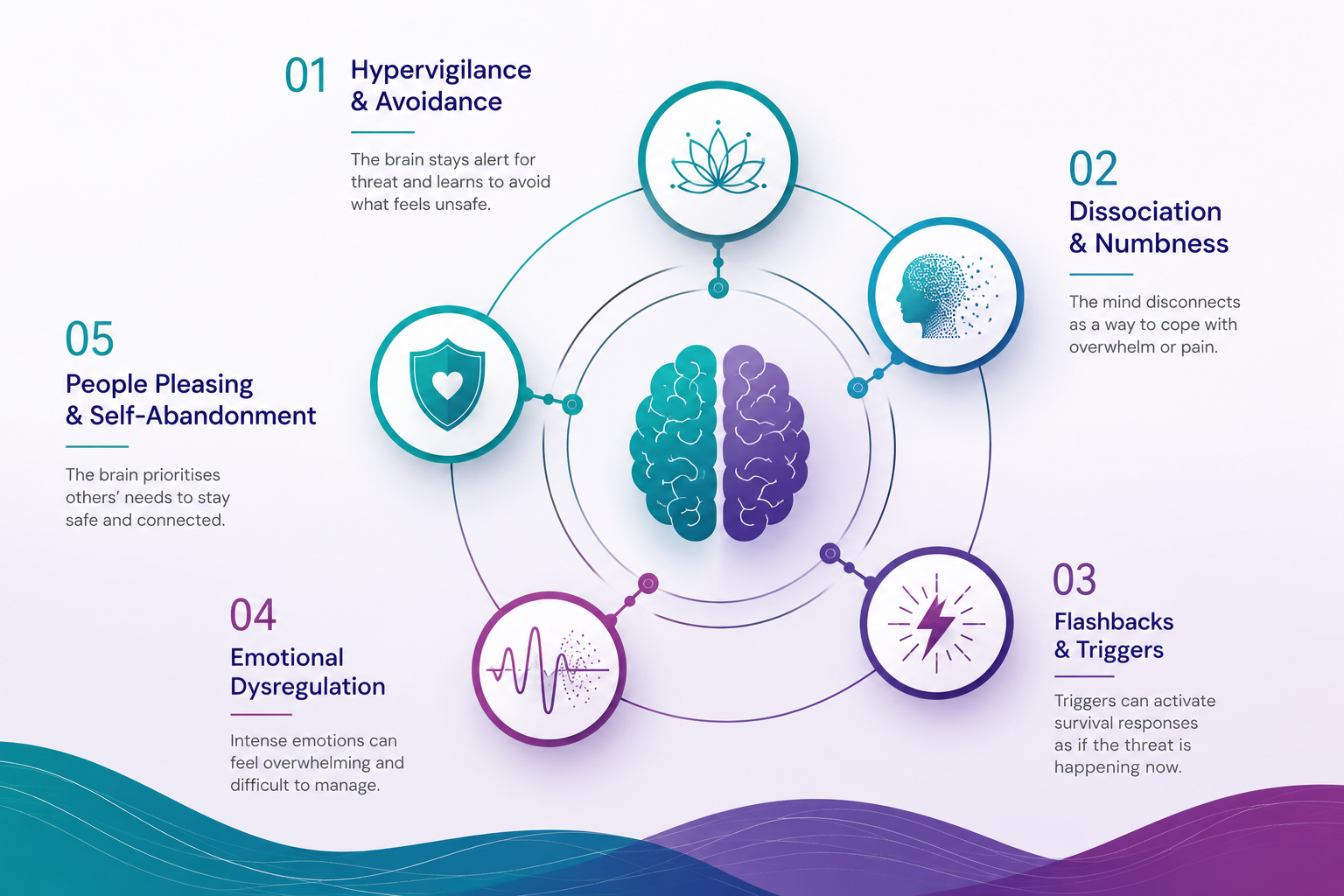
So if you have CPTSD, survival patterns can change what you can access in real time during an appointment. “Survival patterns” here means automatic nervous system responses that once kept you safe, like fawning (pleasing to reduce conflict), freezing (going blank), or shutting down (feeling far away). They are not character flaws, but they can shape how you speak, what you remember, and whether you feel allowed to disagree.


Here are a few common in-the-moment effects that can make dismissal easy to miss, even when something important was skipped:

  • You agree quickly to end discomfort, then realise later that you did not consent to the plan you actually wanted

  • Your mind goes blank when asked an open question like “So what brings you in”, and you forget key symptoms until you get home

  • You minimise automatically by saying “It’s probably nothing” or “I don’t want to be dramatic”, even if the pain is daily

  • You feel shame when you cry, go quiet, or dissociate (feel unreal or far away), and then you stop giving details

  • You accept a vague reassurance like “Looks fine” without asking “What did you rule out” because your body reads questions as danger

  • You leave with a referral or prescription but no clear next step, timeline, or safety plan, and only notice the gap afterward


Here's the catch: these responses can also make the appointment look “fine” on the surface. You may sound calm, polite, and compliant while internally feeling panicked or numb, and the clinician may read that as resolution. This is why self-blame is so common afterward, because the mismatch between how you felt and how you appeared is real.


If you do one thing, do this: treat “I only realised later” as useful information, not a failure. The goal is not to perform the “perfect patient” in the room, but to build small supports that reduce the load on memory and assertiveness when your nervous system is doing its job.


Common mistake: trying to fix this by forcing yourself to be more forceful or rehearsed, then crashing into shame when you cannot. A more reliable fix is to lower the stakes in the moment with one concrete anchor, like a written symptom list, a single sentence you can read out loud, or asking for a brief pause to think before you answer.

The five common appointment patterns and what to try instead

Next are five patterns that often show up in medical appointments when your nervous system is trying to keep you safe.


Each one makes sense as a brain-based adaptation, but each one can also hide useful information from the clinician and leave you without the care plan you needed.

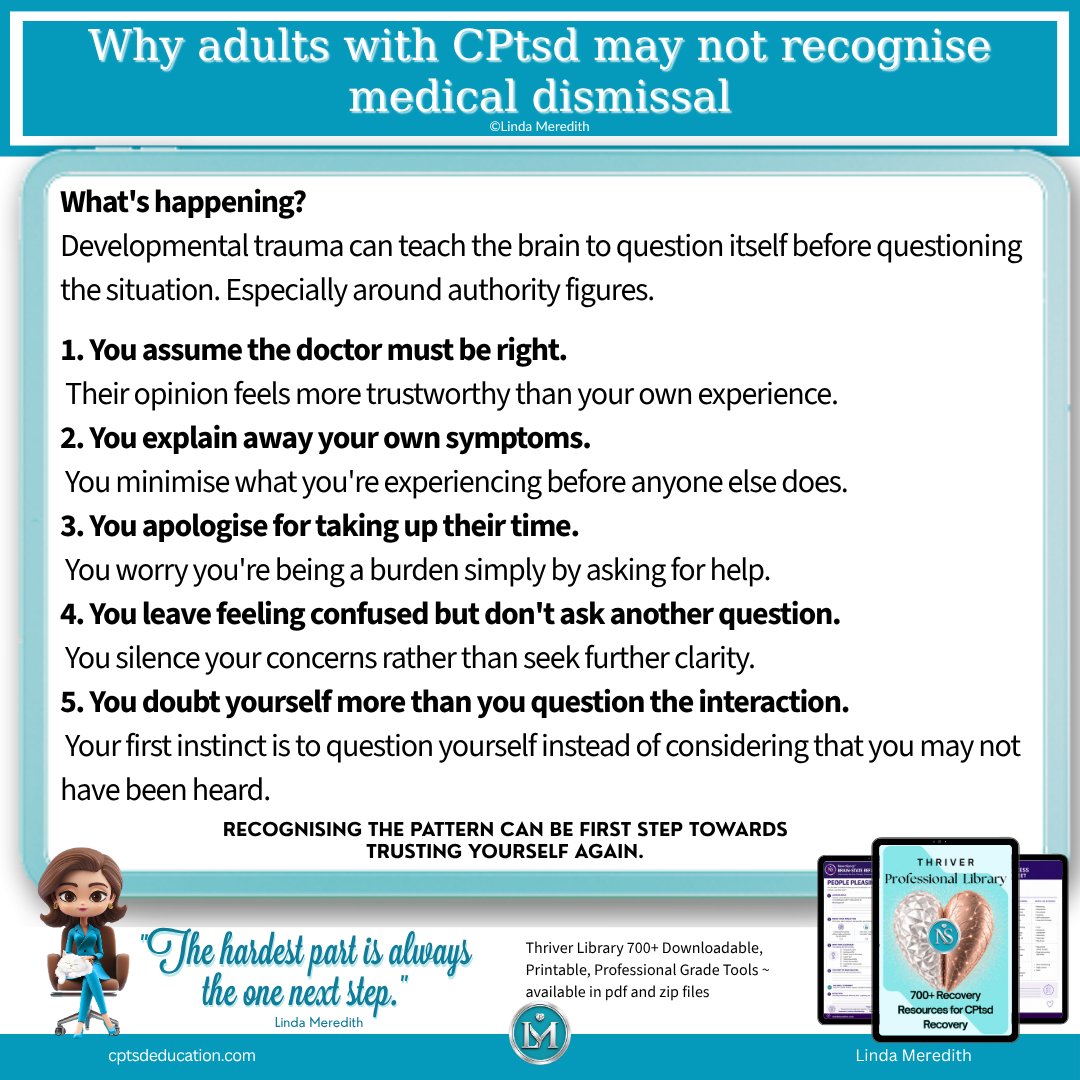
You assume the doctor must be right

Also, if you grew up needing to stay safe with authority, your threat system may push you to agree fast. This can look like fawning, going quiet, or choosing the answer that feels least risky, especially in a 10 to 15 minute appointment.

What it can look like

  • You say “That makes sense” even when you are unsure

  • You downplay doubts like “I’m probably overthinking it”

  • You accept a quick explanation and skip asking about other causes or options

What to try instead (one small shift)

  • Try a pause line: “Can I check I understand, and then ask one more question”

  • Ask for alternatives: “What else could this be, and how would we rule that out”

  • Ask for a time marker: “If it doesn’t improve in 2 weeks, what should I do next”

Gentle reflection question

  • If I trusted my body 10 percent more today, what one question would I ask

You explain away your own symptoms

Next, many people with CPtsd learned to minimise pain so they would not be judged, punished, or ignored. Your brain may default to a safer story like stress, lack of sleep, or “it’s not that bad,” even when daily function is changing.

What it can look like

  • You say “It’s just anxiety” before describing what you feel

  • You skip the impact (missed workdays, waking up at night, not driving, not eating)

  • You only share the mild version and leave out the worst days

What to try instead (facts first)

  • Use a simple structure: symptom, frequency, impact

  • Give one measurable detail: “It’s been 5 days a week for a month” or “I can’t stand longer than 10 minutes”

  • Name function changes: “I stopped exercising” or “I had to leave work early twice last week”

Gentle reflection question

  • What are the facts I know, separate from my fear of being too much

You apologise for taking up their time

But if your system expects annoyance or rejection, apologising can feel like a way to reduce the threat. The cost is that you rush, soften the story, or leave the main concern unsaid.

What it can look like

  • You open with “Sorry, I know you’re busy” or “This is probably nothing”

  • You tell the easy part and skip the concern that scares you most

  • You rush details and leave out timeline, severity, or what you already tried

What to try instead (a clear opening)

  • Start with one sentence: “I’m here because X is affecting my day to day life”

  • If there are two topics, name it: “I have two concerns, the main one is…”

  • If time is tight, prioritise: “If we only cover one thing today, I want it to be…”

Gentle reflection question

  • If my need for care was valid, what would I say first without apologising

You leave feeling confused but don’t ask another question

So when you are overwhelmed, your brain may shift into freeze or shutdown. You might nod along, lose track of details, or forget your questions, then walk out without a plan you can follow.

What it can look like

  • You nod but cannot repeat what the plan was 10 minutes later

  • You forget to ask about side effects, follow-up, or what to do if things worsen

  • You leave without knowing whether this is “watch and wait” or “we are testing”

What to try instead (one clarity check)

  • Ask for a one-sentence plan: “Can you say the next step in one sentence”

  • Ask for a contingency: “What should make me call sooner”

  • Ask for a recap: “Can I repeat it back to check I got it right”

Gentle reflection question

  • If clarity were one sentence, what would I need it to say

You doubt yourself more than you question the interaction

That said, after an appointment, CPtsd can pull you into rumination and self-blame. If care felt rushed or dismissive, your system may still decide the safest move is to disappear, delay follow-up, or convince yourself you imagined it.

What it can look like

  • You replay the conversation and criticise how you spoke

  • You wait weeks to book follow-up even as symptoms persist

  • You tell yourself “They would have said something if it mattered”

What to try instead (a basic standards check)

  • Write down what happened in 3 lines: what you reported, what they said, what the plan was

  • Compare the visit to simple standards: respect, being heard, a clear next step

  • If you are short on time, do one thing: schedule a follow-up or ask for clarification by message with 2 questions max

Gentle reflection question

  • If I judged this interaction by respect and clarity, what would I want to be different next time

One Next Step to try before your next appointment

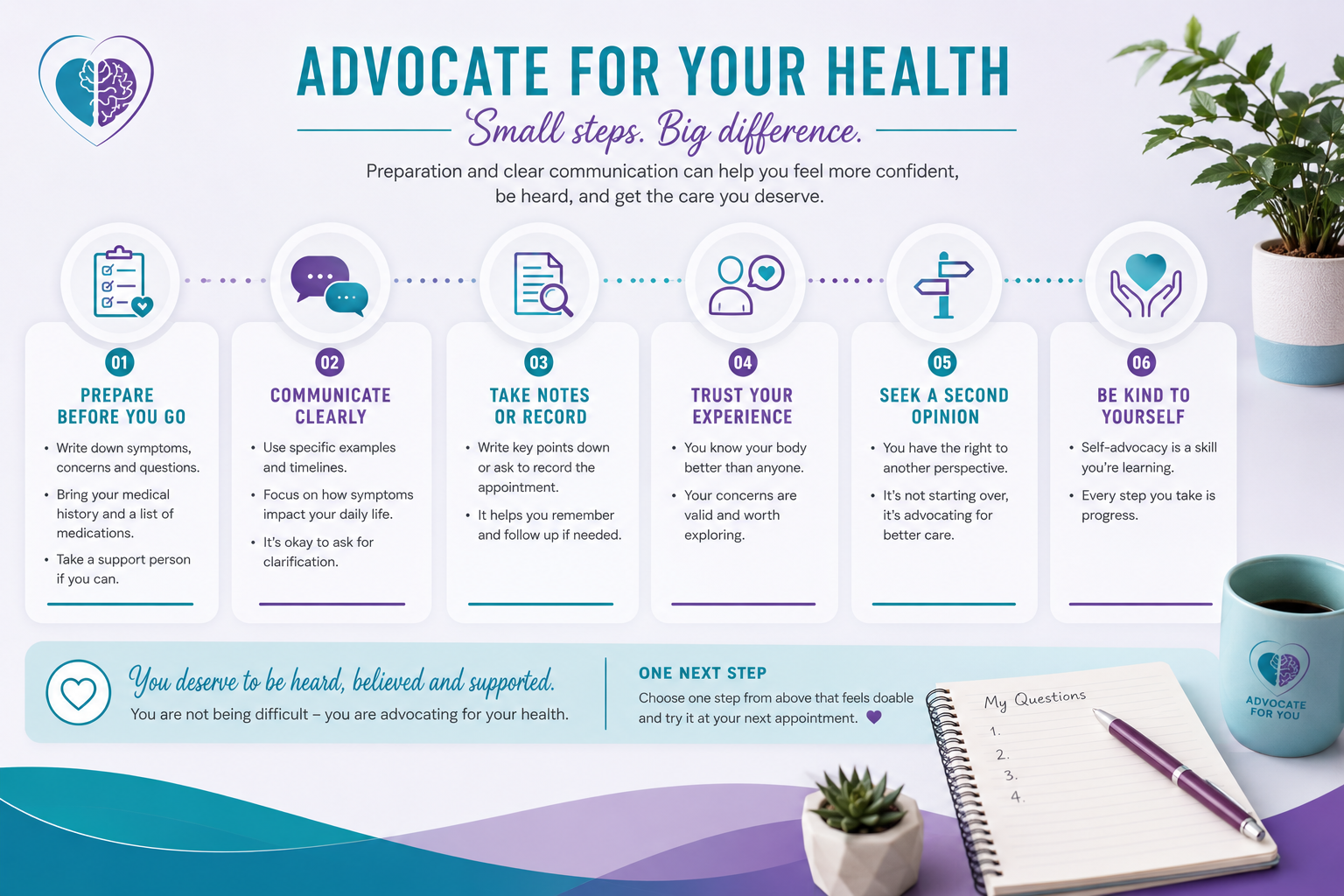
So before your next appointment, do one small bit of prep that makes it easier to speak even if you freeze in the room.

  • Pick one sentence that names your main concern and the impact, then say it out loud twice

    • Example: “I’ve had chest tightness for 3 weeks, and it’s stopping me from sleeping and working”

    • If you’re short on time, write it on a note in your phone and read it once out loud

  • Bring a short written list you can hand over or read from

    • Top 3 symptoms (keep each to 5 to 10 words)

    • Duration (when it started, and whether it’s getting worse, better, or unchanged)

    • Triggers (what makes it flare, and what helps)

    • What you need by the end of the visit (for example: tests, a referral, a medication change, or a clear plan for the next 2 weeks)

A common mistake is bringing a long history and hoping the clinician finds the point. Fix that by leading with your one sentence, then using the list as backup if you get interrupted or start doubting yourself.

Choose your One Next Step

References

  • American Psychiatric Association. (2022). Diagnostic and Statistical Manual of Mental Disorders (5th ed., text rev.; DSM-5-TR). American Psychiatric Publishing

  • Centers for Disease Control and Prevention. (2024). Preventing adverse childhood experiences (ACEs): Leveraging the best available evidence. CDC

  • Cloitre, M., Garvert, D. W., Weiss, B., Carlson, E. B., & Bryant, R. A. (2014). Distinguishing PTSD, complex PTSD, and borderline personality disorder: A latent class analysis. European Journal of Psychotraumatology, 5, 25097

  • Dueñas, J. L., et al. (2020). Gender bias in clinical practice guidelines: A systematic review. PLOS ONE, 15(9), e0239324

  • Elliott, A. M., Alexander, S. C., Mescher, C. A., Mohan, D., & Barnato, A. E. (2016). Differences in physicians’ verbal and nonverbal communication with black and white patients at the end of life. Journal of Pain and Symptom Management, 51(1), 1–8

  • International Society for Traumatic Stress Studies. (2019). Posttraumatic stress disorder prevention and treatment guidelines: Methodology and recommendations. ISTSS

  • Kirmayer, L. J., & Rai, S. (2017). Medical anthropology and the study of global mental health. Psychiatric Clinics of North America, 40(2), 315–330

  • National Institute for Health and Care Excellence. (2018, updated). Post-traumatic stress disorder: NICE guideline (NG116). NICE

  • Purtle, J. (2020). Systematic review of evaluations of trauma-informed organizational interventions that include staff trainings. Health Services Research, 55(S2), 459–475

  • Saitz, R., Larson, M. J., LaBelle, C., Richardson, J., & Samet, J. H. (2008). The case for chronic disease management for addiction. Journal of Addiction Medicine, 2(2), 55–65

  • Samuels, E. A., et al. (2018). “Sometimes you feel like the freak show”: A qualitative assessment of emergency care experiences among patients with chronic pain. Annals of Emergency Medicine, 72(5), 532–541

  • World Health Organization. (2021). Guidance on community mental health services: Promoting person-centred and rights-based approaches. WHO


  • Write your awesome label here.
    Testimonials

    Some feedback from our students

    We are dedicated to empowering you with knowledge, skills, and confidence to provide immediate answers to your clients.

    “Interesting courses”

    The course was the right mix of technical and non-technical elements. The course was also interesting, as I learned a lot about complex trauma and how this would apply for individual clients in the real world. Linda Meredith did a good job of communicating and making it easier to work with my  clients with CPtsd.
    Paula w.

    “I improved my knowledge”

    The course taught me in a very friendly and engaging way. The course material was really helpful in preparing my skills and knowledge needed in the real world. It was well structured and the content was interesting and relevant. The materials were excellent, the mentoring approach was excellent and the free supervision helped me get my business off the ground.
    Gina F.

    “Easy to understand”

    The courses are taught by Linda Meredith who is highly experienced and knowledgeable. Linda clearly understands the importance of working with clients with complex trauma and takes the time to ensure you understand the information in a way that is easy to grasp and use with clients. 
    Lisa A.

    Linda Meredith

    Passionate, Innovative, and Dedicated to

    Complex Trauma Recovery


    An Advanced, Neuroscience Based Approach for Mental Health Professionals

    Linda Meredith is an accredited trainer, counsellor  and creator of the NeuroSynqt™ modality for CPtsd recovery. Known as a Professional Brain Untangler, Linda combines advanced neuroscience, lived experience  and years of client practice to develop trauma trained education that’s both practical and deeply human.

    Her work has been peer reviewed and accredited by specialists with tertiary qualifications in the trauma field, ensuring every course is grounded in professional standards as well as real world application.

    👉 Want to know more about Linda’s background, qualifications  and journey? Read Linda’s full story 
    Write your awesome label here.

    NeuroSynqt™ education is peer reviewed and delivered by a Registered Training Provider.

    Write your awesome label here.

    Supporting integration that addresses intergenerational trauma at its source

    By addressing developmental trauma at the level of organisation, NeuroSynqt™ supports:

    • more stable identity across contexts
    • improved relational capacity
    • consistent behavioural change
    • reduced reliance on coping cycles

    This is where recovery becomes sustainable - not cyclical.


    Stay connected:
    Follow us on social media using the links below and sign up for our newsletter to receive special offers and updates on new content.
    Thank you!
    Created with