Key Takeaways
When Your Pain Becomes the Conversation Instead of the Behaviour
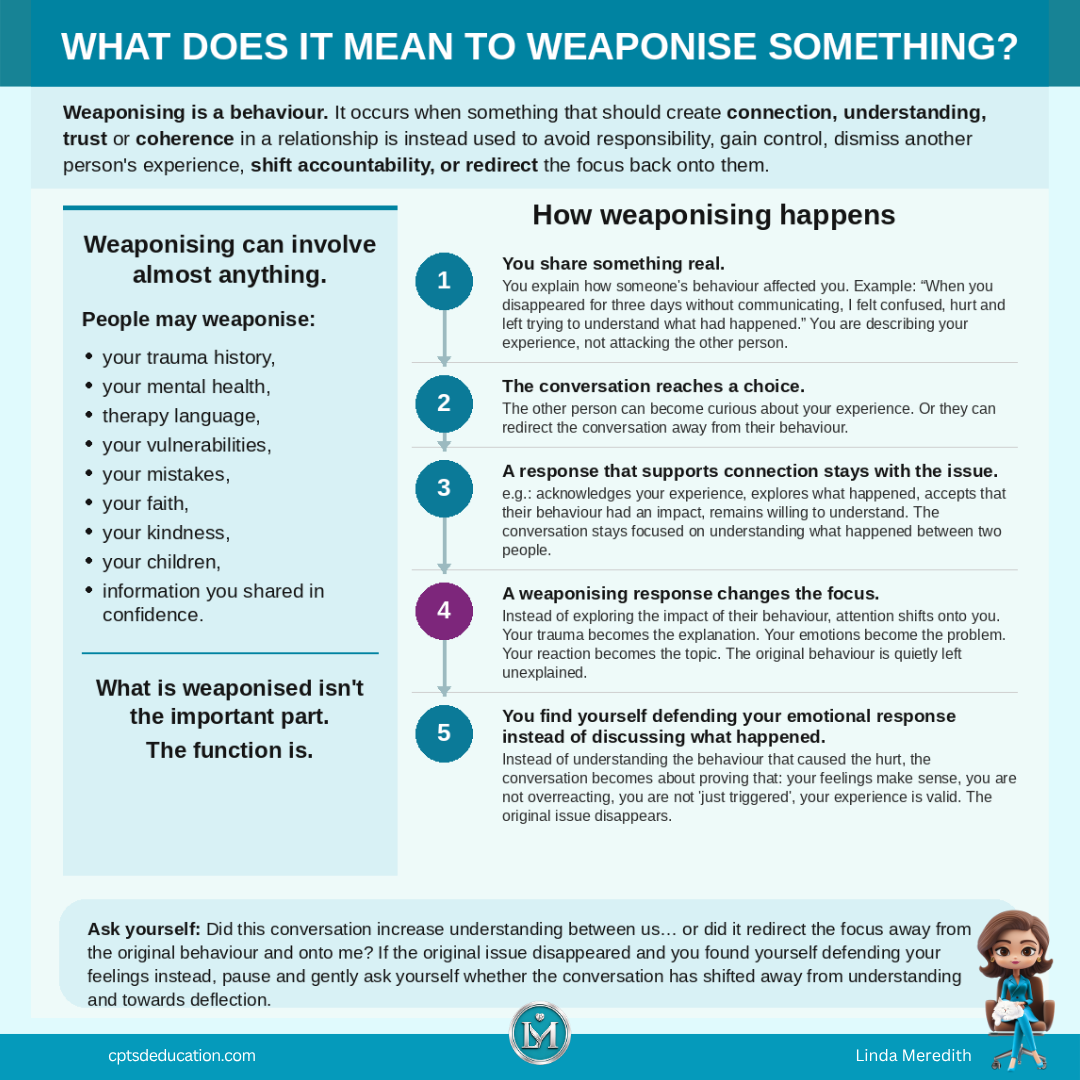
What Does Weaponising Actually Mean?
The five-step pattern that turns a repair conversation into a defence case
Step 1: Map the sequence so you can spot it early
Step 2: Call out the pivot when the issue disappears
When this pattern works to connect, and when it fails
How to respond without abandoning yourself
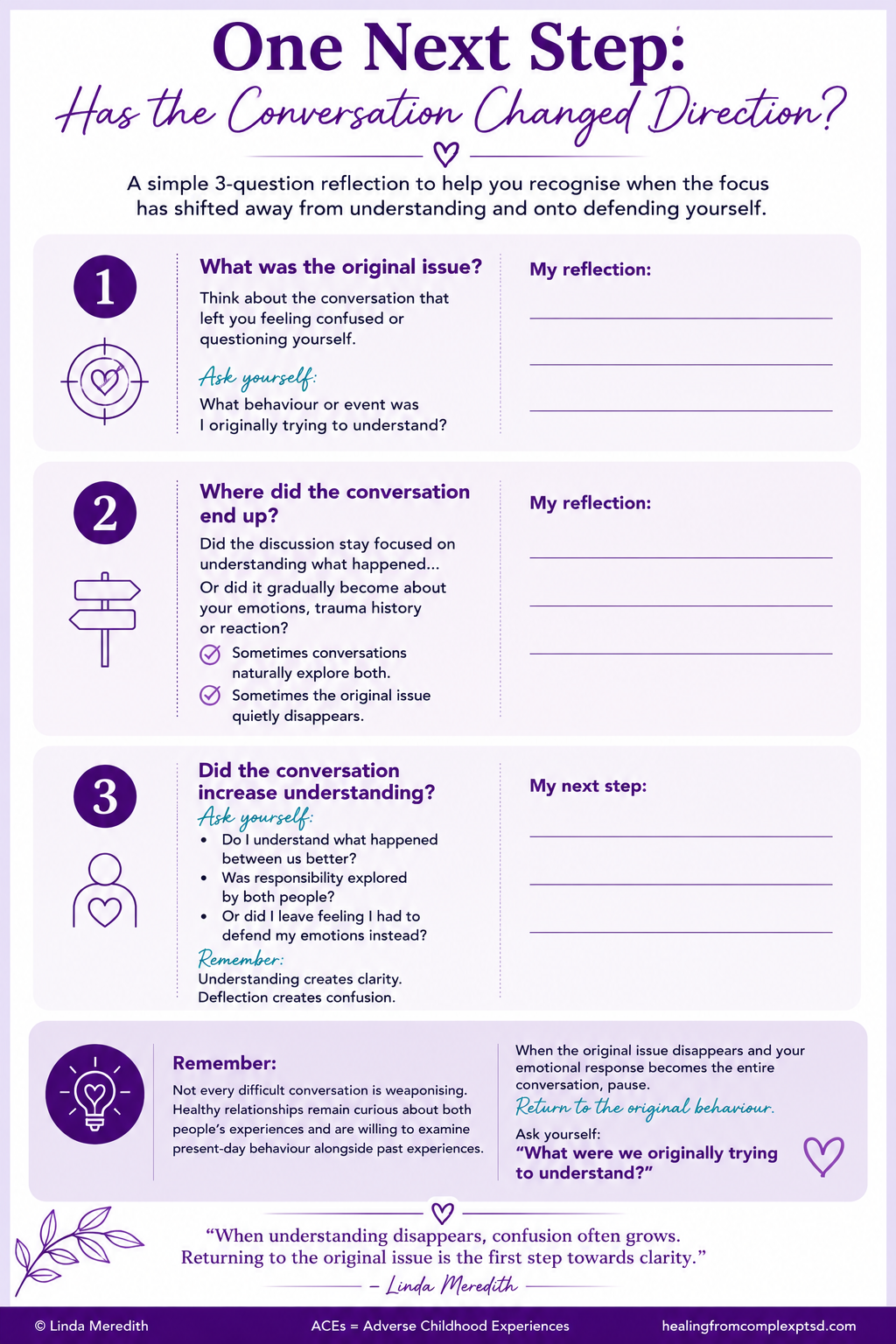
Return to the original issue
Protect your ability to think clearly under pressure
FAQ
How is weaponising different from a partner gently asking about triggers?
What if I am triggered and my reaction is bigger than the moment?
Can someone weaponise therapy language without realising it?
What are red flags that a relationship is not safe for repair conversations?
Watch the video
Clinical note:
Choose your One Next Step
Education
CPtsd Recovery Libraries
CPtsd Recovery with Linda
References
Adverse Childhood Experiences Study
Felitti, V. J., Anda, R. F., Nordenberg, D., Williamson, D. F., Spitz, A. M., Edwards, V., Koss, M. P., & Marks, J. S. (1998). Relationship of childhood abuse and household dysfunction to many of the leading causes of death in adults: The Adverse Childhood Experiences (ACE) Study. American Journal of Preventive Medicine, 14(4), 245–258.
Trauma and Recovery. (1992). Trauma and Recovery. Basic Books.
The Body Keeps the Score. (2014). The Body Keeps the Score: Brain, Mind, and Body in the Healing of Trauma. Viking.
The Developing Mind. (3rd ed.). (2020). The Developing Mind: How Relationships and the Brain Interact to Shape Who We Are. Guilford Press.
A Secure Base. (1988). A Secure Base: Parent-Child Attachment and Healthy Human Development. Basic Books.
Attachment in Psychotherapy. (2007). Attachment in Psychotherapy. Guilford Press.
Mentalization-Based Treatment for Personality Disorders. Bateman, A., & Fonagy, P. (2016). Mentalization-Based Treatment for Personality Disorders: A Practical Guide. Oxford University Press.
Adult Children of Emotionally Immature Parents. (2015). Adult Children of Emotionally Immature Parents: How to Heal from Distant, Rejecting, or Self-Involved Parents. New Harbinger Publications.
Complex PTSD: From Surviving to Thriving. (2013). Complex PTSD: From Surviving to Thriving. Azure Coyote Publishing.
Nonviolent Communication. (2015). Nonviolent Communication: A Language of Life (3rd ed.). PuddleDancer Press.
Linda Meredith
Passionate, Innovative, and Dedicated to
Complex Trauma Recovery
An Advanced, Neuroscience Based Approach for Mental Health Professionals
NeuroSynqt™ education is peer reviewed and delivered by a Registered Training Provider.
NeuroSynqt™ education is peer reviewed and delivered by a Registered Training Provider.
Supporting integration that addresses intergenerational trauma at its source