

Jul 1 / Linda Meredith

Medical Misogyny and Complex PTSD in Adults: Recognising Medical Dismissal

Learn to recognise medical misogyny, spot dismissal patterns in care, and use trauma-informed steps to advocate effectively. Read now.

Key Takeaways

Medical misogyny is not always loud. It can show up as subtle dismissal, minimising language, or symptoms being pinned on stress, weight, hormones, or anxiety without a careful workup. For many adults living with Complex PTSD, those moments can derail care and increase shame fast.


Recognising predictable dismissal patterns gives both clinicians and clients something concrete to respond to. Instead of replaying the appointment and wondering if you imagined it, you can document what happened, name the gap in care, and choose a safer next step.


  • Medical misogyny can look like subtle dismissal, minimisation, or misattribution of symptoms, and it commonly harms adults with Complex PTSD

  • Learning common dismissal patterns helps you document concerns, reduce harm, and improve care pathways

  • Trauma-informed communication and simple advocacy steps can shift appointments from proving pain to planning treatment

When you leave an appointment feeling smaller than when you arrived

You come in with a clear concern, maybe a symptom you have tracked for weeks, and you leave with a shrug and a label. Your pain is treated like a personality problem: stress, anxiety, hormones, or “just trauma”, without anyone taking a proper history or doing a basic exam.

Many people describe consults that last only 5–10 minutes, and that time pressure makes it easier for a clinician to reach for the quickest explanation. The problem is not that stress can never affect the body, it is that stress becomes the answer before the question has been asked.

Dismissal cues you can spot in the moment

Next, look for patterns that signal your report is being minimized rather than assessed. These cues often show up as language, tone, and what gets skipped.

  • Jumping to a mental health explanation in the first minute, before asking symptom details

  • Not asking follow-up questions like onset, duration, triggers, or what you have already tried

  • No exam, no vitals, and no plan for tests when red flags are present

  • “Normal labs” used to end the conversation, without discussing what the labs did and did not rule out

  • Advice that is vague or moralizing, like “try to relax” or “it’s probably anxiety”

  • Talking over you, changing the subject, or focusing on weight, periods, or relationship stress regardless of your complaint

Why it matters more than hurt feelings

But dismissal is not just awkward, it can change what happens next. You may delay care, stop mentioning symptoms, or doubt your own memory and bodily signals, which is especially risky if you have Complex PTSD.

If you do one thing, do this: treat dismissal as a safety and information problem, not a debate about who is right. The goal is to slow the visit down enough to get assessment, documentation, and a clear plan.

Concrete scripts and steps that protect you
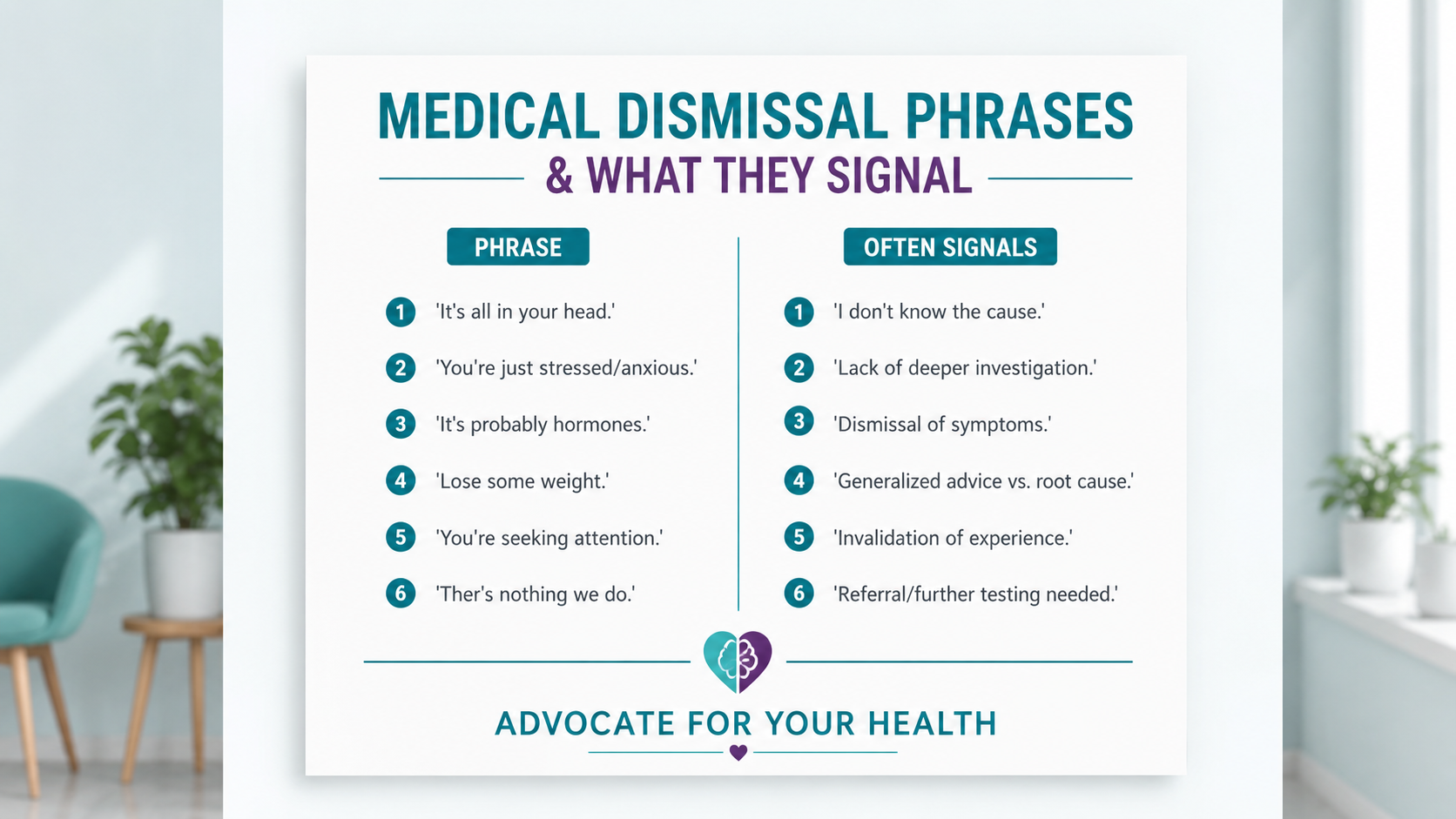
So use short, specific language that brings the conversation back to assessment. These lines work best when you stay calm and repeat them once, then ask for the next action.

  • “I hear stress is a possibility. What else are you ruling out today, and how”

  • “What in my history or exam makes you confident it’s anxiety rather than a physical cause”

  • “Can you document that I requested an exam or test and that it was declined”

  • “What are the red flags that mean I should seek urgent care, and in what timeframe”

  • “What is the follow-up plan if this is not better in 7–14 days”


Here's the catch: these steps can fail when the clinician is rushed or defensive. If you're short on time, skip the long background story and do a tight timeline instead:

  • Start date and pattern (for example, “daily since May, worse after meals”)

  • Top 2 symptoms and severity (0–10)

  • 1–2 functional impacts (missed work, waking at night, cannot drive)

  • What you have tried and what changed


A common mistake is trying to prove you are “reasonable” by downplaying symptoms. Fix it by stating your concern plainly, then asking for one next step: exam, test, referral, or a scheduled follow-up.

Spotting medical misogyny and dismissal in the room

Next, it helps to name what’s happening while it’s happening, because dismissal often sounds “reasonable” in the moment.

A quick rule: a clinician can disagree with you and still take you seriously. The problem starts when your report is treated as less credible by default, especially when the room shifts from investigating symptoms to judging your character, emotions, or “tone.”

Red flags to listen for in real time

Here are common signals that you’re being minimized rather than assessed. One or two may be clumsy communication, but repeated patterns matter.

  • Minimising language: “It’s probably just stress,” “Lots of women feel that,” “You’re too young for that,” “That’s normal for your age”

  • Psych-only explanations: symptoms get assigned to anxiety, hormones, or “somatic” causes without screening for medical causes first

  • Refusal to investigate without a clear rationale: “There’s no point testing,” “It won’t change anything,” or “You don’t meet criteria,” with no explanation of what criteria, what alternatives, or what would change the plan

  • Moving goalposts: you bring a new detail, and the bar for being taken seriously shifts again

If you do one thing, do this: ask for the reasoning out loud. A solid clinician can explain what they’re ruling in or out and why, in plain language.

Pattern recognition: when uncertainty turns into blame

But dismissal often shows up most clearly when a provider is uncertain and the uncertainty gets redirected onto you. Instead of “we don’t know yet,” the dynamic becomes “you’re not a reliable narrator.”

Watch for these credibility tests and “prove you’re sick” dynamics:

  • Your account is treated like a courtroom cross-examination (exact dates, exact pain scores, perfect memory)

  • You’re asked to perform wellness (calm, smiling, agreeable) to be believed, and distressed affect is used against you

  • Your symptoms are reframed as personal failure: “You just need to sleep more,” “You need to lose weight,” “You’re not managing stress,” without offering specific support or checking medical causes

  • You’re told it’s “just anxiety,” but no one asks what your anxiety looks like, when it started, or why it would explain new physical changes

Here’s the catch: some investigations are appropriately deferred. The key difference is whether the clinician offers a clear plan, such as what they’re monitoring, what would trigger tests, and when you should come back (for example, “If X persists past 2 to 4 weeks or you develop Y, we’ll do Z”).

Why dismissal hits harder for adults with Complex PTSD
Next, it helps to name why a brushed-off comment can feel like more than a bad bedside manner when you live with Complex PTSD (CPTSD).

CPTSD often comes with threat responses that were learned over time, usually in relationships where speaking up was unsafe. So when a clinician dismisses symptoms, the body can react as if the old danger is back, even if the room looks calm and professional.

Common CPTSD-linked responses that can get triggered during dismissal include:

  • Fawn response: you agree, minimize, or over-apologize to keep the interaction safe, then realize later you did not say what you needed

  • Shutdown or freeze: your mind goes blank, your voice gets quiet, and it becomes hard to answer simple questions or ask follow-ups

  • Memory gaps under threat: you forget key dates, meds, or symptoms in the moment, then remember them in the car or at home

  • Difficulty self-advocating: you know something is wrong, but the words do not come, especially if you are being interrupted or doubted

That pattern matters because it changes what care you can access and stick with. A 10 minute appointment where you shut down can turn into months of untreated symptoms, because the record ends up reading like you had “no concerns” or “reassured,” even when you were panicking inside.

Downstream effects often look like this:

  • Avoidance of care: canceling follow-ups, not booking referrals, or waiting until symptoms are severe before seeking help

  • Somatic escalation: stress shows up as pain, GI symptoms, headaches, fatigue, or flares for days after the appointment

  • Fragmented treatment: you bounce between providers, repeat your history, and start over because the last visit felt unsafe

  • Reinforced shame narratives: thoughts like “I am too sensitive,” “I should not take up space,” or “I can’t explain things right,” which make the next appointment even harder

If you do one thing, do this: treat the reaction as a real body-based threat response, not proof that you are “bad at appointments.” That reframes the problem from personal failure to a predictable CPTSD pattern you can plan around in the next steps.

What to do next: safer appointments, better documentation, clearer escalation

Next, treat your next appointment like a short, structured meeting, not a test of whether you can “perform” your pain. A simple plan helps when Complex PTSD symptoms show up as blanking out, appeasing, or freezing, especially in a 10 to 15 minute slot.

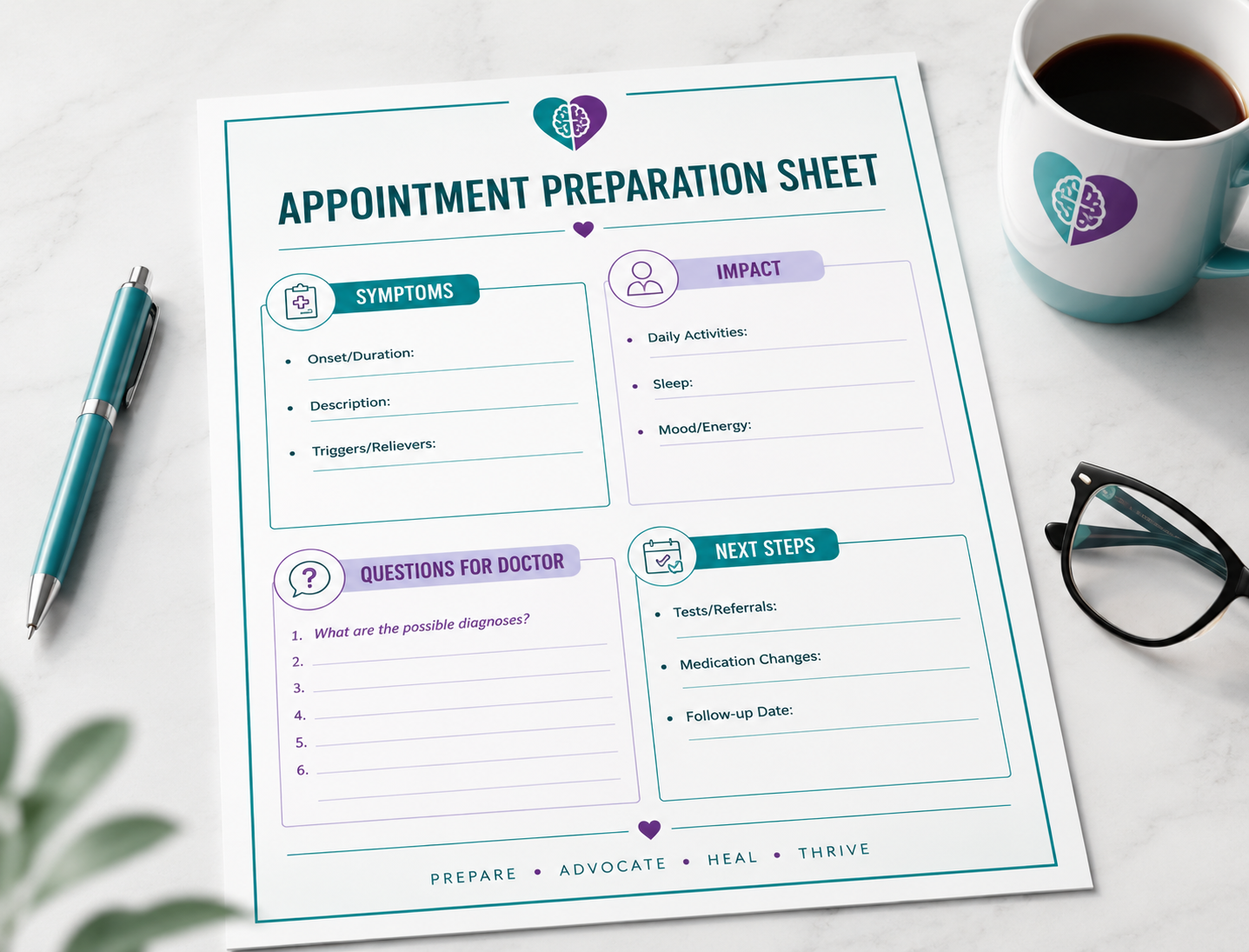
If you do one thing, bring a one page prep sheet and hand it over at the start. Keep it plain, specific, and easy to scan so the clinician can use it while they talk and type.

Preparation tactics that reduce dismissal

Also, walk in with information that is hard to wave away and easy to document. Aim for concrete observations, a clear request, and a back up plan if the first answer is no.

Use this checklist before you go:

  • Symptom timeline: what changed, when, and what makes it better or worse (example: “Headaches started 6 weeks ago, now 4 days per week”)

  • Impact in numbers: missed workdays this month, sleep hours on average, how often you cancel plans

  • Your specific ask: one or two items only (example: “I’d like to rule out anemia and thyroid issues”)

  • Testing thresholds: what would make you feel comfortable waiting (example: “If pain is still above 7 out of 10 after 2 weeks, I want imaging discussed”)

  • A one page trauma informed note: what helps you participate (example: “Please explain steps before touching me and ask consent each time”)

Common mistake: bringing a long narrative or a stack of screenshots, then running out of time. Fix: put details in an appendix on your phone, but keep the handout to one page.

In-appointment scripts you can read verbatim

That said, what you say in the room matters because it prompts what gets written in the chart. Scripts are useful when you feel yourself fawning or going quiet.

Try these consent based, boundary setting prompts:

  • “Before we start, I want to check consent. Please tell me what you’re going to do before you do it”

  • “I’m getting overwhelmed. I need 30 seconds to breathe, then I can continue”

  • “I’m not comfortable with that exam today. Can we discuss alternatives or schedule it for another visit?”

  • “Could you explain your clinical reasoning in plain terms and what you’re ruling in or out?”

  • “If we’re not ordering that test, can you document the reason and the signs that would change your mind?”

Here’s the catch: these work best with clinicians who are open to collaboration, and they may fail when the clinician is defensive or rushed. If you’re short on time, skip explaining your whole history and focus on three lines: what changed, how it’s affecting daily function, and what you’re asking for today.

Escalation that stays factual and keeps you safer

So, if the visit still feels dismissive, shift to documentation and next steps instead of debating. Your goal is a paper trail and a clear safety plan, not winning the conversation.

Before you leave, ask for:

  • A written summary or after visit notes and when to return

  • Clear red flags (example: “If I have chest pain plus shortness of breath, I should go to urgent care”)

  • A follow up timeframe (example: “Recheck in 2 to 4 weeks if symptoms persist”)

  • A referral option (example: “If this continues, I want a specialist opinion”)

Role based example: if you are a parent and you keep being told it is “just stress,” bring a logged list of school absences and symptom days, then ask, “What is your plan to rule out medical causes first?” If you are an employee trying to keep your job, ask for functional guidance: “What activity limits should I follow this week, and can that be documented in my notes?”

Also, keep this sentence close when self-doubt shows up after a hard appointment: “You can be traumatised and still deserve thorough medical care.” If you freeze, over-explain, or go blank in the room, that is not proof you are unreliable, it is a body response to threat and power imbalance.


Next, consider what would change if your goal for the next visit was clarity and collaboration, not credibility. You might ask for the plan in writing, confirm what symptoms you want evaluated (for example, sleep, pain spikes, or medication side effects over the last 14 days), and end by repeating the next step and timeline you agreed on.


That said, if you only do one thing, make it this: leave with a shared record. Use a one minute recap such as, “Today we agreed to X, we ruled out Y, the next step is Z, and we will review in two weeks,” then request it in the after-visit notes.


So if the room starts to feel like a debate about whether you are believable, bring it back to what you need to understand and decide. Clarity is a valid goal, collaboration is a valid ask, and you do not have to be perfectly calm to deserve careful care.

Explore Complex Trauma Trained Certification for working effectively with CPtsd

Also, if you want support that goes beyond reading and reflection, structured training can help you show up more consistently for clients with Complex PTSD (CPTSD) in healthcare settings.


Look for training that builds practical, experiential skills you can use the same week, such as:

  • Trauma-informed communication that reduces shutdown, fawning, or escalation in the room

  • Assessment thinking, meaning how to form safer working hypotheses when histories are fragmented or somatic symptoms dominate

  • Client advocacy in healthcare, including how to document concerns, ask for second opinions, and plan for safer re-referrals

  • Risk and safety planning that accounts for medical triggers and past dismissal


Next, if you do one thing, choose a program with supervised practice, skills rehearsal, and clear guidance on scope, especially if you work in primary care, emergency settings, therapy, or care coordination.


Here’s the catch: a short webinar can raise awareness, but it often fails when you need to respond in real time to a freeze response, a clinician power dynamic, or a client who has learned that protest makes things worse. If you are short on time, skip collecting more resources and start with a single training track you can complete in small weekly blocks.


To take the next step, consider the International Complex Trauma Association’s Complex Trauma Trained Certification to build these applied skills and a more reliable way of working with CPtsd in healthcare contexts.

Choose your One Next Step

Education

CPtsd Recovery Libraries

CPtsd Recovery with Linda

References

Medical misogyny / diagnostic bias
Hamberg K. (2008). Gender Bias in Medicine. Women's Health. 4(3), 237-243.

Samulowitz A, Gremyr I, Eriksson E, Hensing G. (2018). "Brave Men" and "Emotional Women": A Theory-Guided Literature Review on Gender Bias in Health Care and Gendered Norms Towards Patients with Chronic Pain. Pain Research and Management.

Hoffmann DE, Tarzian AJ. (2001). The Girl Who Cried Pain: A Bias Against Women in the Treatment of Pain. Journal of Law, Medicine & Ethics.


Diagnostic delay

World Health Organization. Gender and Health (overview of gender inequities in healthcare).

National Institutes of Health. Research on sex differences in diagnosis and treatment.


Trauma-informed healthcare

Substance Abuse and Mental Health Services Administration. SAMHSA's Concept of Trauma and Guidance for a Trauma-Informed Approach.

Centers for Disease Control and Prevention. Adverse Childhood Experiences (ACEs).

Write your awesome label here.

Linda Meredith

Passionate, Innovative, and Dedicated to

Complex Trauma Recovery


An Advanced, Neuroscience Based Approach for Mental Health Professionals

Linda Meredith is an accredited trainer, counsellor  and creator of the NeuroSynqt™ modality for CPtsd recovery. Known as a Professional Brain Untangler, Linda combines advanced neuroscience, lived experience  and years of client practice to develop trauma trained education that’s both practical and deeply human.

Her work has been peer reviewed and accredited by specialists with tertiary qualifications in the trauma field, ensuring every course is grounded in professional standards as well as real world application.

👉 Want to know more about Linda’s background, qualifications  and journey? Read Linda’s full story 
Write your awesome label here.

NeuroSynqt™ education is peer reviewed and delivered by a Registered Training Provider.

Write your awesome label here.
Testimonials

Some feedback from our students

We are dedicated to empowering you with knowledge, skills, and confidence to provide immediate answers to your clients.

“Interesting courses”

The course was the right mix of technical and non-technical elements. The course was also interesting, as I learned a lot about complex trauma and how this would apply for individual clients in the real world. Linda Meredith did a good job of communicating and making it easier to work with my  clients with CPtsd.
Paula w.

“I improved my knowledge”

The course taught me in a very friendly and engaging way. The course material was really helpful in preparing my skills and knowledge needed in the real world. It was well structured and the content was interesting and relevant. The materials were excellent, the mentoring approach was excellent and the free supervision helped me get my business off the ground.
Gina F.

“Easy to understand”

The courses are taught by Linda Meredith who is highly experienced and knowledgeable. Linda clearly understands the importance of working with clients with complex trauma and takes the time to ensure you understand the information in a way that is easy to grasp and use with clients. 
Lisa A.

Supporting integration that addresses intergenerational trauma at its source

By addressing developmental trauma at the level of organisation, NeuroSynqt™ supports:

  • more stable identity across contexts
  • improved relational capacity
  • consistent behavioural change
  • reduced reliance on coping cycles

This is where recovery becomes sustainable - not cyclical.


Stay connected:
Follow us on social media using the links below and sign up for our newsletter to receive special offers and updates on new content.
Thank you!
Created with