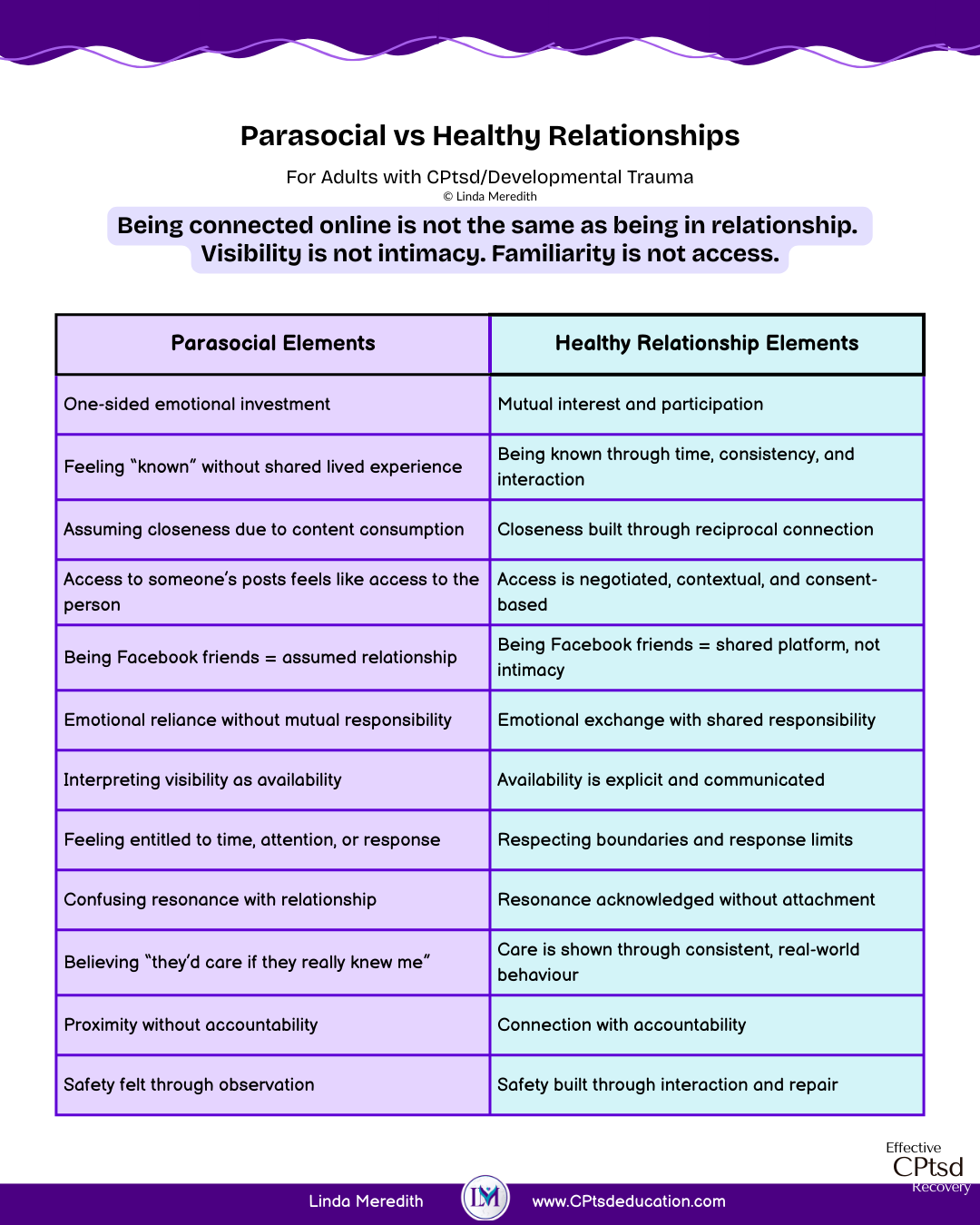
Parasocial bonds

Jan 1 / Linda Meredith


Parasocial Bonds and CPtsd - When the Brain Mistakes Familiarity for Safety


If you live with CPtsd, parasocial bonds make complete sense.
They are not a character flaw. They are not immaturity. They are a brain adaptation.

A parasocial bond is a one-sided emotional attachment to someone who feels familiar - a public figure, educator, influencer, author, podcaster, or even a fictional character. The connection feels personal and emotionally real, even though there is no mutual relationship.

For adults with CPtsd, these bonds often form not because of obsession, but because the brain is searching for predictability, safety, and emotional consistency.

And yes - social media supercharges this.

What Parasocial Bonds Actually Feel Like in CPtsd

For a trauma-impacted brain, parasocial connections can feel:

  • 🧠 Regulating - the person feels steady, familiar, and emotionally predictable

  • 🧠 Soothing - their voice, tone, or presence reduces internal noise

  • 🧠 Connecting without risk - no fear of rejection, conflict, or abandonment

  • 🧠 Identity-anchoring - “Someone like me exists”

For many adults with CPtsd, parasocial bonds are often the first place the brain feels safe enough to connect at all. That matters.

Why Adults with CPtsd Are More Prone to These Bonds

CPtsd changes how the brain learns relationship.

Common drivers include:

  • 🔹 Attachment injury - connection once meant danger, inconsistency, or loss

  • 🔹 Relational fatigue - real relationships feel effortful, confusing, or unsafe

  • 🔹 Chronic isolation - emotional, not just social

  • 🔹 Identity disruption - needing models of coherence, strength, or stability

Parasocial bonds offer connection without demand.
No negotiation. No emotional labour. No rupture to repair.

From a brain perspective, that’s incredibly efficient.

The Social Media Effect - Why It Feels “Almost Mutual”

Modern platforms blur the line between observer and participant:

  • Comments get liked

  • Replies appear personalised

  • Stories feel intimate

  • Live videos feel interactive

This creates what researchers now call “one-and-a-half-sided” relationships - not truly reciprocal, but emotionally activating enough that the brain treats them as if they are.

For a CPtsd brain, this can intensify attachment, especially during stress, loneliness, or identity rebuilding phases.

No weakness here. Just neurobiology doing what it learned to do.

When Parasocial Bonds Help

Used well, parasocial connections can:

  • ✔ Provide emotional stability during isolation

  • ✔ Support identity repair and hope

  • ✔ Reduce shame through shared language

  • ✔ Act as stepping stones toward real-world connection

They are often bridges, not destinations.

When They Start to Hurt


Parasocial bonds become problematic when they:

  • ❌ Replace real relationships entirely

  • ❌ Create expectations of closeness that cannot exist

  • ❌ Trigger comparison, inadequacy, or longing

  • ❌ Pull excessive emotional or financial investment

  • ❌ Reinforce avoidance of mutual connection

The issue isn’t attachment.
The issue is attachment without integration into real-world connection.

A Trauma-Trained Reframe


Instead of asking“Why am I like this?”
A better question is“What did my brain need when this bond formed?”

Parasocial bonds aren’t pathology.
They’re signals.

  • Signals that connection matters.
  • Signals that safety matters.
  • Signals that the brain is still wired for relationship - even after trauma.

And that’s not a problem to fix. It’s a capacity to guide.


Parasocial bonds are not inherently unhealthy.
For adults with CPtsd, they often reflect adaptive intelligence, not dysfunction.

The work isn’t to cut them off.
The work is to re-anchor connection in places where it can become mutual, embodied, and real - at a pace the brain can tolerate.

No shame. No moralising. Just clarity.

(And yes, if social media has ever felt “safer than people”, you’re not broken. Your brain was being practical.)

🌿 Thriver Library: Parasocial Bonds Toolkit

Everything you see on this page is available as downloadable worksheets, charts, and step-by-step guides inside the Thriver Library.

These resources are designed to help you gently separate felt safety from real-world connection and build healthier relational patterns without shame or pressure.

👉 For individuals:
Use the worksheets, prompts, and self-guides to reduce emotional dependence, steady your brain, and reconnect with real-world support safely.

👉 For practitioners:
Use the clinician notes, session frameworks, and discussion tools to help clients work through parasocial attachment in a way that protects capacity and preserves alliance.

When you’re ready, the Library gives you structure, language, and practical tools so change doesn’t just make sense — it becomes doable.

Skills. Practice. Confidence. Progress.


Write your awesome label here.

THRIVER LIBRARY

Skills. Practice. Confidence. Progress.

A practical library designed to build capacity one doable step at a time.

The Thriver Library is our growing collection of practical tools, worksheets, and guides designed to make CPtsd recovery easier in everyday life. No overwhelm. No academic jargon. Just brain-based resources you can use immediately to gain clarity, reduce crashes, and build steadier foundations step by step.

Whether you’re learning for yourself or supporting others, the Library helps you turn insight into integration – one doable action at a time.

Write your awesome label here.

Are you Looking to Take the Next Step?

Living with CPtsd?
What if recovery meant no longer remaining in survival mode?

I spent years chasing answers to a constant felt sense that something was “wrong” with me. On the outside I appeared functional - wife, mum, business owner. Inside, I was cycling through crippling anxiety and depression with no clear pattern.

Each time I sought help, I was told, variations of “You’re doing better than 98% of my clients - you’ll be fine.” The truth? Most clinicians/practitioners weren’t trained in complex/developmental trauma, making it impossible for them to see how CPtsd was impacting my life and eroding my capacity.

The basics I needed weren’t happening - and my health challenges increased every year.
Write your awesome label here.


Linda's Qualifications include:

Clinical Complex Trauma Professional LvL 2 (Janina Fisher)

Certified Trauma Recovery Coach Supervisor
Dip Couns
CPtsd recovery is a shared walk, not a solo test of willpower.
With the right support, language, tools and Trauma Brain Mapping old survival patterns can settle. Experience less pressure, more progress and kind accountability so your effort finally lands as change you experience in your daily life. Personal freedom starts here.
If you’re ready for practical, brain-based support that treats the whole self, CPtsd Recovery Counselling with Linda could be your next step.

Work directly with Linda

Find a practitioner near you

Write your awesome label here.

CPtsd Courses & Certification

✨ Whether you’re a professional, a survivor, or someone supporting a loved one, our CPtsd courses are designed for everyone. Explore practical, neuroscience-based tools and compassionate guidance you can use right away.
Follow us on social

Developmental Trauma/CPtsd Courses

Together, we can be the generation that ends the cycle of abuse and intergenerational trauma.

By leading the way in effective complex trauma recovery across the globe, Healing from Complex PTSD is creating real, lasting change.

Here, you can:

📚 Access professional education and support from industry leaders
🧠 Learn a proven, results-driven approach to CPtsd recovery
🛠 Explore a full library of ready-to-use tools and resources that make a difference in real lives

Stay connected:

Follow us on social media using the links below and sign up for our newsletter to receive special offers and updates on new content.

Join our newsletter

Sign up for our newsletter—a valuable digest of the latest Complex Trauma Recovery insights, news, and opportunities.

Simply enter your name & email address to subscribe.
You can easily update your preferences or unsubscribe anytime.
Thank you!
Empty space, drag to resize
Created with