"I had literally been searching for decades to questions I could never frame. Walking through life was a continual nagging that my life was being held back, that I wasn't able to achieve the dreams I had. Even when those dreams were seemingly run of the mill. To be a wife, mum and raise a healthy family. When I first read this book I shed tears of pure relief. Finally, someone understood what I could never put into words."
- Linda Meredith
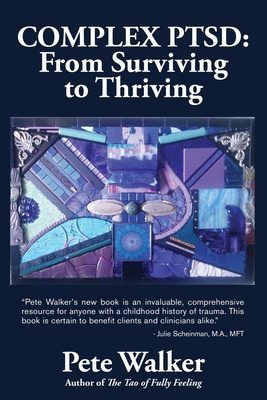
We have a free Peer Support Facebook group and the consensus across people reading this book ranges from "I have to read it slowly as I'm being triggered, to "I had to read it in one sitting." All with the overriding emotions of "finally, someone understands me."
From Pete Walker, author and walking the cptsd recovery journey -
"I have Complex PTSD [Cptsd] and wrote this book from the perspective of someone who has experienced a great reduction of symptoms over the years. I also wrote it from the viewpoint of someone who has discovered many silver linings in the long, windy, bumpy road of recovering from Cptsd.
I felt encouraged to write this book because of thousands of e-mail responses to the articles on my website that repeatedly expressed gratitude for the helpfulness of my work. An often echoed comment sounded like this: At last someone gets it. I can see now that I am not bad, defective or crazy...or alone! The causes of Cptsd range from severe neglect to monstrous abuse.
Many survivors grow up in houses that are not homes - in families that are as loveless as orphanages and sometimes as dangerous. If you felt unwanted, unliked, rejected, hated and/or despised for a lengthy portion of your childhood, trauma may be deeply engrained in your mind, soul and body. This book is a practical, user-friendly self-help guide to recovering from the lingering effects of childhood trauma, and to achieving a rich and fulfilling life. It is copiously illustrated with examples of my own and my clients' journeys of recovering.
This book is also for those who do not have Cptsd but want to understand and help a loved one who does.
This book also contains an overview of the tasks of recovering and a great many practical tools and techniques for recovering from childhood trauma. It extensively elaborates on all the recovery concepts explained on my website, and many more. However, unlike the articles on my website, it is oriented toward the layperson. As such, much of the psychological jargon and dense concentration of concepts in the website articles has been replaced with expanded and easier to follow explanations.
Moreover, many principles that were only sketched out in the articles are explained in much greater detail. A great deal of new material is also explored. Key concepts of the book include:
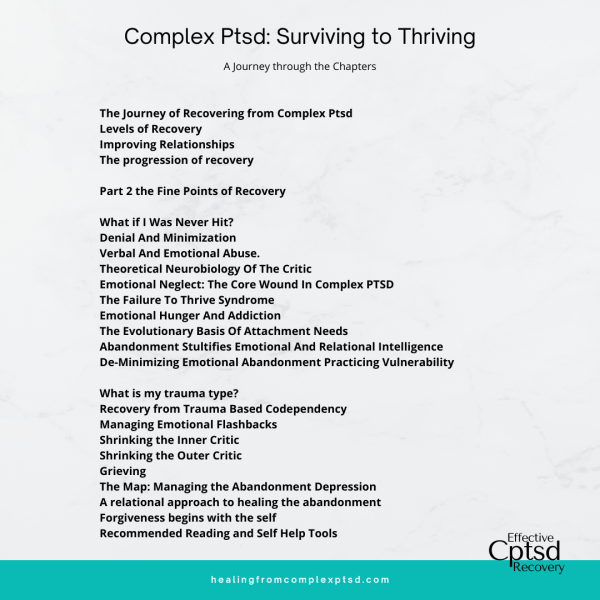
- Managing emotional flashbacks.
- Understanding the four different types of trauma survivors.
- Differentiating the outer critic from the inner critic.
- Healing the abandonment depression that come from emotional abandonment and self-abandonment.
- Self-reparenting and reparenting by committee.
- Deconstructing the hierarchy of self-injuring responses that childhood trauma forces survivors to adopt.
The book also functions as a map to help you understand the somewhat linear progression of recovery, to help you identify what you have already accomplished, and to help you figure out what is best to work on and prioritize now. This in turn also serves to help you identify the signs of your recovery and to develop reasonable expectations about the rate of your recovery. I hope this map will guide you to heal in a way that helps you to become an unflinching source of kindness and self-compassion for yourself, and that out of that journey you will find at least one other human being who will reciprocally love you well enough in that way."