Raw & Real: I can't begin to count how many times I've had no idea which way to turn to take my one next step throughout my recovery journey. Then there's the other side of the coin where I'm moving forward in recovery and BAM! CRASH! I unknowingly spiral downwards and can't get out of bed for some unknown reason. Frustrating much? Yes!
This article was posted on our original blog at Healing from Complex ptsd, June 21st 2021.
From Chaos to Calm
Raw & Real: I can't begin to count how many times I've had no idea which way to turn to take my one next step throughout my recovery journey. Then there's the other side of the coin where I'm moving forward in recovery and BAM! CRASH! I unknowingly spiral downwards and can't get out of bed for some unknown reason. Frustrating much? Yes!
Over time and studying Complex Trauma I developed a few practical and effective ways to get back on track with my recovery journey. These core concepts and understanding why and what my brain needed have helped me not crash into bed anymore, except for Saturday morning sleep ins!
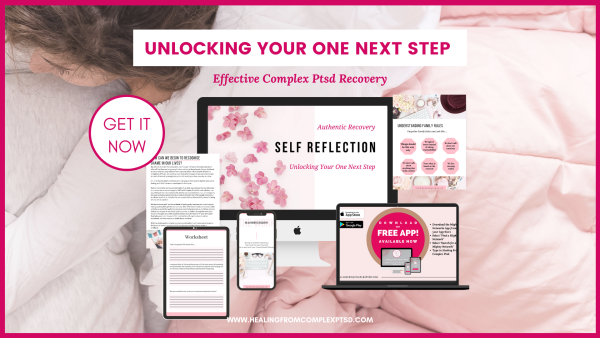
From Neuroscientists to Trauma Recovery Coaches we all know YOU have the answers lying inside of you for your one next step. Now you can unlock your one next step in this easy to use Workbook.
Empty space, drag to resize
Workbook: Unlocking Your One Next Step is 63 pages
Included are the following information pages and relevant worksheets ~ - How to have an Authentic Recovery - How to work with your Trauma Recovery Coach/Therapist - Self Reflection: How it Works and Why it's vital for Complex Trauma Recovery - How to Write a Stream of Consciousness - What are Family Rules? Identifying My Own Family Rules - Identifying How Shame began in Our Lives - Questions for Self Reflection: Unpacking my internal layers -Overwhelmed? Questions for Immediate Relief - Crisis Help: International Text Lines & More You're only question is Am I Ready to Unpack my one next step?
Workbook: Unlocking Your One Next Step
Highlights
What's included in this package
⇣Digital Download📎 Digital File Type: 1 Pdf
📱Free Read/Write App
🦋 Free Peer Support Group
🙋🏻♀️ Free Community App
This is a listing for a digital .pdf you can print out at home or fill-in and save with the free read/write instructions listed in the workbook. Literally take it with you wherever you go.
Achieve your CPtsd recovery goals
Unlock Healing and Empowerment with CPtsd Coaching with Linda
Harness the latest in neuroscience, psychoeducation, and practical strategies to build on the progress you’ve already made. Linda’s expert coaching offers advanced, tailored support to help you break through persistent challenges and reach new levels of empowerment after years of work.
Discover the breakthrough you’ve been seeking.
Write your awesome label here.
Effective. | Trauma. | Recovery. | Found Here.
Learn more about complex trauma recovery coaching with Linda. For those taking a proactive approach to recovery and needing answers to help heal their whole self.
This short self-check is educational only. It does not diagnose trauma.
If you feel triggered or overwhelmed, please pause and reach out to your local supports.
Developmental Trauma Self-Check
Over the past 12 months, how many and how often have you noticed:
I work hard to hold it together in public, then crash in private.
I struggle to name what I feel until it overloads me.
I say yes to keep the peace, then feel resentful or empty.
I feel loyal to people who do not treat me well.
I lose time or feel foggy when stressed.
I avoid closeness or over-attach quickly, then panic.
I find it hard to trust my own judgement.
I feel shame when I try to set boundaries.
I need external approval to feel steady.
I push through fatigue instead of pausing.
How to use this: 0–3 items often: you may be using a few survival patterns. 4–7 items often: consider paced support to rebuild safety and choice. 8–10 items often: a trauma-trained professional can help you restore stability and connection.
By completing this self-check, you understand it is for educational reflection only, not assessment or therapy.
Brain Impact Self-Check
This self-check explores how developmental trauma can affect daily brain function.
No personal details are stored. Please read at your own pace.
Over the past 12 months, how often have you noticed:
My mind jumps to what could go wrong, even in safe moments.
I find it hard to remember recent details when I am stressed.
Decisions feel risky, so I delay or avoid them.
I forget good experiences quickly and dwell on the bad.
I feel numb or overwhelmed, with little in-between.
I lose words when emotions rise.
I misread neutral faces or tones as negative.
I struggle to notice body signals like hunger, tension or breath.
I do better when someone I trust is nearby.
I feel different “versions” of me in different settings.
How to use this:
0–3 often: some protective habits; gentle self-care may help.
4–7 often: consider trauma-trained coaching to build daily brain skills.
8–10 often: a paced, brain-based plan can restore clarity, memory and confidence.
These reflections align with NeuroSynqt™’s brain-based, experiential process — a framework that supports identity repair, clarity, and sustainable recovery.
Your practitioner may use validated questionnaires.
For formal assessment, use recognised measures:
ACE-IQ or ACE-10 for adversity history (education only on public pages).
ITQ (International Trauma Questionnaire) for ICD-11 PTSD/Complex PTSD.
DERS for emotion regulation, DES-II for dissociation, PCL-5 for PTSD symptoms.
PHQ-9, GAD-7 for mood and anxiety; OSSS-3 for social support.
Write your awesome label here.
Do not miss!
FREE CPtsd Education RESOURCE HUB
Create your free account and access practical CPtsd tools, short educational videos, infographics and reference guides, with new resources added over time.
Created with
Login or sign up to start learningLogin to start learning