
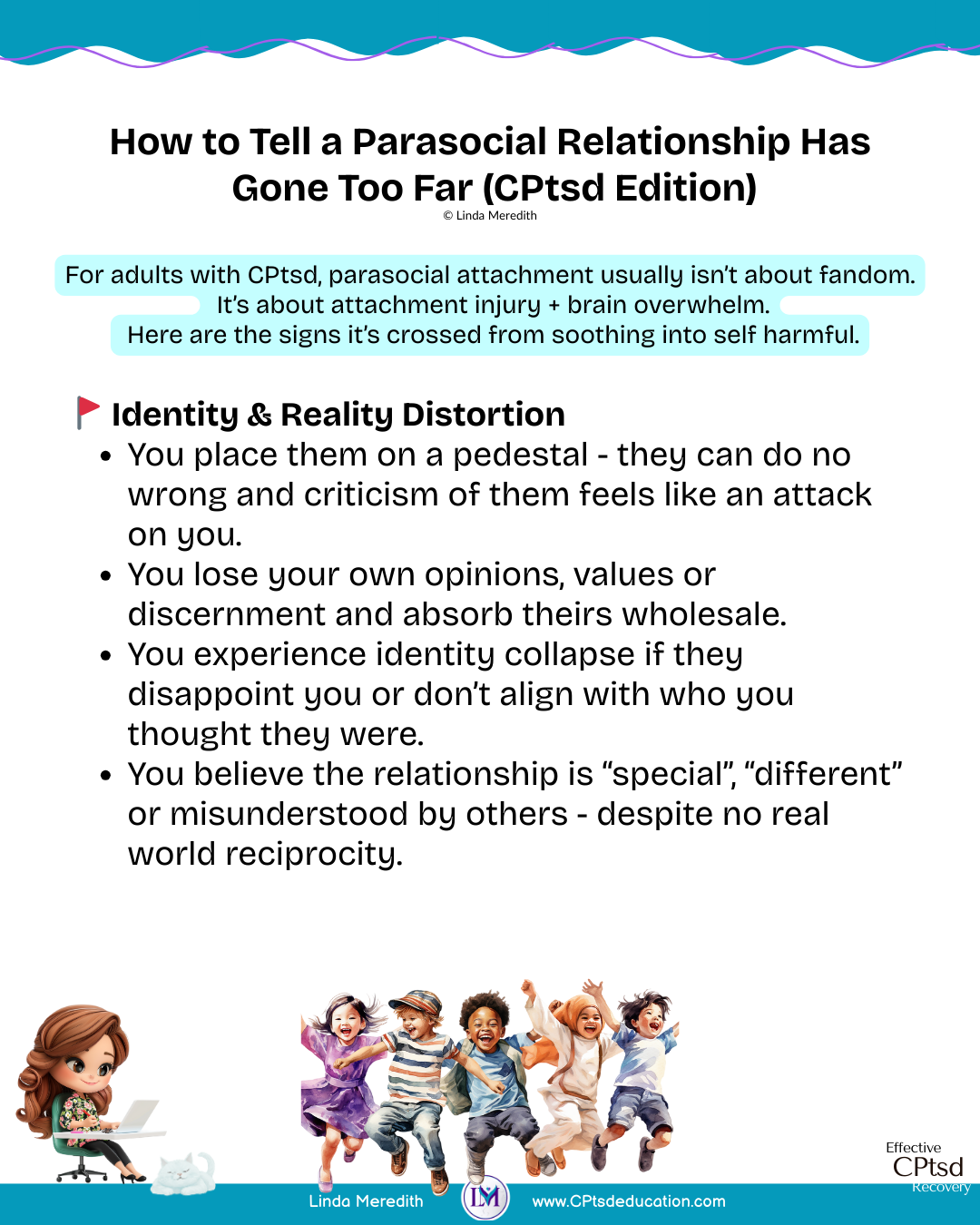
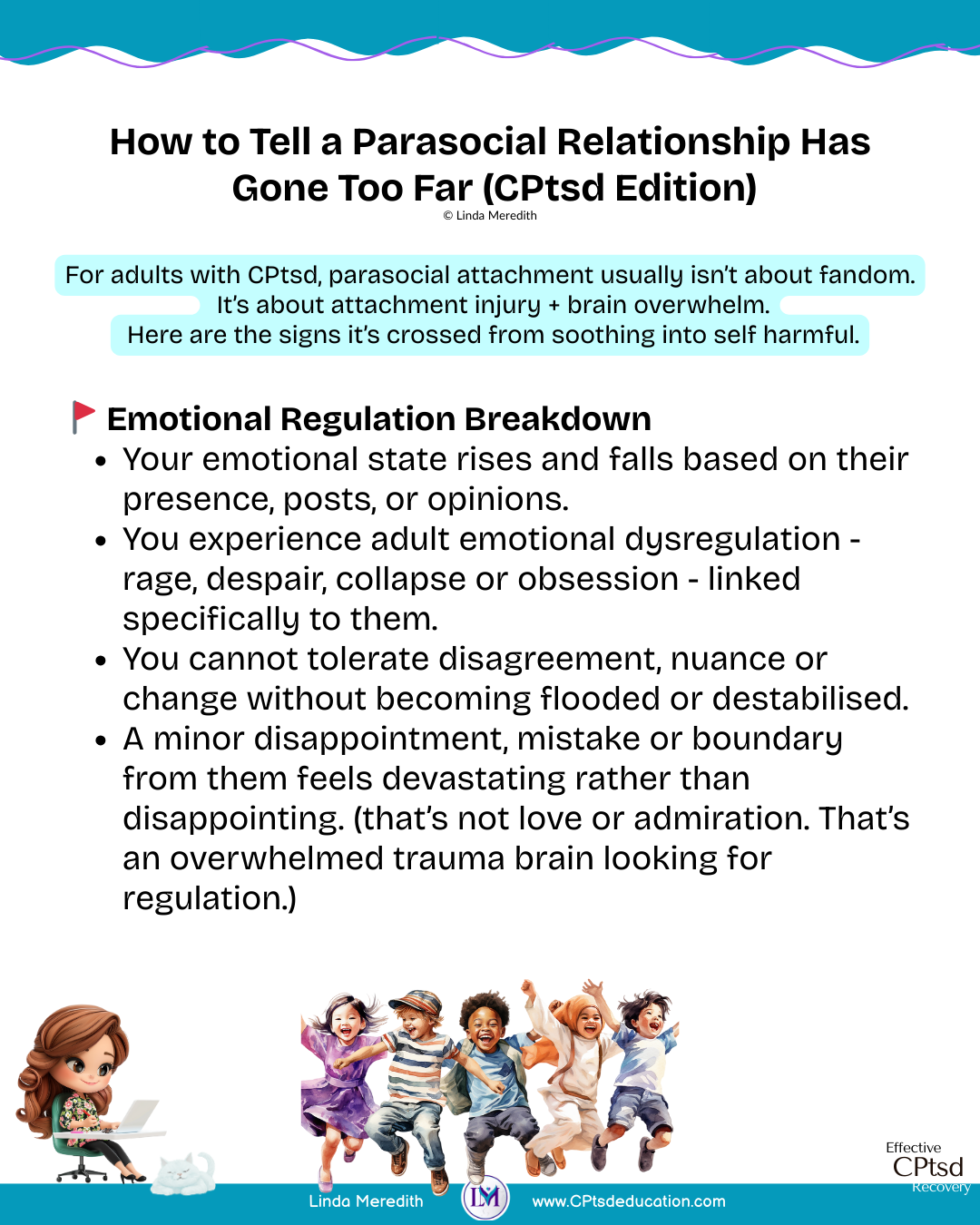
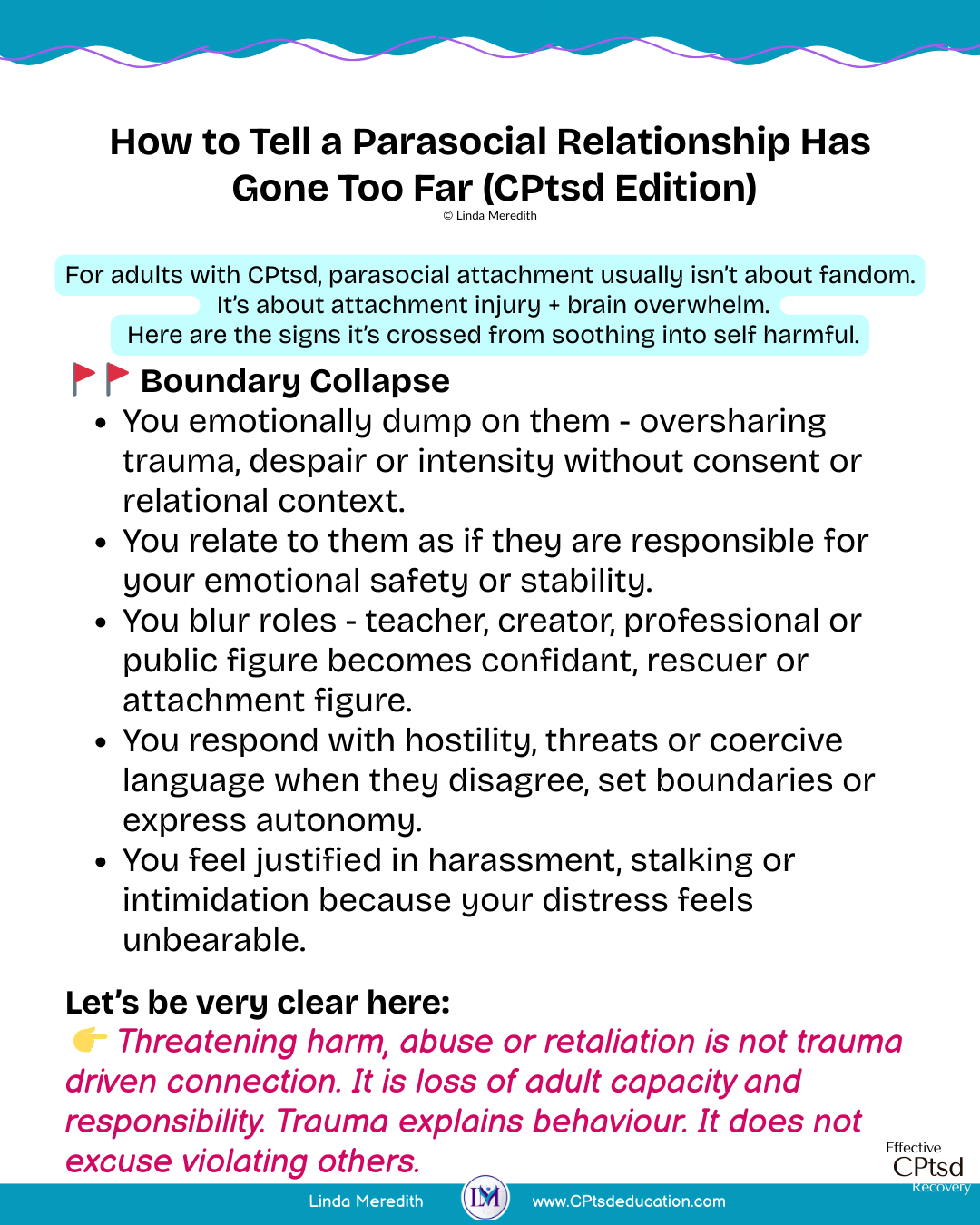
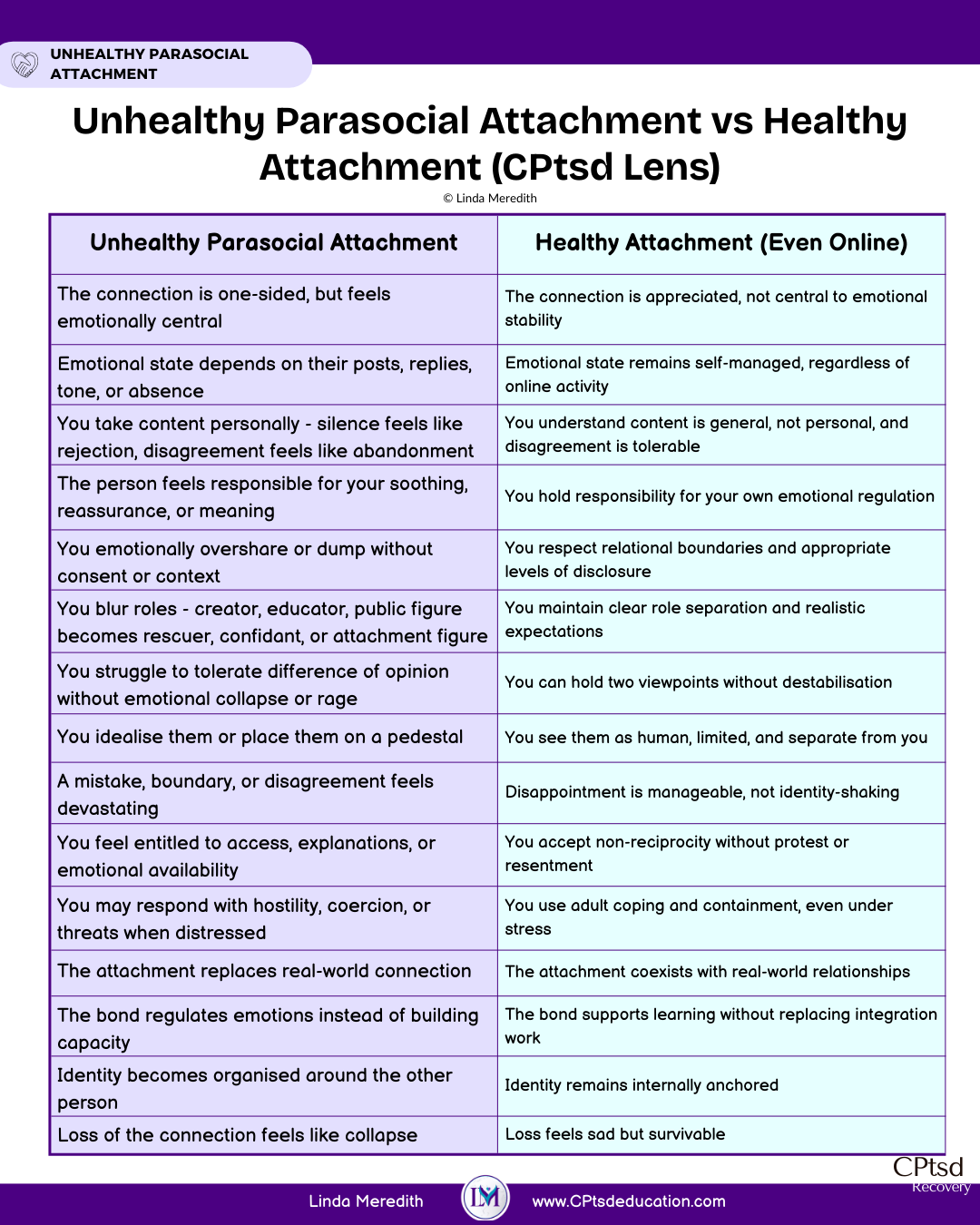
How to Tell a Parasocial Relationship Has Gone Too Far (CPtsd Edition)

Jan 1 / Linda Meredith

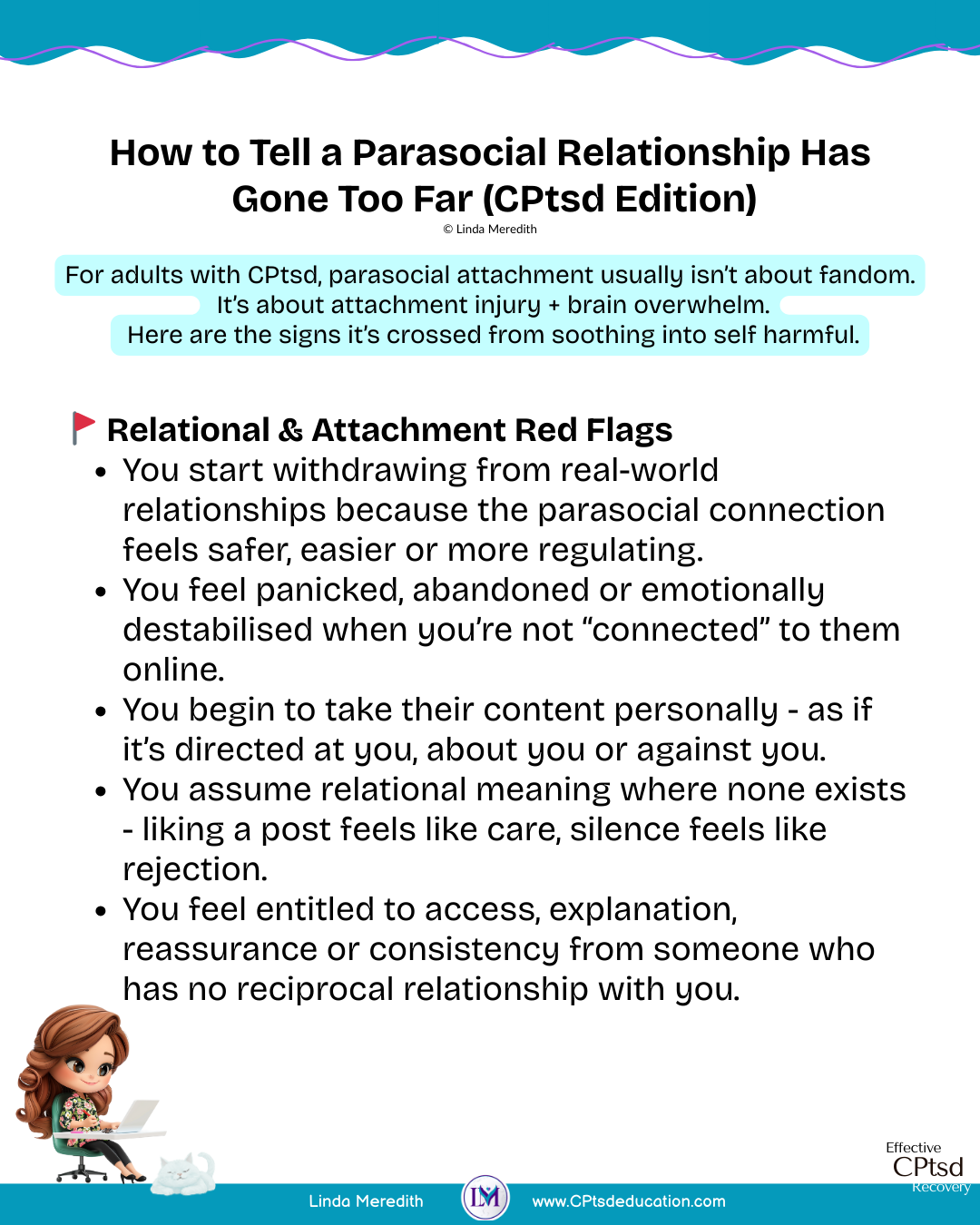
For adults with CPtsd, parasocial attachment usually isn’t about fandom.
It’s about attachment injury + brain overwhelm.
Here are the signs it’s crossed from soothing into self-harmful.


🚩 Relational & Attachment Red Flags

  • You start withdrawing from real-world relationships because the parasocial connection feels safer, easier, or more regulating.

  • You feel panicked, abandoned, or emotionally destabilised when you’re not “connected” to them online.

  • You begin to take their content personally - as if it’s directed at you, about you, or against you.

  • You assume relational meaning where none exists - liking a post feels like care, silence feels like rejection.

  • You feel entitled to access, explanation, reassurance, or consistency from someone who has no reciprocal relationship with you.

Trauma Trained Reality Check

Parasocial bonds become dangerous when they:

  • Replace mutual adult relationships

  • Bypass boundaries instead of building capacity

  • Regulate emotions instead of teaching regulation

  • Collapse autonomy instead of strengthening it

Opinion (firm but compassionate):
When a parasocial bond starts demanding regulation, reassurance, or submission from the other person, it’s no longer connection. It’s unintegrated attachment seeking an external regulator.


The Work Is Not “Stop Attaching”

The work is:

  • Building adult emotional regulation capacity

  • Learning to tolerate difference without collapse

  • Developing mutual, embodied, reciprocal connection

  • Re-anchoring safety inside the adult self, not outsourced to strangers


Parasocial bonds aren’t the enemy.
Uncontained attachment without adult boundaries is.

🌿 Thriver Library: Parasocial Bonds Toolkit

Everything you see on this page is available as downloadable worksheets, charts, and step-by-step guides inside the Thriver Library.

These resources are designed to help you gently separate felt safety from real-world connection and build healthier relational patterns without shame or pressure.

👉 For individuals:
Use the worksheets, prompts, and self-guides to reduce emotional dependence, steady your brain, and reconnect with real-world support safely.

👉 For practitioners:
Use the clinician notes, session frameworks, and discussion tools to help clients work through parasocial attachment in a way that protects capacity and preserves alliance.

When you’re ready, the Library gives you structure, language, and practical tools so change doesn’t just make sense — it becomes doable.

Skills. Practice. Confidence. Progress.


Write your awesome label here.

THRIVER LIBRARY

Skills. Practice. Confidence. Progress.

A practical library designed to build capacity one doable step at a time.

The Thriver Library is our growing collection of practical tools, worksheets, and guides designed to make CPtsd recovery easier in everyday life. No overwhelm. No academic jargon. Just brain-based resources you can use immediately to gain clarity, reduce crashes, and build steadier foundations step by step.

Whether you’re learning for yourself or supporting others, the Library helps you turn insight into integration – one doable action at a time.

Write your awesome label here.

Are you Looking to Take the Next Step?

Living with CPtsd?
What if recovery meant no longer remaining in survival mode?

I spent years chasing answers to a constant felt sense that something was “wrong” with me. On the outside I appeared functional - wife, mum, business owner. Inside, I was cycling through crippling anxiety and depression with no clear pattern.

Each time I sought help, I was told, variations of “You’re doing better than 98% of my clients - you’ll be fine.” The truth? Most clinicians/practitioners weren’t trained in complex/developmental trauma, making it impossible for them to see how CPtsd was impacting my life and eroding my capacity.

The basics I needed weren’t happening - and my health challenges increased every year.
Write your awesome label here.


Linda's Qualifications include:

Clinical Complex Trauma Professional LvL 2 (Janina Fisher)

Certified Trauma Recovery Coach Supervisor
Dip Couns
CPtsd recovery is a shared walk, not a solo test of willpower.
With the right support, language, tools and Trauma Brain Mapping old survival patterns can settle. Experience less pressure, more progress and kind accountability so your effort finally lands as change you experience in your daily life. Personal freedom starts here.
If you’re ready for practical, brain-based support that treats the whole self, CPtsd Recovery Counselling with Linda could be your next step.

Work directly with Linda

Find a practitioner near you

Write your awesome label here.

CPtsd Courses & Certification

✨ Whether you’re a professional, a survivor, or someone supporting a loved one, our CPtsd courses are designed for everyone. Explore practical, neuroscience-based tools and compassionate guidance you can use right away.
Follow us on social

CPtsd Recovery & Practitioner Training

Self-paced | Professional training | For practitioners and professionals

Breaking cycles doesn’t start with fixing the future.

It starts with understanding what survival shaped in you.

Intergenerational trauma continues when survival adaptations are never named, understood, or integrated.

When those patterns are understood, change follows naturally - in relationships, choices, and identity.

You don’t have to carry responsibility for anyone else’s healing. Supporting your own recovery is enough.

Self-paced tools designed to support recovery without overwhelm.

Join our newsletter

Sign up for our newsletter—a valuable digest of the latest Complex Trauma Recovery insights, news, and opportunities.

Simply enter your name & email address to subscribe.
You can easily update your preferences or unsubscribe anytime.
Thank you!
Empty space, drag to resize
Created with