Coercive Control: Why Smart Women Miss the Signs - And What Today’s Trauma Trained Lens Reveals

Dec 8 / Linda Meredith

Some of the signs of coercive control include:

  1. Controlling who a person sees, what they wear and where they go.
  2. Monitoring or tracking everything a person does.
  3. Controlling everyday needs, such as finances, medication, food or exercise.
  4. Regularly criticising a person, or manipulating or blaming them so they doubt themselves and their experiences.
  5. Forcing someone to have sex or do sexual things.
  6. Stopping a person from following their religion or cultural practices.
  7. Threatening a person, their children, family or friends.
  8. Manipulating co-parenting arrangements or child support payments after relationship separation.
  9. These are just some examples of behaviours that can be used as part of a person’s pattern of abuse.
Coercive control isn’t “relationship conflict” with bad manners. It’s a strategic pattern of domination that often escalates into domestic violence and, for too many women, fatal outcomes.

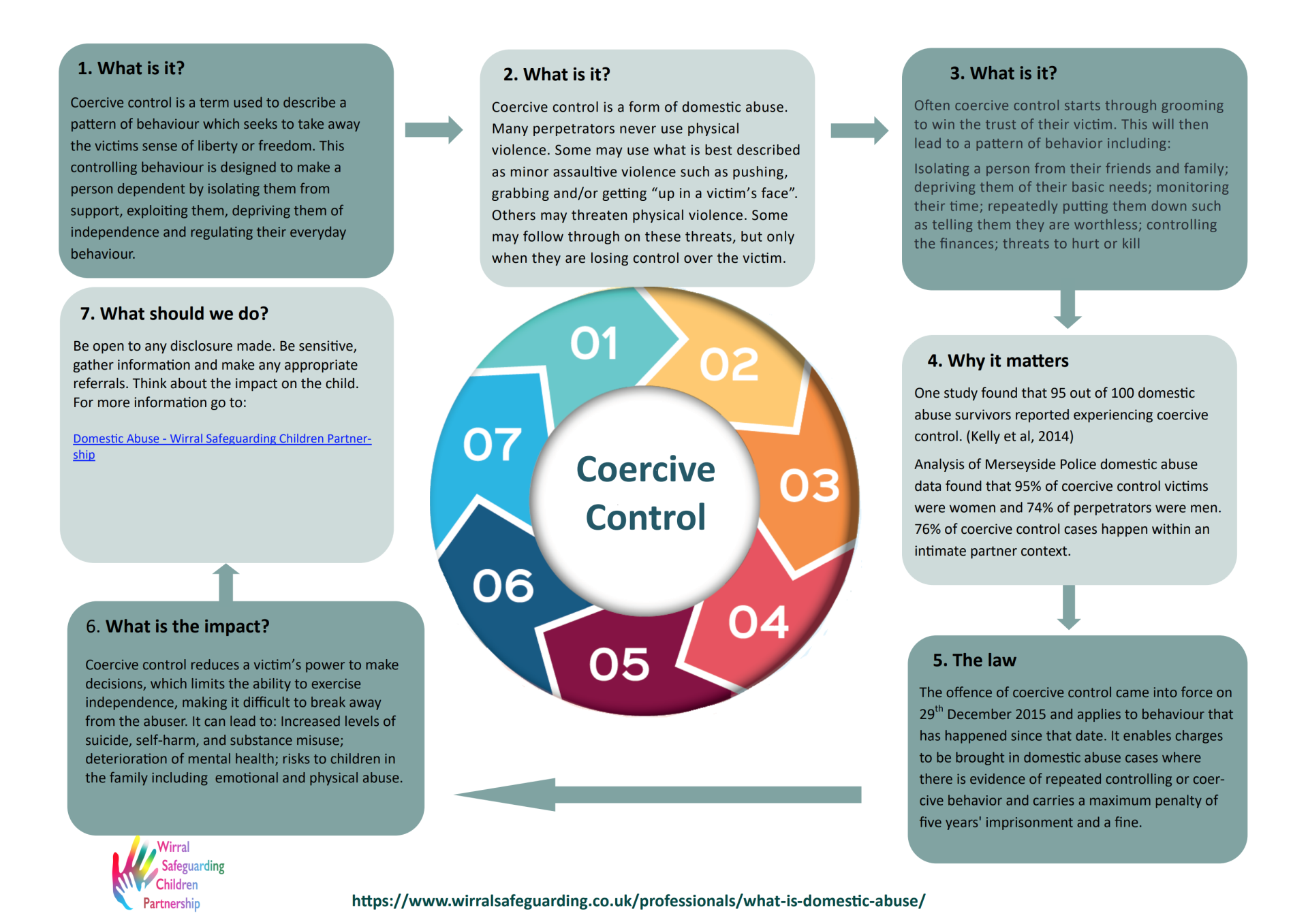
What is coercive control?

The National Principles recognise that coercive control is almost always an underpinning dynamic of family and domestic violence. Coercive control involves perpetrators using patterns of abusive behaviours over time in a way that creates fear and denies liberty and autonomy.

People who use coercive control may use physical or non-physical abusive behaviours, or a combination of both. All abusive behaviours are serious. Coercive control has traumatic and pervasive immediate and long-term impacts on victim‑survivors, their families and communities.

The signs of coercive control can be difficult to spot. People who use coercive control can use many different types of abusive behaviours to exert power and dominance. Behaviours can be subtle and insidious, and individually targeted and tailored to the victim‑survivor.

People experiencing coercive control may feel like they’re walking on eggshells, or that it’s difficult to disagree or say no.

They may not know they are being abused. This may be because:

They may not realise that non-physical abuse is also family and domestic violence.
They may think the abusive behaviour is a normal part of a relationship, especially if friends and family don’t say or do anything to stop it.
The person who uses coercive control may trick a person into doubting their own experiences, or blame them for the abuse.
The abuse does not always stop, and can even become worse, after a relationship ends.

Women aged 35-55 often ask me the same question:
“How did I not see it sooner?”
And here’s the truth - not the sugar-coated version:

"You didn’t see it because your brain was doing exactly what it was shaped to do
after years of developmental trauma."


When a woman grows up in a family where emotional neglect was “normal,” the brain learns early that:

  • love requires accommodating other people

  • harmony is kept by making yourself smaller

  • survival depends on predicting everyone else’s reactions

That childhood pattern fractures identity development. You don’t know it’s fragmented - it just feels like flexibility, loyalty, empathy, or “being easygoing”. Meanwhile, it leaves the brain primed to attach to adults who unconsciously repeat the same rule:
“My needs matter; yours can be negotiated away.”

You’re not naïve.
You’re not weak.
Your childhood conditioning trained your brain to tolerate what should never have been tolerated.

Why the “one rule for me, another for you” dynamic feels familiar

As children, many of us learnt the invisible rulebook:

  • adults get the special rules

  • you must hold the emotional weight

  • fairness is optional

So when a coercive controller uses the same blueprint in adulthood, your brain isn’t shocked.
It’s familiar.
Familiar is not safe, but the trauma-shaped brain often treats it as if it is.

“But he wasn’t like this before marriage.”

No, he wasn’t.
Coercive controllers rarely show the rulebook until commitment is locked in. They know you’d never choose them if they revealed the truth early.

After commitment, the switch flips:

  • more demands

  • shrinking freedom

  • double standards

  • entitlement

  • pressure to comply

  • withdrawal of warmth to enforce compliance

It is calculated, not accidental.

And yes, it shocks women to their core because they showed up honestly - and expected adulthood to mean shared responsibility, mutual respect, and basic humanity. Coercive controllers expect none of that. They expect compliance.

You’re not alone. Thousands of women are waking up to this dynamic and beginning the work of integration - rebuilding the internal architecture that trauma disrupted so they can spot red flags faster, walk away sooner, and stop tolerating adults who behave badly.

“I have sometimes said to a client: “If you are so in touch with your feelings from your abusive childhood, then you should know what abuse feels like. You should be able to remember how miserable it was to be cut down to nothing, to be put in fear, to be told that the abuse is your own fault. You should be less likely to abuse a woman, not more so, from having been through it.” Once I make this point, he generally stops mentioning his terrible childhood; he only wants to draw attention to it if it’s an excuse to stay the same, not if it’s a reason to change.”

Lundy Bancroft, Why Does He Do That? Inside the Minds of Angry and Controlling Men

How Smart Women With Developmental Trauma Get Trapped in Coercive Control
Developmental Trauma Sets Women Up to Experience Coercive Control
If these resonate, it’s a sign your sense of self was shaped around keeping others comfortable.

Coercive Controllers Operate on Rules Like These

1. Their comfort is non-negotiable; yours is a disruption.
You learnt early that your emotions must shrink so theirs can stay stable.


2. Praise and compliance are expected; anything else is “disrespect”.
You’re conditioned to earn safety by being agreeable, even when it harms you.


3. Their freedom is unlimited; yours is monitored.
They get spontaneity; you get scrutiny dressed up as “care”.


4. Your choices must be pre-approved.
They position themselves as the decision-maker because it keeps you predictable.


5. Your attention is their entitlement; their attention is optional.
You’re trained to maintain connection while receiving very little in return.


6. Respect is a one-way street flowing toward them only.
Your dignity becomes negotiable; theirs becomes sacred.


7. They rewrite events to protect their image.
Your reality becomes debatable if it threatens their reputation.


8. You’re expected to stay silent to “keep the peace”.
Your silence becomes their shield.


9. They can lie about you; you must protect them from consequences.
They rely on you to cover their tracks while they damage your credibility.


10. Their anger is justified; yours is dangerous.
Your emotional responses are framed as instability.


11. Their hurt counts; yours is an inconvenience.
Your pain is dismissed as overreaction while theirs demands a full response.


12. Their insults are “jokes”; your boundaries are “attitude”.
They get humour privileges; you get punished for self-respect.


13. They can accuse; you must absorb.
Their projections land on you with no room for truth.


14. Defending yourself is treated as aggression.
Any attempt to correct the narrative becomes “fighting”.


15. You carry their secrets; they broadcast your flaws.
Their privacy is sacred; yours is expendable.


16. You must never complain; their dissatisfaction drives the relationship.
Your concerns are treated as burdens; theirs dictate the emotional climate.


17. They confront; you “nag”.
Your communication is minimised to protect their ego.


18. Their eye-rolls are allowed; your facial expression is a threat.
Their contempt is normalised; your autonomy is policed.


19. They withhold connection; you must stay available.
Disconnect becomes a punishment to keep you compliant.


20. They can leave emotionally or physically; you must stay loyal.
Their absence is excused; your commitment is expected.


21. When they return, you must reset with no accountability.
Your hurt must disappear the second they want closeness again.


22. They can unload about you to others; you must remain silent.
They collect allies while isolating you.


23. They share a victim story; you’re not allowed to share reality.
Their narrative dominates; yours is dismissed or called “dramatic”.


24. Your opinions must match theirs.
Difference becomes disloyalty.


25. Agreement is mandatory; they reserve the right to criticise.
You must comply while they stay above reproach.


26. They demand seriousness for themselves and weaponise humour against you.
Their vulnerabilities require reverence; yours become punchlines.


27. You’re expected to mind-read the source of their anger.
You become responsible for emotional diagnostics they refuse to do.


28. Their allies must become yours; your allies become threats.
Your world shrinks while theirs stays resourced.


29. They position themselves as the authority; you’re treated as uneducated.
Your intelligence is strategically minimised to keep you dependent.


30. They are superior; you exist to stabilise them.
Your worth becomes tied to how well you manage their moods.


31. Independent thought is disloyalty.
Curiosity becomes rebellion; autonomy becomes disrespect.


32. Your needs are self-indulgent; theirs are urgent.
Your humanity is optional; theirs is paramount.


33. Your rights are optional; theirs are assumed.
They operate like the rules simply don’t apply to them.


34. You are convenient until you’re not – then discarded, then pulled back when useful.
When you’re too tired, too aware, or too self-respecting, they drop you – and reappear when you’re useful again.

What To Do Next

Women with developmental trauma don’t heal by forcing themselves to “be stronger”. They heal by:

  • rebuilding identity

  • separating survival-mode brain from present-day reality

  • learning internal boundaries first

  • integrating the internal fragmentation trauma left behind

That’s the work.

If you’re beginning to recognise these patterns in your own relationship - or if you love a friend who’s living through it - you don’t have to do this alone.

Explore Linda’s counselling sessions, accredited courses or certification pathway.

You’ll find clear, practical tools inside the Thriver Library to help you rebuild the internal architecture that trauma compromised so you can date, relate, and choose differently.

You’re not broken.
You’re integrating.
And clarity is the first shift.


Are you Looking to Take the Next Step?

Living with CPtsd?
What if recovery meant no longer remaining in survival mode?

I spent years chasing answers to a constant felt sense that something was “wrong” with me. On the outside I appeared functional - wife, mum, business owner. Inside, I was cycling through crippling anxiety and depression with no clear pattern.

Each time I sought help, I was told, variations of “You’re doing better than 98% of my clients - you’ll be fine.” The truth? Most clinicians/practitioners weren’t trained in complex/developmental trauma, making it impossible for them to see how CPtsd was impacting my life and eroding my capacity.

The basics I needed weren’t happening - and my health challenges increased every year.
Write your awesome label here.


Linda's Qualifications include:

Clinical Complex Trauma Professional LvL 2 (Janina Fisher)

Certified Trauma Recovery Coach Supervisor
Dip Couns
CPtsd recovery is a shared walk, not a solo test of willpower.
With the right support, language, tools and Trauma Brain Mapping old survival patterns can settle. Experience less pressure, more progress and kind accountability so your effort finally lands as change you experience in your daily life. Personal freedom starts here.

If you’re ready for practical, brain-based support that treats the whole self, CPtsd Recovery Counselling with Linda could be your next step.
Write your awesome label here.

CPtsd Courses & Certification

✨ Whether you’re a professional, a survivor, or someone supporting a loved one, our CPtsd courses are designed for everyone. Explore practical, neuroscience-based tools and compassionate guidance you can use right away.
Follow us on social

Developmental Trauma/CPtsd Courses

Created with