How to Get Diagnosed with Complex PTSD | USA, UK & Australia
Perhaps you've attended therapy, tried different treatments, or worked hard to understand your symptoms, yet everyday life remains much harder than you can explain.
One of the questions I recently received was from someone who had been diagnosed with severe depression and anxiety four years earlier. They wanted to know how to get assessed for Complex PTSD.
Their message ended with four important words:
"And I need help."
Those words matter.
Because seeking a diagnosis isn't simply about finding another label. It's about understanding what's happening, why certain difficulties continue, and what kind of support might actually help. If you're wondering whether Complex PTSD could be contributing to your experiences, this article explains where to begin in the United States, United Kingdom and Australia.
What Is Complex PTSD?
Complex PTSD is a recognised mental health condition included in the World Health Organization's International Classification of Diseases, 11th Revision (ICD-11). It can develop following exposure to extremely threatening or horrific experiences, particularly repeated or prolonged interpersonal trauma from which escape was difficult or impossible. Examples can include childhood abuse, neglect within threatening or abusive environments, domestic violence, captivity or repeated interpersonal victimisation.
However, a particular type of traumatic experience is not required for diagnosis. Clinicians assess the symptoms and their impact, not simply the number or type of traumatic experiences someone has endured.
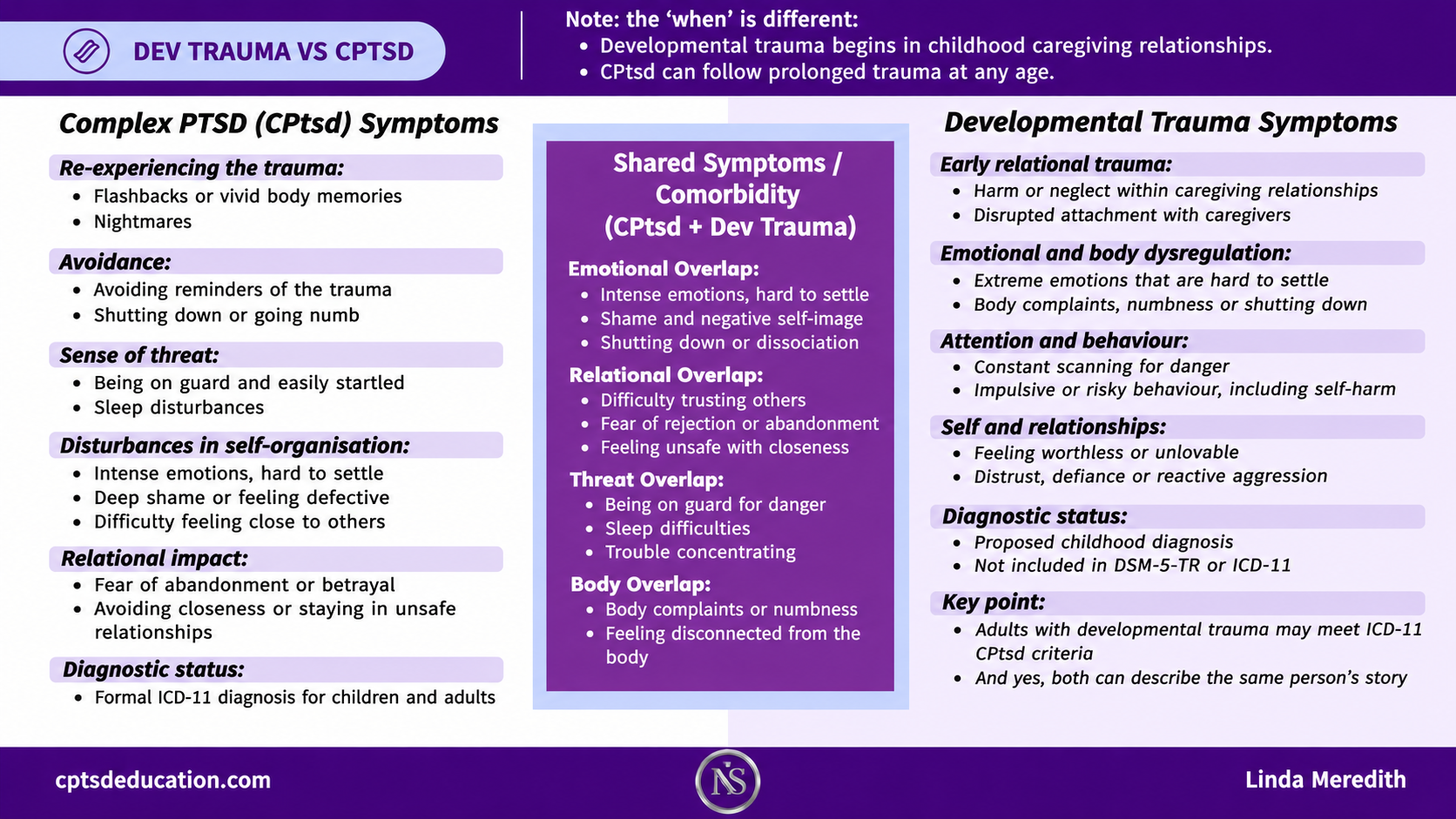
Under the ICD-11, Complex PTSD involves the three core symptom groups associated with PTSD:
1. Re-experiencing traumatic events in the present
This may involve flashbacks or nightmares in which traumatic experiences feel as though they're happening again.
2. Avoidance
Avoiding reminders of traumatic experiences, including situations, conversations, places or internal experiences associated with what happened.
3. A persistent sense of current threat
Feeling continually on alert, hypervigilant or easily startled, even when there is no immediate danger.
Complex PTSD also involves three additional areas known clinically as disturbances in self-organisation:
4. Difficulties with emotional responses
This may include intense emotional reactions, difficulty settling after distress, or emotional numbness and shutdown.
5. Persistent negative beliefs about yourself
For example, deeply held feelings of worthlessness, failure or shame.
6. Difficulties with relationships
This can involve struggling to maintain emotional closeness, feeling disconnected from others or finding relationships particularly difficult to navigate. These difficulties must also cause significant impairment in important areas of life.
Not everyone who has experienced childhood or developmental trauma meets the diagnostic criteria for Complex PTSD. A comprehensive assessment is needed to establish whether these symptoms fit the diagnosis.
Research reference:US Department of Veterans Affairs — Complex PTSD: Assessment and Treatment
Can You Have Depression, Anxiety and Complex PTSD Together?
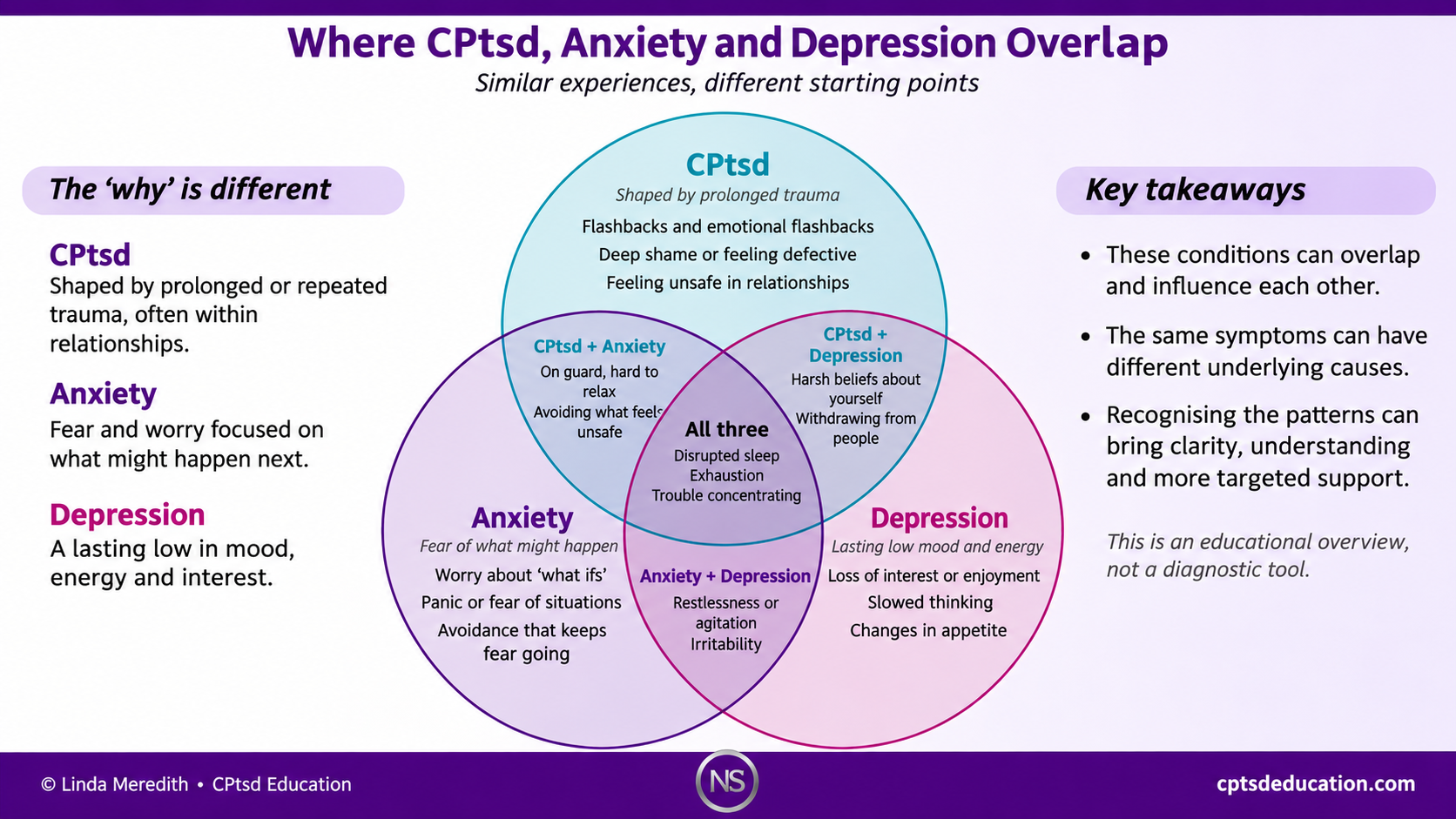
Yes. Depression, anxiety disorders and Complex PTSD can coexist. This is important because receiving a diagnosis of depression or anxiety does not automatically mean your previous practitioner was wrong. Those diagnoses may accurately describe some of your symptoms while other difficulties remain unexplored.
For example, someone may experience persistent low mood, loss of interest, excessive worry and difficulties sleeping. But they may also experience trauma-related re-experiencing, avoidance, a continuing sense of threat, emotional shutdown, persistent shame and significant relational difficulties. These experiences deserve careful assessment rather than being automatically attributed to depression or anxiety. There is also an important distinction between having symptoms associated with developmental trauma and meeting the formal criteria for Complex PTSD.
The purpose of an assessment is not to prove that you have Complex PTSD. It's to understand the full picture of what you're experiencing.
How to Get Assessed for Complex PTSD in the United States
In the United States, you can begin by contacting your primary care physician or a licensed mental health professional who has experience assessing trauma-related conditions. This may include a clinical psychologist, psychiatrist or another appropriately qualified mental health clinician working within their professional scope.
An important complication in the United States is that Complex PTSD is recognised in the ICD-11 but is not a separate diagnosis in the American Psychiatric Association's DSM-5-TR. The DSM-5-TR is widely used in American mental health practice. This means that a practitioner may recognise the broader effects of complex trauma while using a diagnosis of PTSD or another appropriate diagnosis within the DSM framework. It does not mean that the experiences associated with Complex PTSD are imaginary or unimportant.
Where to start
Contact your primary care physician or an appropriately qualified mental health professional.
Explain your existing diagnoses and why you believe a broader assessment may be needed.
Ask specifically for an assessment that considers PTSD, ICD-11 Complex PTSD and other possible or coexisting conditions.
Ask whether the clinician has experience assessing people with prolonged interpersonal or developmental trauma.
Check your insurance coverage, referral requirements and assessment costs before booking.
You can also contact your health insurer to ask which trauma-experienced clinicians are covered by your plan.
Useful American resources:
How to Get Assessed for Complex PTSD in the United Kingdom
In the United Kingdom, a practical first step is to make an appointment with your GP.
Explain your current diagnoses, the difficulties you're experiencing and why you would like a comprehensive trauma assessment.
The UK uses ICD diagnostic classifications within healthcare, although the precise assessment and recording practices can vary between services.
Where to start
Book an appointment with your GP.
Explain why your current diagnoses may not account for all your symptoms.
Ask for a referral to a mental health service or specialist experienced in PTSD and Complex PTSD.
Ask which assessment services are available in your local NHS area.
If you're already receiving mental health treatment, request a review and discuss whether a specialist trauma assessment is appropriate.
Can you refer yourself?
In England, adults can self-refer to NHS Talking Therapies for anxiety and depression, including services that assess and treat PTSD.
However, self-referral does not guarantee access to a specialist Complex PTSD assessment. Some people may need referral to another mental health service. Healthcare arrangements differ across England, Scotland, Wales and Northern Ireland, so the appropriate referral pathway will depend on where you live.
Useful UK resources:
How to Get Assessed for Complex PTSD in Australia
In Australia, your GP is generally a good starting point. You can request a referral to a clinical psychologist, psychiatrist or another suitably qualified mental health professional experienced in trauma assessment.
Complex PTSD is recognised within the ICD-11, although Australian practitioners may use different diagnostic frameworks in their clinical work. The important thing is finding someone who understands both the diagnostic criteria and the broader clinical presentation of complex trauma.
Where to start
Book a longer GP appointment to discuss your mental health concerns.
Explain your existing diagnoses and any ongoing symptoms that haven't been adequately addressed.
Ask about referral to a practitioner experienced in assessing PTSD and Complex PTSD.
Discuss whether you're eligible for a Mental Health Treatment Plan.
Check the costs of assessment and whether Medicare rebates are available.
What about Medicare?
Under Australia's Better Access initiative, eligible people with a diagnosed mental health disorder may access Medicare rebates for up to 10 individual and 10 group mental health treatment sessions per calendar year. These are treatment entitlements, not a guarantee that every specialist diagnostic assessment will be covered. Medicare rebates may not cover the full cost of an appointment, and some services charge additional fees.
Your GP can explain your eligibility and referral options.
Useful Australian resources:
What Should You Say When Asking for an Assessment?
Sometimes the hardest part is knowing how to explain what you're asking for. You may worry that your practitioner will think you're questioning their expertise or attempting to diagnose yourself. But requesting a comprehensive assessment is a reasonable and appropriate step, particularly when you're continuing to experience significant difficulties.
You could say:
"I was diagnosed with depression and anxiety several years ago, but I'm concerned that these diagnoses may not fully explain what I've been experiencing. I've been learning about Complex PTSD and would like a comprehensive assessment that considers my trauma history, PTSD and Complex PTSD, alongside my existing diagnoses. Can you refer me to someone experienced in assessing these conditions?"
- You don't need to arrive with a perfect explanation.
- You don't need to know all the diagnostic terminology.
- And you certainly don't need to be able to explain the neuroscience of trauma before someone takes your concerns seriously.
Your role is to describe what you're experiencing and ask for help understanding it. The clinician's role is to assess those experiences using appropriate clinical knowledge and diagnostic methods.
What Happens During a Complex PTSD Assessment?
A comprehensive assessment should explore more than whether you've experienced traumatic events. A practitioner may ask about your mental health history, traumatic experiences, current symptoms and how those symptoms affect everyday life.
They should consider the recognised diagnostic criteria for PTSD and Complex PTSD, including the additional difficulties involving emotional responses, self-concept and relationships. They should also consider other explanations and coexisting conditions, including depression, anxiety disorders, dissociative symptoms and other relevant mental or physical health conditions.
Will you have to describe everything that happened to you?
Not necessarily. A clinician will need sufficient information to understand your trauma history and assess your symptoms.
However, requesting an assessment does not mean you must immediately provide a graphic, detailed account of every traumatic experience. You can explain when something is difficult to discuss and ask how the assessment can proceed at a manageable pace.A careful assessment should consider your current capacity to participate, your safety and what information is clinically necessary.
Are there specific assessment tools?
Yes. One widely studied tool is the International Trauma Questionnaire (ITQ).
It was developed to assess symptoms associated with ICD-11 PTSD and Complex PTSD. The ITQ examines the core PTSD symptoms, the additional disturbances in self-organisation and the impact on daily functioning. However, it is a self-report measure that can support a provisional diagnostic classification. It is not, by itself, a substitute for a comprehensive clinical assessment.
Another tool is the International Trauma Interview (ITI), a structured clinical interview designed for appropriately trained professionals.
Further reading:
International Trauma Questionnaire — US National Center for PTSD
International Trauma Interview — US National Center for PTSD
What If Your Practitioner Doesn't Recognise Complex PTSD?
This can be particularly confusing when you've already spent years trying to understand why you're struggling.
A practitioner may be unfamiliar with the ICD-11 Complex PTSD diagnosis, may use a different diagnostic framework or may have clinical reasons for considering another diagnosis more appropriate. Those are different situations.
Not receiving a Complex PTSD diagnosis does not automatically mean the practitioner is wrong. But being told that Complex PTSD is not recognised anywhere, or having your concerns dismissed without an appropriate assessment, is a reasonable reason to seek clarification.
You can ask:
"Can you explain which diagnostic criteria you're using and whether my symptoms have been assessed against the ICD-11 criteria for Complex PTSD?"
You can also ask:
"If this isn't an area you specialise in, could you refer me to someone who has experience assessing complex trauma?"
Seeking a second opinion is appropriate when important questions remain unanswered. The goal is not to find someone who will automatically agree that you have Complex PTSD. It's to find someone qualified to investigate your concerns properly.
Do You Need a Formal Complex PTSD Diagnosis Before Getting Help?
No. This is one of the most important things to understand. A formal diagnosis can help clarify your experiences, inform treatment planning and sometimes support access to services. But you do not need to wait until every diagnostic question has been resolved before asking for help with significant symptoms.
If you're struggling with depression, anxiety, sleep, emotional distress, relationships or everyday functioning, those difficulties deserve attention now. If you're already receiving treatment and it isn't helping enough, you can request a review. That review may consider whether your current treatment is appropriate, whether additional assessment is needed and whether another form of support may be beneficial.
For some people, understanding the effects of developmental trauma can also help explain why certain difficulties persist despite considerable effort. However, understanding those effects and establishing a formal psychiatric diagnosis are not the same thing.
Both can have a place in a person's recovery journey.
Normal text.Understanding the Impact of Developmental Trauma
One of the difficulties many adults experience is that they have spent years trying to change patterns they don't fully understand.
They may recognise that they struggle with emotional responses, relationships, self-beliefs or everyday demands. They may have been told to think differently, challenge negative beliefs or practise coping strategies. Yet applying those strategies can remain extraordinarily difficult.
Developmental trauma can influence the development and functioning of brain and body systems involved in detecting threat, processing experiences, managing emotional responses and navigating relationships. These effects are not identical for everyone, and they cannot be established simply from a person's symptoms or history. But understanding the possible developmental influences can open up more useful questions.
Instead of asking only:
- "Why can't I stop reacting this way?"
- We can also begin asking:
- "What happens when I experience this difficulty?"
- "What might be influencing my capacity to respond differently?"
- "And what support or experiences might help me develop that capacity?"
This is an important distinction in the educational work I do through CPtsd Education and NeuroSynqt™.
Understanding the impact of developmental trauma isn't about replacing clinical assessment. It's about helping people understand the difficulties they experience and the possibilities for developing new capacities.
Your One Next Step
If you've been diagnosed with depression or anxiety but believe something important may have been missed, you don't need to work everything out before seeking further help. Start with one appointment. Ask for a comprehensive assessment that considers your existing diagnoses, your trauma history, your current symptoms and their impact on your daily life.
If you're already receiving treatment, explain what isn't improving and ask for a review. And if the first practitioner isn't experienced in Complex PTSD, ask about referral to someone with the relevant expertise.
You don't need to know whether you have Complex PTSD before asking for an assessment. That's what the assessment is for.
You deserve access to appropriate assessment, clear explanations and support that takes your difficulties seriously. One next step is enough to begin.
Further Reading and Reliable Resources
United States
US National Center for PTSD — Complex PTSD: Assessment and Treatment
United Kingdom
NHS — PTSD Diagnosis and Treatment
NHS England — Find NHS Talking Therapies
Australia
Services Australia — Mental Health Care and Medicare
Professional Assessment Resources
International Trauma Questionnaire (ITQ)
International Trauma Interview (ITI)
Feedback
“Interesting courses”
“I improved my knowledge”
“Easy to understand”
Linda Meredith
Passionate, Innovative, and Dedicated to
Complex Trauma Recovery
An Advanced, Neuroscience Based Approach for Mental Health Professionals
CPtsd Education and the NeuroSynqt™ Training Institute
NeuroSynqt™ provides neuroscience based, trauma trained professional education in Complex Ptsd to practitioners internationally, alongside counselling and written response support for adults impacted by childhood developmental trauma.
Founded by Linda Meredith, Complex Trauma Educator and Clinical CPtsd Counsellor.
Popular

Developmental Trauma Self-Check
Over the past 12 months, how many and how often have you noticed:
-
I work hard to hold it together in public, then crash in private.
-
I struggle to name what I feel until it overloads me.
-
I say yes to keep the peace, then feel resentful or empty.
-
I feel loyal to people who do not treat me well.
-
I lose time or feel foggy when stressed.
-
I avoid closeness or over-attach quickly, then panic.
-
I find it hard to trust my own judgement.
-
I feel shame when I try to set boundaries.
-
I need external approval to feel steady.
-
I push through fatigue instead of pausing.
How to use this:
0–3 items often: you may be using a few survival patterns.
4–7 items often: consider paced support to rebuild safety and choice.
8–10 items often: a trauma-trained professional can help you restore stability and connection.
Brain Impact Self-Check
Over the past 12 months, how often have you noticed:
-
My mind jumps to what could go wrong, even in safe moments.
-
I find it hard to remember recent details when I am stressed.
-
Decisions feel risky, so I delay or avoid them.
-
I forget good experiences quickly and dwell on the bad.
-
I feel numb or overwhelmed, with little in-between.
-
I lose words when emotions rise.
-
I misread neutral faces or tones as negative.
-
I struggle to notice body signals like hunger, tension or breath.
-
I do better when someone I trust is nearby.
-
I feel different “versions” of me in different settings.
How to use this:
0–3 often: some protective habits; gentle self-care may help.
4–7 often: consider trauma-trained coaching to build daily brain skills.
8–10 often: a paced, brain-based plan can restore clarity, memory and confidence.
For formal assessment, use recognised measures:
-
ACE-IQ or ACE-10 for adversity history (education only on public pages).
-
ITQ (International Trauma Questionnaire) for ICD-11 PTSD/Complex PTSD.
-
DERS for emotion regulation, DES-II for dissociation, PCL-5 for PTSD symptoms.
-
PHQ-9, GAD-7 for mood and anxiety; OSSS-3 for social support.