You're Invited ... Home
This article was posted on our original blog at Healing from Complex ptsd, May 4th 2021.
The journey is long, and the company matters
safe connections are fundamental to meaningful and satisfying lives.”
- Bessel van der Kolk (via Twitter)
The Fear of other Adults, it's just not logical
I'd ask myself repeatedly why couldn't I manage "normal" adult responsibilities? Why couldn't I get into a routine and keep it? Why did other people scare the living daylights out of me on one hand but on the other hand we could be instant friends? Quite frankly none of it made any logical sense at all.
Oh, and we can't forget the times I said yes before I even thought things through, when I should have been able to say no. Then if I dig deeper there were the years of what we now know is people pleasing. Meeting other people's needs before they even knew they had those needs.
I remember saying to a relative I'd be down to pick the kids up after school. I'd already worked out they'd need help with the kids after the death of a spouse and their return to work. At the time they said no, they'll be fine, then once they'd had time to think things through they realised they would need help. I don't think it would take any of us long to compile a list of how often, when and what incidents we'd thought of other people's needs before our own.
Coming to understand all these responses are bound up in a repeated trauma response developed in childhood, from Adverse Childhood Experiences, ACE's, Childhood Abuse and Neglect if we don't dance around the wording overly much, has changed the direction of my recovery.
Working through Recovery alone is not the healthy answer
I don't know how long it took me to walk up the hallway, across the dining room, the kitchen and into my office chair, but I began to do it daily. Always praying I wouldn't fall over because I didn't know how I would get back up again.
Even though I couldn't talk, I began to help other people with the information I'd learned over the previous years of self discovery. Working away on the computer helped me to bring back some of my verbal memory because I could use a thesaurus to find words I couldn't think of.
The people I met online were truly wonderful. Having the connection to others in the world helped me have hope I could find answers to what was wrong with me. They were my encouragers when I couldn't leave the house, when all the friends had fallen away, talking with them gave me a hope that one day I'd find my way back to good health.
Relational not Relationships
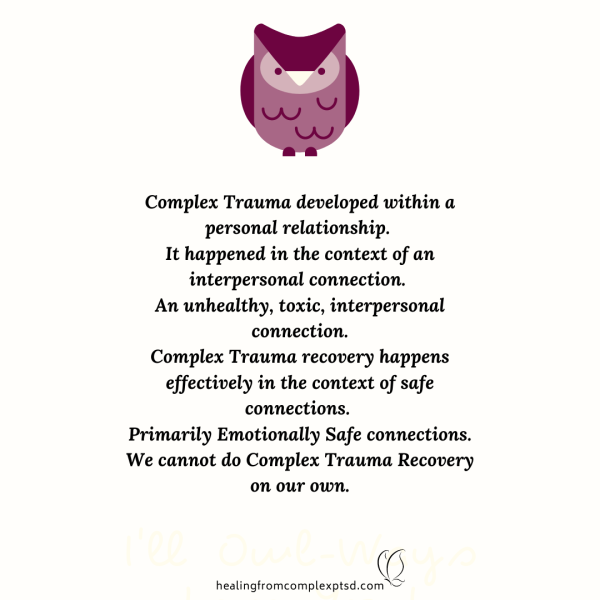
More about chaos and disaster another time. The absolutely, blow me away, fantastic news is I don't need to be in a relationship of the being married and committed variety to fully heal. Phew! The key word here is relation or relational - having a relationship with other people that goes beyond the surface level "g'day, how's your mothers chooks?" (Aussie slang for hello, how are you, how's things going?)
Relationships where you actually care about each other, through the damn tough times, love and accept each other warts and all, even when both of you know you've done or about to do a stupid thing, or maybe you don't know what you're about to do will have disastrous results. Genuine, solid friendships like this, where only you and the besties know where the body's are hidden because you helped each other bury them, are the stuff of a messy, fulfilling, exhilarating, challenging life. Even from your armchair or bed or desktop computer.
Why? Because all the people involved do their own internal, self reflecting work, everyone owns their disappointments, their negative emotions, their childhood trauma, their mental illness, their failings and manage to navigate through love, acceptance, forgiveness, stand loyally with each other and take personal responsibility for the choices they make. Thankfully, not all in one day.
They key here is time. Robust relationships take time. They value honesty. I was once was pretty critical of one of my best friends for staying with a husband who wasn't doing anything about his personal addiction. I had a zero tolerance level for people who are adults and they keep repeating the same disruptive behaviour that hurts other people repeatedly. Thankfully on our next coffee meet up I told her how sorry I was for being so rude, and both of us ended up in tears. Time. We all need time to find our way through our mess. Me included. She needed time too, to work out what the direction was to be for her life as well. They're still married, he stepped up and made choices, and I love him dearly.
The Alone in Loneliness
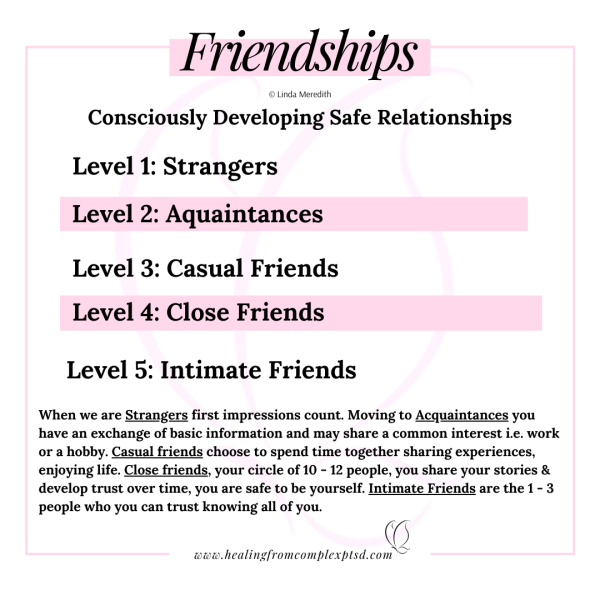
I would never wish on anyone the gaping sense of aloneness in a world that is so populated. We are wired to desire to be fully known and fully accepted. So what do you do when everything crumbles in life, and even your best friend, the last one remaining, runs off with your exhusband? You decide if you want to remain alone or you want to learn how you can venture out into life safely again, believing in the intrinsic goodness of life despite what life experiences have shown you up until now.
For me I was intuitively led to a community of people who help out in the community. I couldn't interact much initially, and I still get crippled with shyness at times, but what I did was spend time looking around for something I could do without falling to pieces. I went to a group each week where we chatted about all things life and eventually I helped out in the café simply collecting money or cleaning tables. This meant all I needed to do was smile and keep moving in another direction. Talking was just too hard at that time. However, the minimal interaction helped me begin to regulate my emotions over time just by being around people.
The other plus was I developed an emotionally safe online peer support group and together, again over time, we have thrived and bring others along too who are seeking to move from surviving to thriving. I've just taken us off social media so we can grow again into a flourishing community of peer support without the hassles of social media. Come and join us here as we are a wonderful bunch of people who understand not only what you're recovering from but where you want to be too.
Fear doesn't Win, Courage Does
I created our on line community because I used to have to take my one next step, with an overwhelming fear of what's going to happen if I fall over? No one is home, I'll find it really hard to get back up, and so afraid that it'd mean if I fell over I'd never recover. Despite the fears, the anxiety, the panic attacks, I kept choosing to take another step. Just one, literally. To this day I can still remember the moment I made it up and down my hallway 4 times in one day. Exhausted I fell back into bed with a smile on my face. I knew if I could make it up and down and across the house and back 4 times then somehow, someway I was going to recover from I knew not what.
And I believe you also can recover from now we know what, Complex Ptsd caused by Childhood Developmental Trauma, passed on for many generations before us.
Courses
CPtsd Education and the NeuroSynqt™ Training Institute
NeuroSynqt™ provides neuroscience based, trauma trained professional education in Complex Ptsd to practitioners internationally, alongside counselling and written response support for adults impacted by childhood developmental trauma.
Founded by Linda Meredith, Complex Trauma Educator and Clinical CPtsd Counsellor.
Popular
Developmental Trauma Self-Check
Over the past 12 months, how many and how often have you noticed:
-
I work hard to hold it together in public, then crash in private.
-
I struggle to name what I feel until it overloads me.
-
I say yes to keep the peace, then feel resentful or empty.
-
I feel loyal to people who do not treat me well.
-
I lose time or feel foggy when stressed.
-
I avoid closeness or over-attach quickly, then panic.
-
I find it hard to trust my own judgement.
-
I feel shame when I try to set boundaries.
-
I need external approval to feel steady.
-
I push through fatigue instead of pausing.
How to use this:
0–3 items often: you may be using a few survival patterns.
4–7 items often: consider paced support to rebuild safety and choice.
8–10 items often: a trauma-trained professional can help you restore stability and connection.
Brain Impact Self-Check
Over the past 12 months, how often have you noticed:
-
My mind jumps to what could go wrong, even in safe moments.
-
I find it hard to remember recent details when I am stressed.
-
Decisions feel risky, so I delay or avoid them.
-
I forget good experiences quickly and dwell on the bad.
-
I feel numb or overwhelmed, with little in-between.
-
I lose words when emotions rise.
-
I misread neutral faces or tones as negative.
-
I struggle to notice body signals like hunger, tension or breath.
-
I do better when someone I trust is nearby.
-
I feel different “versions” of me in different settings.
How to use this:
0–3 often: some protective habits; gentle self-care may help.
4–7 often: consider trauma-trained coaching to build daily brain skills.
8–10 often: a paced, brain-based plan can restore clarity, memory and confidence.
For formal assessment, use recognised measures:
-
ACE-IQ or ACE-10 for adversity history (education only on public pages).
-
ITQ (International Trauma Questionnaire) for ICD-11 PTSD/Complex PTSD.
-
DERS for emotion regulation, DES-II for dissociation, PCL-5 for PTSD symptoms.
-
PHQ-9, GAD-7 for mood and anxiety; OSSS-3 for social support.