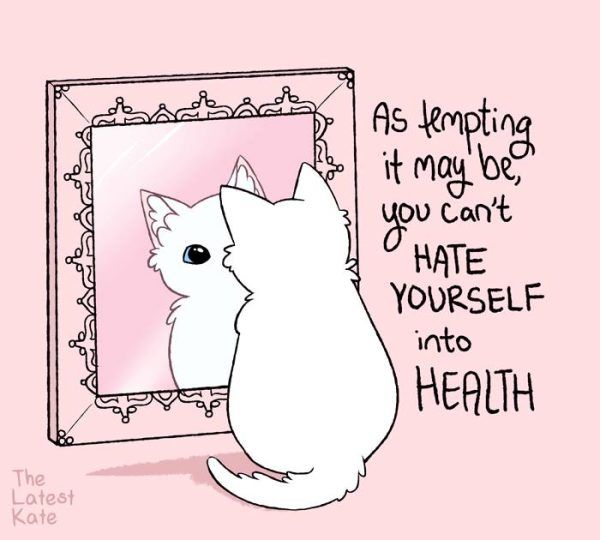
You Can't Hate Yourself Into Recovery
This article was posted on our original blog at Healing from Complex ptsd, March 20th 2021.
You Can’t Hate Yourself Into Recovery
In some ways it was like a reactive habit. The belief went like this: "If I believe the worst about myself and I act like the worst is true, then I can take actions to make sure I never upset anyone and/or other people never find out the worst about me." Sound nuts? This is the reality of being raised in generations of Complex Trauma. Until we know better, understand healthier ways, can see what's happening for us internally, we can't change the recording.
My literal thoughts at that time were "well believing I'm a bad person hasn't worked for me so far, so I'll try listening to what others say about me." Then I began correcting the negative, unkind thoughts I had about myself. It was a super slow journey, and even now I have to keep a close guard because being online there are people ready to assume the worst about me. And that's okay too. I'm never going to be everyone's cup of tea. Getting to the stage where I'm never going to be everyone's cup of tea and being more than okay with it is pure liberation. I highly recommend it.
For me, I can now stand up to bully's, there's plenty online. I can now voice my truth and be okay with your truth being something completely different. Complex Trauma certainly gave me the ability to accept others no matter what because I spent so long not being accepted or recognised for who I am in my family of origin. The irony being they can't see this at all due to nonverbal family rules.
I want to encourage you to be kind, spread it around like wildfire, listen to the thank you's, take on board the compliments and listen to your thoughts and feelings so you can consciously choose the direction they're going towards. Healing becomes possible only through taking intentional steps, it never happens just by accident. You are loved and you are needed here. Let's do this life together.
Blessings and dreams,
Linda.
What to do in the Darkest Hours
When things get dark, take just one small step at a time. I promise one small step consistently taken does lead you forward in your recovery journey.

Courses
Let's Create Generational Change Together
To support this goal, Healing from Complex PTSD allows you to:
- Access professional education and business support from industry leaders
- Learn a results-driven approach to CPtsd recovery
- Discover a full library of ready-to-use tools and resources
Developmental Trauma Self-Check
Over the past 12 months, how many and how often have you noticed:
-
I work hard to hold it together in public, then crash in private.
-
I struggle to name what I feel until it overloads me.
-
I say yes to keep the peace, then feel resentful or empty.
-
I feel loyal to people who do not treat me well.
-
I lose time or feel foggy when stressed.
-
I avoid closeness or over-attach quickly, then panic.
-
I find it hard to trust my own judgement.
-
I feel shame when I try to set boundaries.
-
I need external approval to feel steady.
-
I push through fatigue instead of pausing.
How to use this:
0–3 items often: you may be using a few survival patterns.
4–7 items often: consider paced support to rebuild safety and choice.
8–10 items often: a trauma-trained professional can help you restore stability and connection.
Brain Impact Self-Check
Over the past 12 months, how often have you noticed:
-
My mind jumps to what could go wrong, even in safe moments.
-
I find it hard to remember recent details when I am stressed.
-
Decisions feel risky, so I delay or avoid them.
-
I forget good experiences quickly and dwell on the bad.
-
I feel numb or overwhelmed, with little in-between.
-
I lose words when emotions rise.
-
I misread neutral faces or tones as negative.
-
I struggle to notice body signals like hunger, tension or breath.
-
I do better when someone I trust is nearby.
-
I feel different “versions” of me in different settings.
How to use this:
0–3 often: some protective habits; gentle self-care may help.
4–7 often: consider trauma-trained coaching to build daily brain skills.
8–10 often: a paced, brain-based plan can restore clarity, memory and confidence.
For formal assessment, use recognised measures:
-
ACE-IQ or ACE-10 for adversity history (education only on public pages).
-
ITQ (International Trauma Questionnaire) for ICD-11 PTSD/Complex PTSD.
-
DERS for emotion regulation, DES-II for dissociation, PCL-5 for PTSD symptoms.
-
PHQ-9, GAD-7 for mood and anxiety; OSSS-3 for social support.