
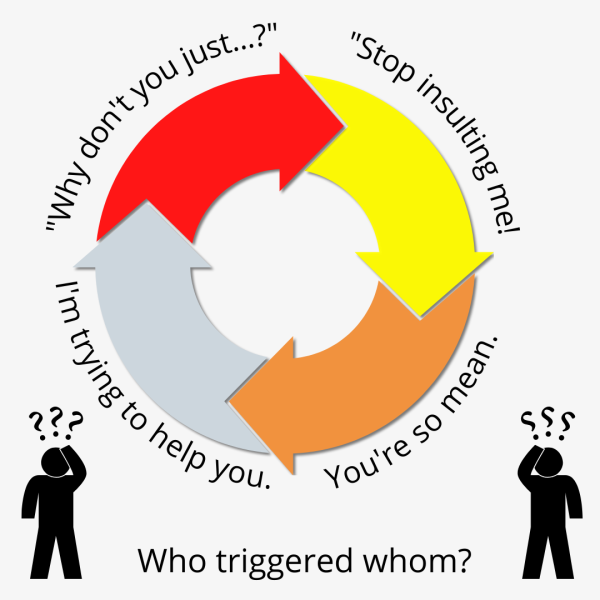
The Vicious Trigger Cycle Dance: "Why Don't You Just... ?"
This article was posted on our original blog at Healing from Complex ptsd, May 4th 2021.
Feeling Attacked
At the time, I felt attacked and horribly helpless. I just wanted to yell “I would if I could!” If only it were that simple to ‘just’ do as I say or say as I do, I would do it. Of course I would lose weight if I could. Of course I would stop talking about losing weight and just accept this fat me if I could. But I couldn’t. Or more accurately, I didn’t know how to. Or at a deeper level, there was a need that overeating was somehow meeting… a maladaptive coping mechanism!
Food was my addiction. I didn’t smoke, I didn’t drink, I didn’t do drugs. I don’t mean to sound holier-than-thou, although I probably felt that at one time. My addiction was (is) food. Eating was (well… uh… is) my escape from the stresses of work, from managing people, from the nonstop needs of my kids, from the messiness of my house, from the judgment of others… It was (and still is, did I mention that it still is…!?) my moment of escape.

My Side of the Equation
Being a bit curious about this now that I have been doing the work, I have been thinking about this dominos effect:
- identifying something that I want to fix (feeling critical about me)
- not really knowing how to fix it (feeling dumb that I don’t know how to fix it)
- feeling that the challenges are too difficult to overcome (feeling helpless)
- coming down on myself for not being able to ‘just’ do it (attacking myself)
- hearing someone articulate a ‘simple’ solution (feeling attacked by someone else)
- feeling the inner critic rise up with reasons why I couldn’t ‘just’ do that (feeling defensive)
- feeling the anger rise in me that my priorities (excuses) were brushed aside (feeling hurt)
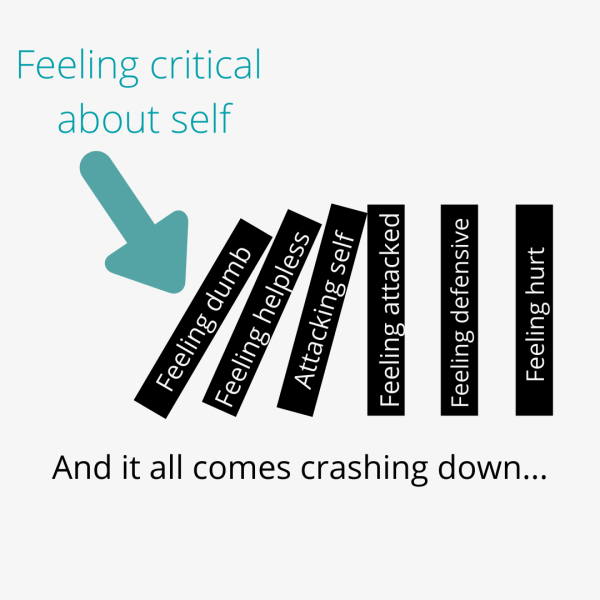
The Vicious Trigger Cycle Dance
Maybe, they didn’t mean to say ‘just’ but my raw nervous system feels it differently. So their intention is to be helpful, but I interpret it as an attack, and therefore the impact to me is a trigger that starts off my spiral… and then my reaction may be something that is more aggressive than I mean it to be.
Their question might actually be THEIR trigger response to something I said that inadvertently set off their internal spiral and they just needed to shut me down so that they wouldn’t feel their discomfort from my spiraling. Which came first? The chicken or the egg? (I love that Peanuts comic where Peppermint Patty wails “It all started when she hit me back!~~”)
In any case, when someone says this to me, I’m learning to pause and sit with it rather than get drawn into an argument about “excuses”, “semantics”, or defending my need not to feel insulted.
I am learning not to get caught up in the Trigger Cycle Dance.
Focusing on the Here and Now
For me, I need to make sure I don’t do anything I regret before I get too caught up in my need to resolve the issue.
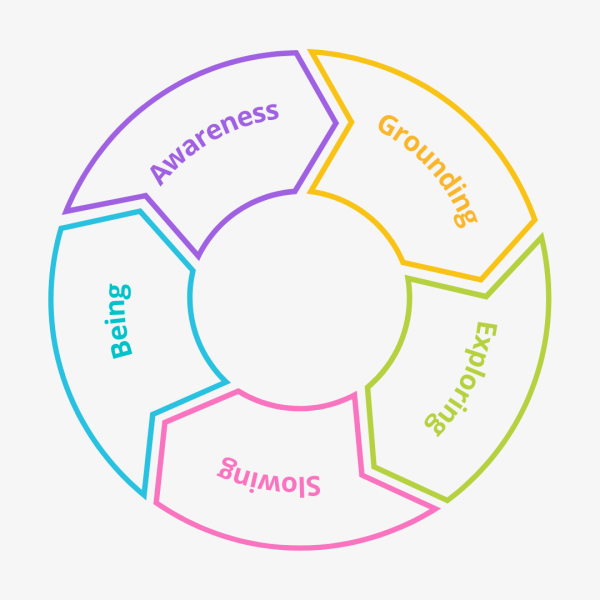
Which means:
- being aware that I am triggered and no longer using my prefrontal cortex
- grounding myself so that I’m no longer in a triggered state
- noting down my reactions and pulling out valid points that I would like to explore
- slowing everything down to give my unconscious brain the opportunity to sit with it
- learning to be okay with not being okay
The Whining
And I think this is the crux of the challenge. It is here where it can fall apart. Everything up to here is intellectually almost easy to understand. It’s the application of it on a day-to-day basis. It’s the overwhelm from dealing with too many triggers at once. It’s the fear of a coming confrontation that I just want to avoid. It’s the self-blame when I figure out it was a trigger retroactively after I behaved ‘badly’ to make things worse…
It’s so hard because our brains are wired to protect us and came up with coping mechanisms helped us in the past. The problem is that these techniques are no longer serving us and are in fact making it harder for us to get done what we want to get done.
So whining done. But what next?
We Start Where We Start: Taking One Next Step
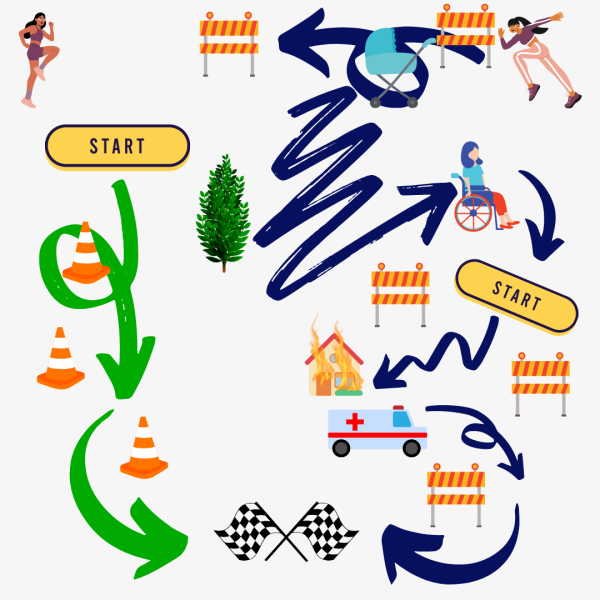
What I’m learning to do is to focus on one next step and not the final destination of perfection that I so desperately want. That seems to be a part of my healing journey. Everything else takes a lot of time and some of it requires work I’m not yet ready to do.
If I keep trying to accomplish things that are just not quite developmentally appropriate for me, given where I am, I keep setting myself up for failure and I keep running into the overwhelming challenges that I want to run away from.
But if I can focus just on one step at a time, I will slowly make progress. This progress will be slow, but steady. I break down my one next step into something I can do. If I can’t do it, it’s not small enough.
It may also be helpful to understand that this journey of getting from here to there is just not linear and it’s not the same for everyone. We each have different sets of skills, experiences, and barriers. It’s important to understand that and not cause ourselves even more stress by comparing or giving ourselves a hard time.Here in this Community, we are big proponents of “One Next Step” and specifically in Sandwich Parenting, we also like to ensure that we remember that “We Start Where We Start.”
Can you name your one next step? Do you need help noodling it with your community? Can another perspective help you break it down? Do you need a peer reminder that you are doing your best and that you will get there?
You are not alone!
You are in the right place!
Let's heal together!
Courses
CPtsd Education and the NeuroSynqt™ Training Institute
NeuroSynqt™ provides neuroscience based, trauma trained professional education in Complex Ptsd to practitioners internationally, alongside counselling and written response support for adults impacted by childhood developmental trauma.
Founded by Linda Meredith, Complex Trauma Educator and Clinical CPtsd Counsellor.
Popular
Developmental Trauma Self-Check
Over the past 12 months, how many and how often have you noticed:
-
I work hard to hold it together in public, then crash in private.
-
I struggle to name what I feel until it overloads me.
-
I say yes to keep the peace, then feel resentful or empty.
-
I feel loyal to people who do not treat me well.
-
I lose time or feel foggy when stressed.
-
I avoid closeness or over-attach quickly, then panic.
-
I find it hard to trust my own judgement.
-
I feel shame when I try to set boundaries.
-
I need external approval to feel steady.
-
I push through fatigue instead of pausing.
How to use this:
0–3 items often: you may be using a few survival patterns.
4–7 items often: consider paced support to rebuild safety and choice.
8–10 items often: a trauma-trained professional can help you restore stability and connection.
Brain Impact Self-Check
Over the past 12 months, how often have you noticed:
-
My mind jumps to what could go wrong, even in safe moments.
-
I find it hard to remember recent details when I am stressed.
-
Decisions feel risky, so I delay or avoid them.
-
I forget good experiences quickly and dwell on the bad.
-
I feel numb or overwhelmed, with little in-between.
-
I lose words when emotions rise.
-
I misread neutral faces or tones as negative.
-
I struggle to notice body signals like hunger, tension or breath.
-
I do better when someone I trust is nearby.
-
I feel different “versions” of me in different settings.
How to use this:
0–3 often: some protective habits; gentle self-care may help.
4–7 often: consider trauma-trained coaching to build daily brain skills.
8–10 often: a paced, brain-based plan can restore clarity, memory and confidence.
For formal assessment, use recognised measures:
-
ACE-IQ or ACE-10 for adversity history (education only on public pages).
-
ITQ (International Trauma Questionnaire) for ICD-11 PTSD/Complex PTSD.
-
DERS for emotion regulation, DES-II for dissociation, PCL-5 for PTSD symptoms.
-
PHQ-9, GAD-7 for mood and anxiety; OSSS-3 for social support.