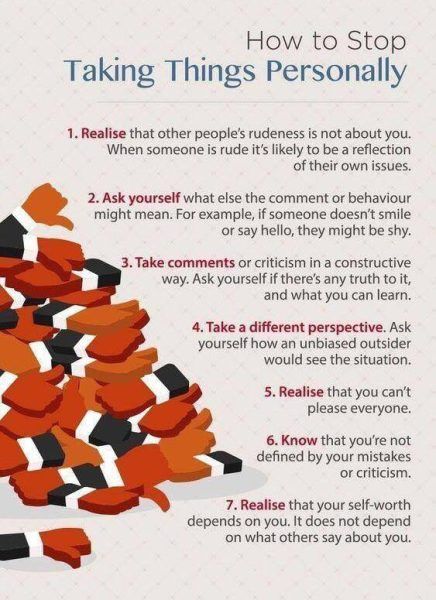
Taking Things Personally
This article was posted on our original blog at Healing from Complex ptsd, May 21st 2021.
There's Layers we Need to Address
It's vital we remember we are all human, even when dealing with mental health professionals. In our humanity we are all going to make mistakes, we are all going to have bad days, and we are all going to stuff up royally. Gosh, I did last week simply through not reading my schedule properly, and then not remembering it properly.

Rethinking our Mistakes
When reading messages, we read them through our own abandonment wound, our own I was never loved or cared for wound, our own emotional neglect wound, our own Complex Ptsd wound of multiple layers, and that's okay. What's not okay is expecting others to pick up our pieces and make us whole because only we can do that ourselves. It's hard work and takes courage and we can do it one step at a time.

Inflexible Thinking
Healthy relationships require flexible thinking, a state achieved through our recovery process. To go into relationships or to have relationships without flexible thinking will mean one of two things are happening. We return to our people pleasing ways, our codependent ways, and the other person takes from us repeatedly or we are so rigid no one can be around us because it's our way or not at all.
Working with our Deep Pain
Emotional maturity comes from being willing to take on responsibility for our whole selves, to take on more responsibility and understand our internal self instead of avoiding it by taking on responsibility for other peoples lives. Emotional maturity is further enhanced as we face what's inside of us that doesn't belong and we choose to do the painful work, the most courageous work, of dealing with deep pain.
Love Wins
Courses
CPtsd Education and the NeuroSynqt™ Training Institute
NeuroSynqt™ provides neuroscience based, trauma trained professional education in Complex Ptsd to practitioners internationally, alongside counselling and written response support for adults impacted by childhood developmental trauma.
Founded by Linda Meredith, Complex Trauma Educator and Clinical CPtsd Counsellor.
Popular
Developmental Trauma Self-Check
Over the past 12 months, how many and how often have you noticed:
-
I work hard to hold it together in public, then crash in private.
-
I struggle to name what I feel until it overloads me.
-
I say yes to keep the peace, then feel resentful or empty.
-
I feel loyal to people who do not treat me well.
-
I lose time or feel foggy when stressed.
-
I avoid closeness or over-attach quickly, then panic.
-
I find it hard to trust my own judgement.
-
I feel shame when I try to set boundaries.
-
I need external approval to feel steady.
-
I push through fatigue instead of pausing.
How to use this:
0–3 items often: you may be using a few survival patterns.
4–7 items often: consider paced support to rebuild safety and choice.
8–10 items often: a trauma-trained professional can help you restore stability and connection.
Brain Impact Self-Check
Over the past 12 months, how often have you noticed:
-
My mind jumps to what could go wrong, even in safe moments.
-
I find it hard to remember recent details when I am stressed.
-
Decisions feel risky, so I delay or avoid them.
-
I forget good experiences quickly and dwell on the bad.
-
I feel numb or overwhelmed, with little in-between.
-
I lose words when emotions rise.
-
I misread neutral faces or tones as negative.
-
I struggle to notice body signals like hunger, tension or breath.
-
I do better when someone I trust is nearby.
-
I feel different “versions” of me in different settings.
How to use this:
0–3 often: some protective habits; gentle self-care may help.
4–7 often: consider trauma-trained coaching to build daily brain skills.
8–10 often: a paced, brain-based plan can restore clarity, memory and confidence.
For formal assessment, use recognised measures:
-
ACE-IQ or ACE-10 for adversity history (education only on public pages).
-
ITQ (International Trauma Questionnaire) for ICD-11 PTSD/Complex PTSD.
-
DERS for emotion regulation, DES-II for dissociation, PCL-5 for PTSD symptoms.
-
PHQ-9, GAD-7 for mood and anxiety; OSSS-3 for social support.