9 Signs of Fear of Abandonment
This article was posted on our original blog at Healing from Complex ptsd, March 11th 2021.

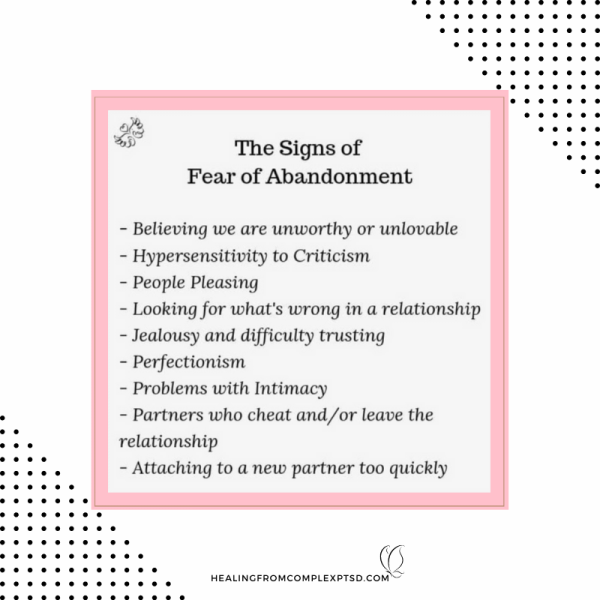
When I read this list I was like "what?" I could barely believe there was a list that explained the areas of disorganised attachment I need to work on. Fortunately a couple of them, people pleasing and perfectionism, I've been working on for some time.
Here's the big one for me though - Partners who cheat and/or leave the relationship. I had no idea! And, this is definitely a pattern I can see on repeat throughout my life.
I was driving home last night pondering how come this keeps happening. What did I need to overcome in my recovery? Was it part of my disorganised attachment? What was it I couldn't see that I needed to address. 'Cause lets face it, having people cheat on you rates at zero on the fun list in life!
Searching for the belief I was holding onto I understood finally! I believed everyone would leave me.
When I was younger, my parents separated for a time, and my brother and I were sent to live with different sets of relatives.
Essentially what kid isn't going to believe that everyone leaves when the whole nuclear family left overnight? My parents got back together, then separated again. Here's the crunch. When my dad left the second time my greatest fear that I didn't know I was holding onto was that mum would leave too.
We're kids. And as adults, we hold this emotion in our bodies and subconscious until we can process it. Then, and this is the important part, we take steps to address the belief and change it around.
We take steps that regain our power to act, to trust our judgement, to see the people who are short on character and know that we can choose to keep moving right along in our recovery.
May this bless your heart and soul and help you break the cycle too. I know for me, I won't be going down this road again.
Courses
Let's Create Generational Change Together
To support this goal, Healing from Complex Ptsd allows you to:
- Access professional education and business support from industry leaders
- Learn a results driven approach to CPtsd recovery
- Discover a full library of ready to use tools and resources
Developmental Trauma Self-Check
Over the past 12 months, how many and how often have you noticed:
-
I work hard to hold it together in public, then crash in private.
-
I struggle to name what I feel until it overloads me.
-
I say yes to keep the peace, then feel resentful or empty.
-
I feel loyal to people who do not treat me well.
-
I lose time or feel foggy when stressed.
-
I avoid closeness or over-attach quickly, then panic.
-
I find it hard to trust my own judgement.
-
I feel shame when I try to set boundaries.
-
I need external approval to feel steady.
-
I push through fatigue instead of pausing.
How to use this:
0–3 items often: you may be using a few survival patterns.
4–7 items often: consider paced support to rebuild safety and choice.
8–10 items often: a trauma-trained professional can help you restore stability and connection.
Brain Impact Self-Check
Over the past 12 months, how often have you noticed:
-
My mind jumps to what could go wrong, even in safe moments.
-
I find it hard to remember recent details when I am stressed.
-
Decisions feel risky, so I delay or avoid them.
-
I forget good experiences quickly and dwell on the bad.
-
I feel numb or overwhelmed, with little in-between.
-
I lose words when emotions rise.
-
I misread neutral faces or tones as negative.
-
I struggle to notice body signals like hunger, tension or breath.
-
I do better when someone I trust is nearby.
-
I feel different “versions” of me in different settings.
How to use this:
0–3 often: some protective habits; gentle self-care may help.
4–7 often: consider trauma-trained coaching to build daily brain skills.
8–10 often: a paced, brain-based plan can restore clarity, memory and confidence.
For formal assessment, use recognised measures:
-
ACE-IQ or ACE-10 for adversity history (education only on public pages).
-
ITQ (International Trauma Questionnaire) for ICD-11 PTSD/Complex PTSD.
-
DERS for emotion regulation, DES-II for dissociation, PCL-5 for PTSD symptoms.
-
PHQ-9, GAD-7 for mood and anxiety; OSSS-3 for social support.