NeuroSynqt™ Training Institute
CPtsd Recovery for Adults with Developmental Trauma
Neuroscience Based Integration Architecture for Complex Ptsd
Choose your One Next Step
For Professionals
For Individuals
Adults with CPtsd and developmental trauma
For people who understand their patterns but still lose access to clarity, language, choice or steadiness under pressure.
Therapists and practitioners
For professionals working with complex, nonlinear trauma presentations who are seeking a wider framework for considering Complex Ptsd recovery and professional application.
Referral sources
For clinicians, support coordinators or professionals seeking online CPtsd counselling, written response support or structured recovery education for adults with developmental trauma.
Who this site is not for
Acute crisis support, primary mental health care, or first time trauma work without an existing clinician. If you are in crisis in Australia, contact Lifeline on 13 11 14. International readers, please use your local crisis line.

'Why does it keep coming back?'
You might recognise this:
- You understand your patterns but can't shift them consistently.
- You feel steady in one part of your life and undone in another.
- You make progress and then lose ground.
- What you understand does not always translate into lasting change.
Start here if you are looking for CPtsd counselling, written response support or structured recovery education for yourself.
Why is this client plateauing?
You’ve trained to reduce symptoms, build coping capacity and increase insight. Your client has tools. They have language. They can name what is happening.
And still the work can stall.
Complex Ptsd can involve developmental, psychological and brain based complexity that is not always adequately explained by symptoms, insight or one therapeutic model. A client may engage well, understand their history and appear highly functional in some areas while significant difficulty remains elsewhere.
Their presentation may also vary across relationships, environments, stress and different areas of life. What appears straightforward in one context may look very different in another.
This is where specialist Complex Ptsd education can extend professional enquiry without replacing your existing assessment, formulation, modality or clinical judgement.
NeuroSynqt™ was developed for practitioners working with this complexity.
Start here if you are a counsellor, therapist, psychologist, supervisor or practitioner seeking specialist Complex Ptsd training, greater professional context for complex non linear presentations, or a referral pathway for clients requiring integration focused support.
Why recovery can remain complex
Recovery from Complex Ptsd does not always follow a straightforward course.
Insight, symptom reduction and periods of greater stability can all be meaningful parts of recovery without accounting for every area affected by developmental trauma.
For some people, difficulties remain uneven across relationships, identity, emotional experience, daily functioning and changing life contexts. What appears resolved in one setting may remain relevant in another.
HOW THIS MAY PRESENT IN PRACTICE
Different Layers of Trauma Related Professional Knowledge
Trauma informed awareness
Provides principles for recognising trauma and supporting safer, more responsive environments.
Trauma Trained
Develops specialist professional knowledge for working with trauma related presentations within an established professional scope.
Developmental IntegrationNeuroSynqt™
Provides an additional neuroscience based framework developed specifically for developmental trauma and CPtsd.
These areas can be complementary. NeuroSynqt™ is designed to integrate with existing professional training and scope rather than replace established modalities or qualifications.
NeuroSynqt™: Integration Architecture for Complex Ptsd
Complex Ptsd can affect multiple areas of experience across development, identity, relationships, emotional functioning and everyday life.
NeuroSynqt™ is a neuroscience based professional and recovery framework developed specifically for the complexity of childhood developmental trauma and Complex Ptsd.
For practitioners, it provides an additional developmental integration lens through which different areas of Complex Ptsd knowledge can be considered within a wider clinical picture.
NeuroSynqt™ complements existing professional modalities, qualifications and individual recovery supports rather than replacing them.

Professional Training in NeuroSynqt™ Integration Architecture
Learn within a professional education framework developed specifically for developmental trauma and Complex Ptsd.
Training extends existing professional knowledge across neuroscience, developmental trauma and the wider complexity of Complex Ptsd presentation.
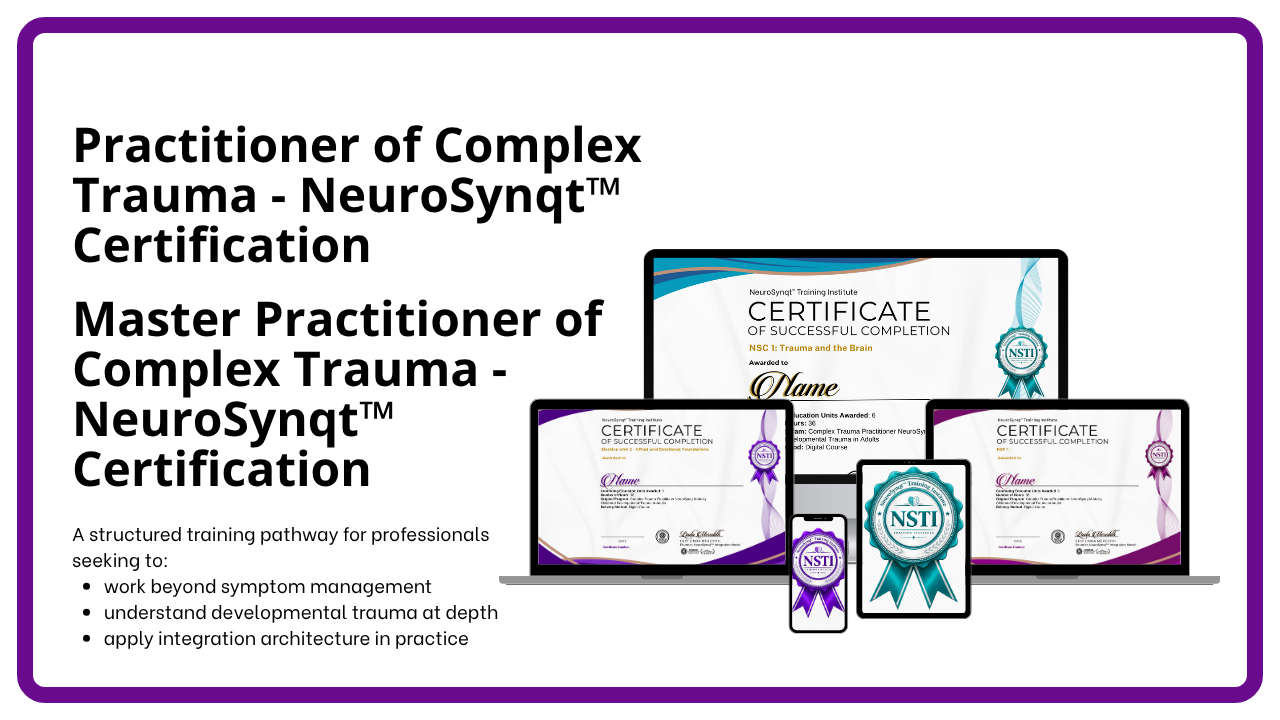
Designed to complement established modalities and professional scope, NeuroSynqt™ education ranges from individual specialist courses through to the Master Practitioner of Complex Trauma certification pathway.
Global Accreditation
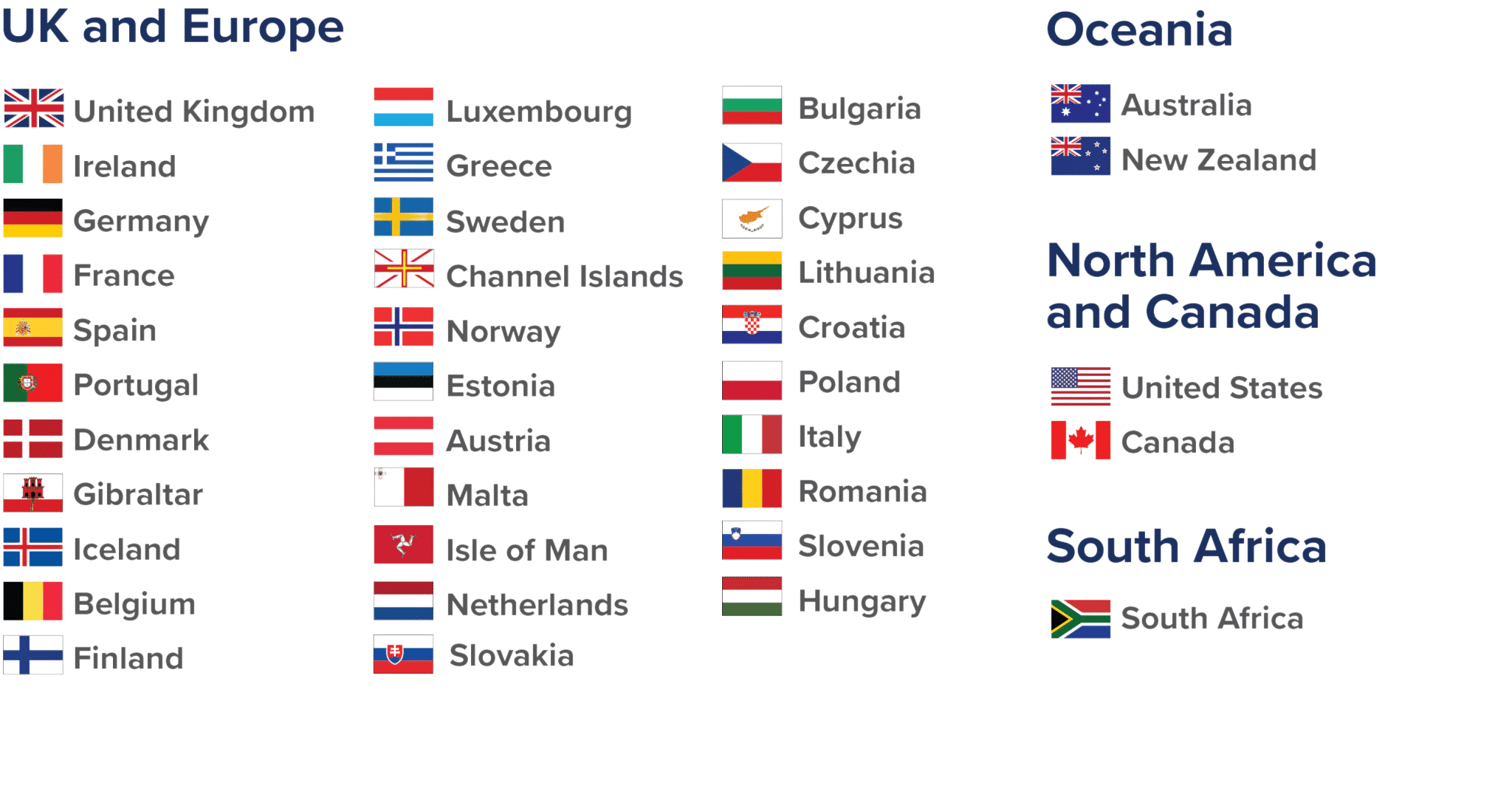
NeuroSynqt™ training is accredited through the International Institute for Complementary Therapists (IICT). NeuroSynqt™ training and courses have been peer reviewed at university level.
Supporting:
- professional recognition
- insurance eligibility
- global application across settings
Applicable across:
- clinical settings
- counselling and professional support settings
- coaching environments
- professional practice
Developed by Linda Meredith

Applied, not theoretical

Don't just take our word for it